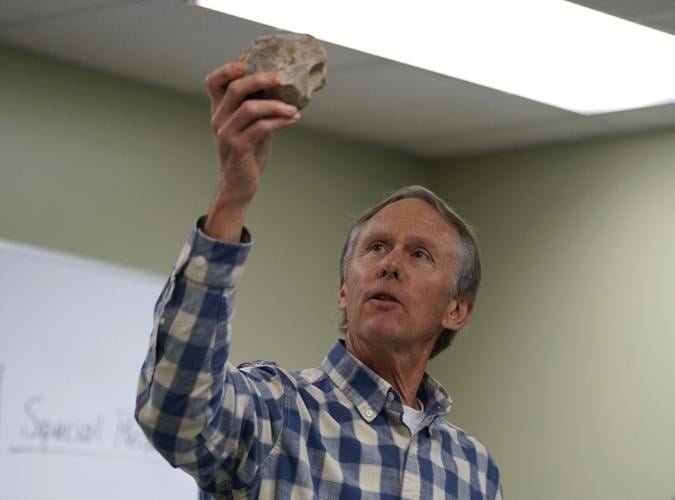
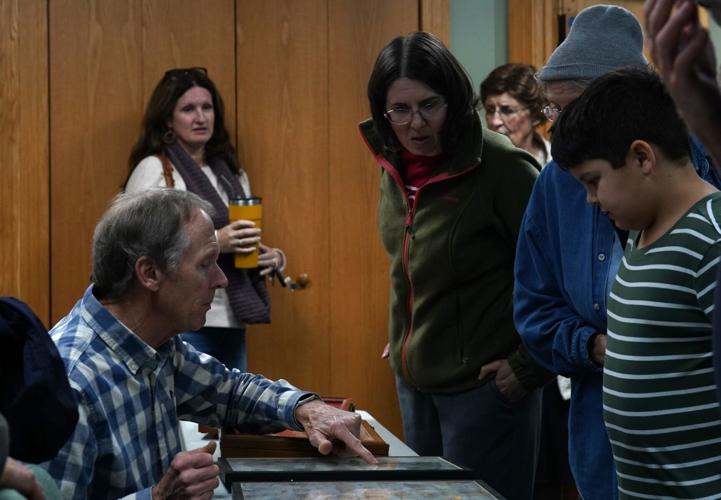
A variety of historic and geologic artifacts were showcased on Jan. 8 during the monthly meeting of the Ozark Rivers Chapter of the National Audubon Society. Rich Hall, a 37-year veteran of the U.S. Forest Service, who also oversaw Mark Twain National Forest’s archelogy program, shared various findings he’s unearthed from around Rolla and beyond. Among the items Hall displayed during the event at Rolla’s United Methodist Church were fossils, dinosaur bones, arrowheads and Civil War relics.
“Metal detecting, and finding something that was left behind by someone, is the closest thing you can get to time travel,” Hall said. “You're picking it up and wondering who is the last person to have touched it? What were they thinking? Who were they? You are put into the position of trying to imagine.”
Various flint points made up the greatest variety of Hall’s items. He said most were found after he bulldozed a defunct dirtbike track on this property along Dry Fork only to find it was home to hundreds of Native American artifacts dating back thousands of years. The age of the items was no guess by Hall. Based on their shape, he said some were from Archaic Period from 1000 to 7000 B.C. with some older “Dalton Points” from 7000 to 8000 B.C.
“I believe that these people were there for thousands of years. They kept coming back, and that's why I have buckets full of broken points that never made it to production.” Hall said, later adding, “They were nomadic in nature, and so they traveled around to the best areas where they could find their food, shelter and material needs. They were fond of shelter bluffs. If you know where Gourd Creek Cave just south of town, it’s a big shelter bluff, and a great example of an Archaic dwelling.”
Matching the knapped points in number were bullets and other items from the Civil War. During the conflict, Hall said Rolla was home to Fort Wyman with around 10,000 soldiers sometimes camped in the area around where Menard’s now stands with thousands more camped south of Interstate 44. Among the “Holy Grail” discoveries that Hall has found around town are a belt buckle, epaulet, finial and pistol parts.
One of the most interesting items Hall found was an “E4” ornament that was worn on a soldier’s hat. With the help of local historian John Bradbury, Hall said the artifact was traced to someone likely enlisted in Iowa’s Regiment E, Company 4, when it was stationed in Rolla in 1861.
Even when accounting for all those treasures, they don’t equal Hall’s most explosive find.
“I got pretty good at metal detecting, and I heard this sound, and it sounded really good, so I started digging and I called my friend over,” Hall said. “I asked, ‘What do you think?’ It sounded so good, so we kept going and digging and digging into the hard soil. Finally, when we got to it, the detector started to make a different sound, real clear, real pure. I found at the surface this sphere. We started to unearth it a little more, and a little more, and your heart begins to race. Could it be? Is it? Finally, you get half of it exposed, and it's the real thing.”
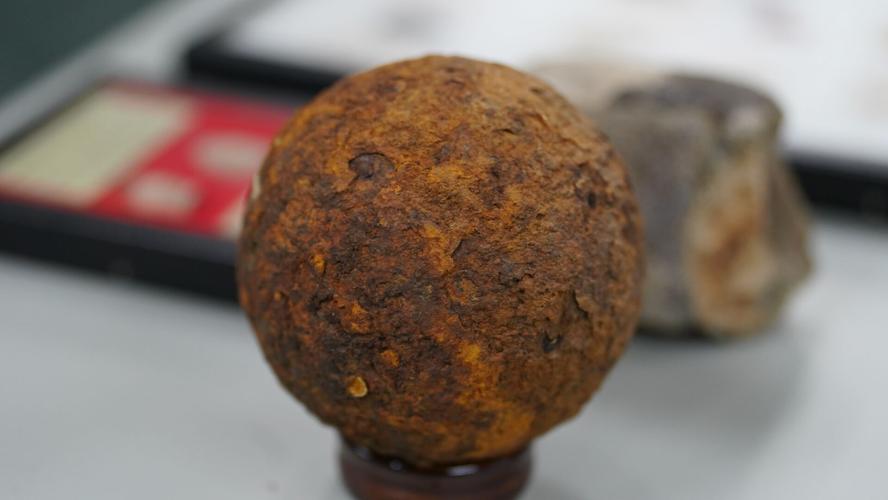
Hall said it wasn’t a cannonball, but a 12-pount Howitzer artillery shell.
“What is the difference between a shell and a ball? A shell is loaded with gunpowder,” Hall said. “It was still live, and there have been a lot of people who've dug these up who’ve not fared so well because they're live and black powder turns to nitroglycerin when it degrades.”
After pretending to nearly drop the shell on the floor, Hall said it was defused by a specialist in Civil War relics he visited in Tennessee.
“The specialist uses a remote drill to drill into the shell and suck out the gunpowder to render It inert,” Hall said.
Importantly, Hall said he’s only hunted for artifacts on private property, never public property, and always gets permission from the landowner. The program ended with Hall expressing interest in potentially leading a future program on archeology at the Audubon Trails Nature Center in Rolla.