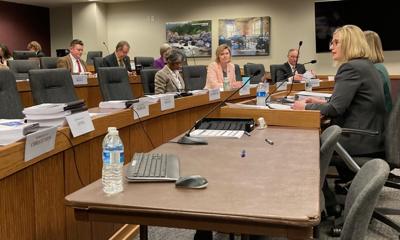
Missouri lawmakers scrounged for unspent or underutilized funds that could be cut from next year’s budget Monday, Feb. 9, vowing to protect programs they said are vital to the health of Missourians.
Republican state Rep. Darin Chappell of Rogersville vowed during a presentation of the Missouri Department of Health and Senior Services to minimize proposed cuts to two programs designed to help Missourians with developmental disabilities live safely in their homes and participate actively in their communities, avoiding costly and isolating institutionalization.
“I’m going after every shred of fat and wastefulness everywhere it can be found before I have to tell someone whose life depends upon us that we don’t have any money,” said Chappell, who is chair of the budget subcommittee covering health, senior services, mental health and social services.
The proposed cuts to disability services would apply to the state’s Department of Mental Health. Even though Mental Health Director Valerie Huhn won’t testify before the House Budget Committee until Tuesday, the presence of the recommendations shaped the Monday hearing, with lawmakers referring to messages they received from concerned constituents and advocates.
“If we didn’t get an email about anything else, we got an email about this particular budget,” said Democratic state Rep. Raychel Proudie of Ferguson, referring to the mental health budget.
Gov. Mike Kehoe’s proposed budget for fiscal year 2027 recommends a $17.5 million funding reduction for self-directed supports, which lets people with disabilities or their families hire, train and manage their own care staff. Another recommendation would cut $61.7 million from providers of structured group programs called day habilitation.
Lawmakers in Monday’s hearing also questioned proposed cuts to substance use disorder prevention and treatment grants in the health and senior services budget. Kehoe’s recommended budget would eliminate $500,000 in grants for the use of medication-assisted treatment as part of the state’s drug and DWI courts. The recommendations would also cut $350,000 for drug use resistance education in schools.
Republican state Rep. John Black of Marshfield, the vice-chair of the subcommittee, said lawmakers would resist cuts to grants aimed at reducing harms of tobacco and drug use.
“We know that the grants to the programs, to the providers that are providing prevention and treatment for persons with [substance use disorders] in fact save the state money,” Black said.
The budget proposal would slash $300,000 from youth tobacco use prevention initiatives. While the fiscal year 2026 budget allocated $2.5 million to services to help Missourians quit tobacco and nicotine products, including phone and online coaching programs, recommendations for fiscal year 2027 allot only $100,000.
“It’s almost like the state makes money off the sale of those things,” Chappell said.
Buoyed by what Chappell described as the state’s “budget calamity,” committee members looked for any parts of the budget where lawmakers had appropriated more than state agencies used.
Chappell asked representatives of the state’s health department to commit to spending federal and other sources of funding before dipping into the state’s general revenue.
“Can you all make that commitment yet?” he asked. “Yes is the word you’re looking for, by the way.”
“It’s about the price of a specialty coffee or drink,” Willson said.
Democratic state Rep. Betsy Fogle of Springfield asked why the department has left funds unspent for certain budget items despite claims that public health is underfunded in Missouri.
Fogle gave the example of between $52 million and $65 million in unspent federal funds each year between fiscal years 2023 and 2025 for services related to HIV, sexually transmitted infections and hepatitis.
Lori Brenneke, director of the department’s Division of Community and Public Health, explained that the department requests spending authority without knowing ahead of time how many people will need services.
Brenneke said changes to Medicaid eligibility could increase caseloads for one of the programs in that budget line, which provides support for low-income people living with HIV.
“When Medicaid expansion occurred, we’ve seen a lot of individuals move from the program to Medicaid,” Brenneke said. “We may see some shifting back from that.”
The department is proposing to reduce its budget authority by $10 million.
“Should we be coming down more than $10 million?” Fogle asked. “…Just to have the budget a little more accurately reflect our spend.”
Chappell said that “right sizing the budget” would not wipe out the need to make painful budget cuts to programs like disability care services.
“I cannot promise that those will suffer no loss whatsoever,” he said. “But what I can promise you is that it is my intention to wring every last penny out of every place else before those cuts have to be made.”