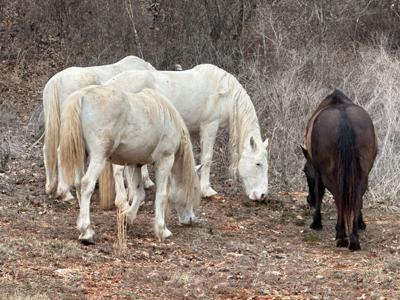
The history of wild horses in Shannon County is steeped in myths and romanticism. Some contend the horses that still roam free there are descendants of stock left behind by the Spaniards.
Most likely the wild horses, that tens of thousands of visitors to the Ozark National Scenic Riverways enjoy seeing each year, are descendants of horses left by people who worked in the timber in the early 1900s after the railroads were completed. Many laborers tried to hang on in the Ozarks by working hardscrabble farms, hunting and fishing. Most, however, left for better jobs in the cities, abandoning their livestock, including horses.
The horses have survived heated debates, legal maneuvering and illegal killings. The horses still roam the hills of the Current River and Jacks Fork rivers, thanks to the Wild Horse League of Missouri.
In August 1994, the National Park Service rejected the proposal of the Missouri Wild Horse League (MWHL) to take over management of the wild horse herds running free in the Ozark National Scenic Riverways. The NPS spokesman stated that no other proposals would be accepted in the future if it included a way for the horses to remain free.
The NPS greatly underestimated the tenacity of the members of the Missouri Wild Horse League.
MWHL members utilized a bit of horse sense and Ozark ingenuity, along with the aide of supporting lawyer Doug Kennedy, from Poplar Bluff, to begin a campaign to save the horses.
In October 1994, Congressman Bill Emerson presented a bill to Congress which would make the wild horses a permanent part of the Ozark National Scenic Riverways.
President Bill Clinton signed the bill into law on Oct. 3, 1996, and the horses officially became a part of the Ozark National Riverways that can never be removed.
Tragedy struck the wild horse herd in December of 2000 when trail riders discovered three mares shot to death east of Eminence.
Three more dead horses were found 400 yards north of the others.
Senator Kit bond and Representative Jo Ann Emerson immediately started a bounty fund. With the help of MWHL members, they collectively raised $10,000.
On May 7, 2001, Harold “Pogo” Williams, of Ellington, pleaded guilty to five counts of misdemeanor animal abuse, in connection with the horse shootings.
On June 22, 2001, Judge Robert M. Heller sentenced Williams to three years in prison and $40,000 in fines.
Deceased NPS ranger Jack Peters, of Timber, Missouri said in a 2010 interview that the horses are doing well.
“I have watched these amazing animals since I first came to the ONSR as the first ranger in 1967,” Peters began. “The wild horses are truly a part of this region’s history and culture. Many local citizens look upon the herd as a symbol of the hardiness and wonderfully independent spirit of the Ozarks and its people.
“The herd is usually made up of three separate “family” groups, with an occasional exchange of individuals among the groups,” Peters stated. “I have watched the dominant color of the herds change several times over the last 40 years. The original stock most likely was remnants left over from families living here during the depression. The first herd I encountered in the Brushy Creek and Big Creek areas was made of dark bays.”
In the early 70’s, a white stallion showed up,” Peters continued. “Some folks thought the stallion had escaped from the Williams farm up on Big Creek.
“From that point on, the herd gradually turned to all white. The foals are born black. With age, they turn a dappled gray. Eventually they turn a snowy white.”
The horses have adapted well to life along the rivers.
“The herds hang around the spring branches a lot in the winter.” Peters continued. “They have adapted to eating watercress. They actually plunge their heads under water to get at the tender watercress, just like a moose.”
T.F. Cox of Eminence was an avid wild horse fan and on the Board of the Missouri Wild Horse League. The herd is doing well partially due to the efforts of the MWHL. “The wild horses are now federally protected, largely due to our efforts,” he pointed out.
“We keep a close eye on the herds,” Cox related. “We keep their numbers at a maximum of 50 animals. If numbers get above that, we cut out the studs, castrate, vaccinate and give them a Coggins test. Then we adopt them out.”
The herd seldom passed the 50 mark, according to Cox. “Colts are often lost during floods. The mature horses can swim the rivers easily. The colts try to follow and often don’t make it.”
Cox and other members of the MWHL also bush hogged designated fields along the rivers to keep them open for the horses to graze. The bottom fields remain an important food source to the herd.
“The wild horses mean a lot to local folks,” Cox said. “But, other people travel from all over the country to see them. They have received a lot of press. Now, they are a tourist attraction.”
“Too, everyone seems to understand that the horses are protected like a lot of other animals. We have not had any more problems with people hurting the horses since Pogo Williams received a heavy fine and a prison term for killing several wild horses back in 2000. He paid full restitution.”
The wild horses are doing great in the wild country of Shannon County. They are a long standing part of the local history and will remain there for visitors to enjoy and ponder about in the future.