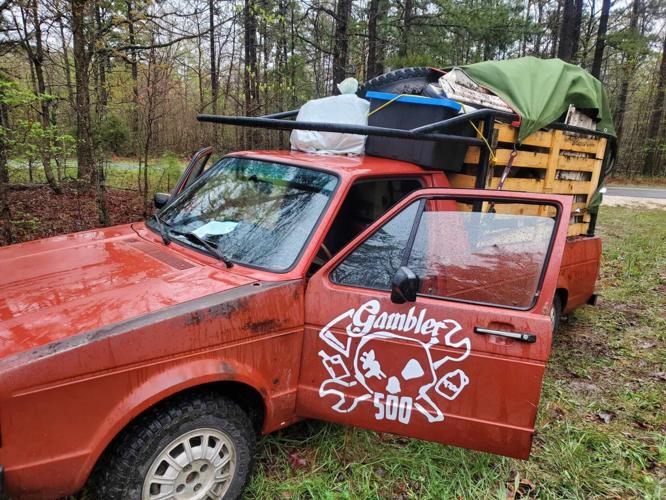
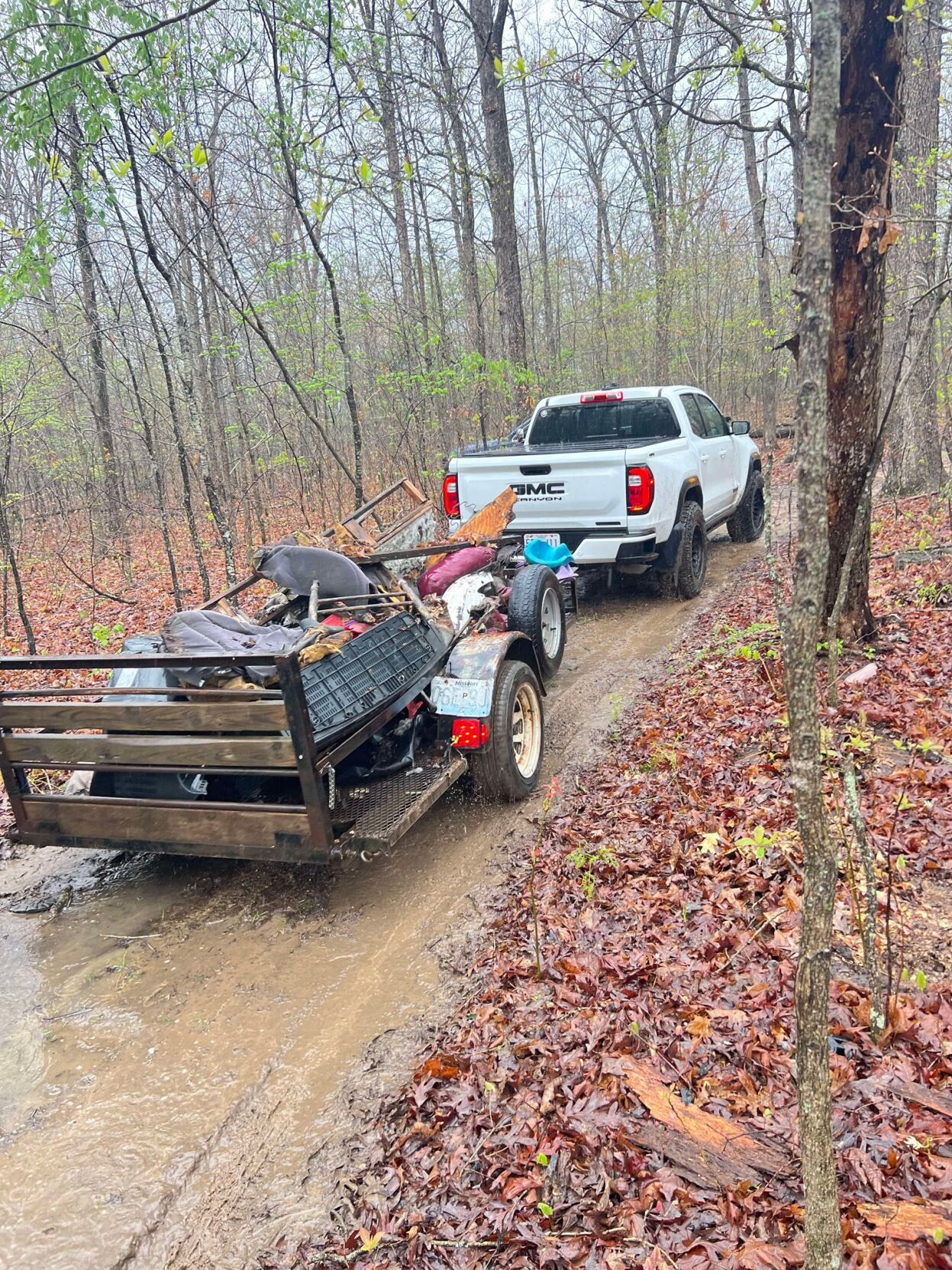
In just over three hours on April 19, volunteers removed 7,940 pounds of illegally dumped waste from 10 sites in the Mark Twain National Forest during the Salem Scrambler, a competitive rally-style cleanup event. The event, organized by Kyle Williams with Ryan Fairless, Donny White, John Schweer, and Dustin Privett, combined elements of off-road navigation with environmental cleanup. Volunteers in nine vehicles competed to collect as much trash as possible and return to a weigh-in within four hours.
The event is what Williams described as a “navigational scatter rally”, a treasure hunt of sorts, with Williams sharing he discovered the idea of the navigational scatter motorsport through a book at the local library on old European motor rallies. Old navigational scatters had a goal of scattering competitors over a designated map, giving each competitor a number of locations to be visited in any order. This navigational scatter rally later blossomed into the Gambler 500 rally, which Williams, and several participants of the Salem Scrambler, participate in through the local Gambler 500 group Missourah Endurah.
The idea of the Gambler 500 is where a person would purchase a $500 car from Craigslist, back when they could, explained Williams. That car would be built up to be functional in some fashion—that way, when it came time to participate in the event, it would be a bit of a gamble for if it would make it through. Thus, Gambler 500. That blossomed even further when organizers started seeing trash on the trails during their events. The idea grew into promoting stewardship and gamifying cleaning up the woods. Gambler 500 events aren’t a race, but rather a competition against your vehicle to see how much trash it can hold.
After participating in several of these Gambler 500 rallies with some friends, Williams spoke with the U.S. Forest Service and Ozarks Solid Waste Management District, a subsidiary of MRPC, and discovered that there are approximately 1,000 dump sites in the Mark Twain National Forest that they have logged away, categorized in a logbook according to contents including size and type of trash found. Williams wanted something that focused a little bit more on clean-up and less off-roading—so the organizing of the Salem Scrambler began.
The event kicked off with participants gathering at a public parking lot, where they received maps and cards detailing various trash sites—each with a unique name, GPS coordinates, and description. In preparation, organizers visited each site prior to confirm they hadn’t already been cleaned by other groups and marked them with stakes. Most sites were directly off the highway and a few sites were hidden, but not impossible to reach. This meant more variation in types of vehicles participants could use.
At 10 a.m., participants were released to begin a four-hour cleanup mission. The limited timeframe of four hours kept the event accessible—allowing people to travel from places like St. Louis or Kansas City and still be home for dinner.
Participants chose their own route during the event, and there was no entry-fee. While not a race, strategy played a big role since teams had limited time to reach as many sites as possible and collect trash. Proof was to be provided to ensure participants reached each designated checkpoint—they were encouraged to snap a photo or log their cleanup at each checkpoint. With 25 points awarded per site visited; one point per pound of trash gathered; and extra points for those coming from far away or bringing unique vehicles, participants were incentivized to pick up as much trash as possible. At the final check-in at Dent County Ag in Salem, the vehicle is weighed with the load, and then again after the haul is dumped at provided dumpsters.
Participants used all kinds of vehicles—minivans, lifted sedans, trucks, and trailers—to haul their collections, with some teams playing a game of Tetris with items in their cars. The variety of vehicles added to the strategic nature of the game.
Despite rain and mud, the 20-person group removed over 125 tires and trash, including televisions, couches, vinyl siding, mattresses, and more. One site—nicknamed the “restaurant site”—was completely cleared.
Winners of the event included:
• 1st Place: Doug Leibman (Mansfield) – 1,800 lbs. from two large sites
• 2nd Place: Chris Martise & Michael Callahan (Sullivan) – 1,200 lbs. from three sites
• 3rd Place: Erik & Clarissa Votipka (Kansas City) – 1,100 lbs. from three sites
"I was afraid the weather would limit turnout, but people showed up and worked hard despite the rain," said Williams. “Seeing everyone work together—even helping pull each other out of the mud—was a reminder of what community action can look like.”
Williams thanked Ozark Rivers Solid Waste Management District for providing essential support by donating dumpsters, gloves, grabbers, trash bags, and other supplies; Dent County Ag for the use of their truck scale and space for weigh-in; and JeT Tires & Auto for assisting with tire support.
The first Salem Scrambler event was such a success that Williams and other organizers are already planning ways to make more events bigger and better, as well as make it a quarterly event. The next event is planned for July 19, labeled the Salem Scrambler II: The Litter Strikes Back. Because the event will take place during the summer, it will take place closer to sundown, starting at 6 p.m. - 11 p.m. To RSVP to the next event, visit https://www.facebook.com/events/1196742361906693/.
The Salem Scrambler is part of the broader Missourah Endurah community—rally enthusiasts who combine adventure with public land stewardship. More cleanups are being planned for summer 2025, along with volunteer participation in the Missourah Endurah fall event.