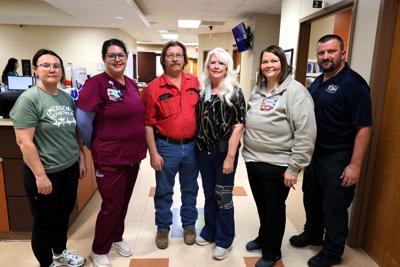
Susan Yardley of Plato began her Sunday morning, November 23, with a cup of coffee and plans to go horseback riding. Within moments, her day and her life took an unexpected turn.
“As I was drinking my coffee, I felt an immediate pain in my neck on my left side that crept down into my shoulder and left arm,” Susan shared. “I looked at my husband, Barrie, and said, ‘I am in trouble.’”
Barrie immediately called 911, and first responders arrived within minutes. Brad Crawford, TCMH paramedic, and Bonny Hill, TCMH EMT, transported Susan to the Texas County Memorial Hospital emergency room.
Upon arrival, Marcus Hennon, DO, the emergency room physician on duty, ordered several tests, including a chest X-ray.
“When they leaned me forward, I told them twice that I was going to pass out and then I did,” Susan said. “When I came to, I felt like I had been dipped into a big bowl of electricity.”
Emergency room staff later shared that Susan coded multiple times and required resuscitation.
Lauren Toman, TCMH respiratory director and STEMI coordinator, explained that the sensation Susan described was the result of ventricular fibrillation, a life-threatening heart rhythm in which the heart quivers instead of pumping blood effectively. In this rhythm, there is no pulse, meaning Susan was clinically dead.
“The only way to convert that rhythm is through immediate defibrillation, administration of epinephrine, and continuous chest compressions to manually circulate blood to the brain, heart, lungs, and other vital organs,” Toman said. “The defibrillation likely explains the ‘ball of fire’ sensation Susan experienced.”
As part of Advanced Cardiac Life Support protocol, the emergency team also administered amiodarone, an antiarrhythmic medication. According to Toman, it was after receiving this medication that Susan converted into sinus rhythm, a normal heart rhythm capable of sustaining life.
“It’s an incredibly intricate and coordinated process,” Toman said. “During a code, if even small steps are missed or if the team isn’t functioning like a well-oiled machine, the patient’s chance of survival decreases significantly. Susan’s outcome is truly a testament to the clinical excellence and teamwork in the emergency room.”
“Susan was unlike any patient we had experienced before,” Frank Steelman, TCMH Emergency Services Director, said. “We were performing chest compressions while Susan was awake and talking, but the moment we stopped, she would code again.”
Susan recalls the urgency in the room and the concern on Dr. Hennon’s face as staff worked quickly to save her life.
Once stabilized, Susan was transferred to Mercy Hospital in Springfield. There, physicians confirmed she had a 100% blockage in her left anterior descending artery, commonly known as the “widow maker.”
“I remember waking up during the stent procedure, looking at the screen, and watching the doctor unblock it,” Susan said. “I thought it was pretty amazing to witness.”
Susan was discharged four days later.
The outcome could have been very different. Grateful for the care she received, Susan and Barrie returned to TCMH to personally thank the emergency medical services and emergency room staff, whose quick actions and exceptional care saved her life.
“You all are amazing,” Barrie said. “Thank you for saving Susan’s life.”
Susan and Barrie have been married for 25 years and have known each other for 30 years. Together, they have four children and five grandchildren, and now many more moments to enjoy with their family because of the life-saving care Susan received.
“I am extremely thankful to God for letting me stay,” Susan shared. “Being here is better than not being here, and I don’t take a single moment for granted.”
According to the American Heart Association, heart attack symptoms may include chest discomfort; pain in one or both arms, the back, neck, jaw, or stomach; shortness of breath; sweating; nausea; or lightheadedness. Anyone experiencing these symptoms should call 911 or go to the nearest emergency department immediately.