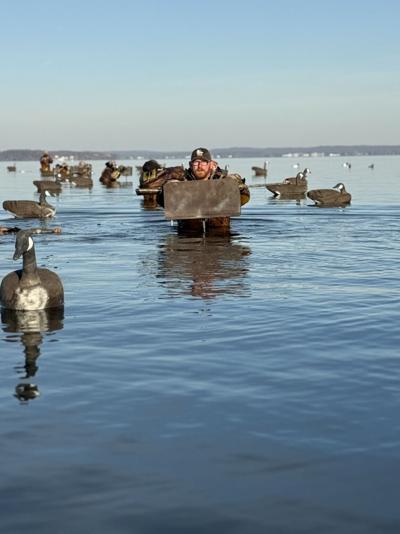
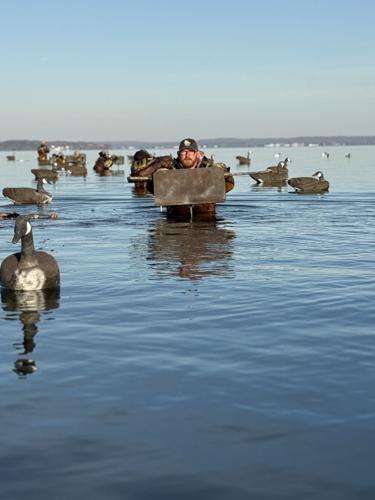
Havre de Grace is referred to by many as the decoy capital of the world. So, it’s a must-visit for anyone who collects hand-carved waterfowl decoys. The Havre de Grace Decoy Museum is worth the trip by itself. Yet, waterfowl hunters need to visit this charming, historic town situated at the head of the Chesapeake Bay to experience the unique practice of “body booting” for ducks and geese.
Regular readers of this column know I am on a quest to successfully hunt all 50 states before I turn 50 years old. I call this quest 50 in 50 by 50: A Hunter’s Quest to Experience America. I explain it by saying if you understand how Anthony Bourdain used food to connect to people and places, I’m doing the same thing through hunting. I’m far more interested in the places I visit and the people I meet than I am in collecting any trophy animals along the way. I’m after experiences, and Havre de Grace was perfect for checking the box next to Maryland.
Delta Waterfowl, to me, is a premier conservation organization. The work Delta does for waterfowl and waterfowl habitat truly moves the needle, and the men and women who make up the organization—staff, volunteers, and members—are some of the finest conservationists out there. I was pleased to be offered an opportunity to join six other Delta members from Missouri, including Kaleb Nunan, the Chairman of the Missouri State Committee, on a special duck hunt with Joey Jobes, a renowned decoy carver.
Jobes is the youngest of three sons of Captain Harry R. Jobes, a widely respected decoy carver. Capt. Harry has his own section of the Decoy Museum, and I believe it’s safe to say someday Joey will have his own special section in the museum right alongside his father’s. Joey was raised in Havre de Grace and remains there today. His life has revolved around the water and waterfowl. He was so young when he began helping in the family decoy shop that he can’t remember life before doing so. By age 13, he was fishing and crabbing on his own boat. Then, in 1976, he started carving decoys on his own.
As cool as the history of Havre de Grace is, I did need to knock down a duck to complete Maryland for my quest. Our hunt took place on the Susquehanna Flats at the head of the Chesapeake Bay. We were hunting just below the river mouth, a spot steeped in waterfowl history. The water is shallow, with just a hint of salt. We had to break ice to get the boats out that morning.
Body booting is not something I had heard of prior to this invitation. The basis of the experience is that you wear a full-body survival dry suit and stand in the water. Legally, your feet must remain on the natural bottom. You can’t sit on a chair or ladder. You can’t stand on cinder blocks or a sunken pallet. A box affixed to the top of a pole driven into the bottom is all you have to stand behind and keep your gear in. You squat or kneel behind the box with only your shoulders above water. You have to remain still and low if you hope to have ducks land in your spread.
Our decoy spread was a sight to behold. We hunted over 125 handmade canvasbacks carved by Joey. This was the first time they were hunted over. Another 130 hand-carved goose decoys were set around us as well. We couldn’t shoot geese, but for some reason they seem to make the ducks comfortable. Eight hunters, seven guys from Missouri and a Delta Waterfowl Regional Director from Pennsylvania, stood in a line chest-deep for six hours. We shot 21 ducks. The haul included nine different species.
After the hunt, we had a private, after-hours tour of the decoy museum. The history in that building is incredible. Decoys from the late 1800s worth prices that made us shake our heads and keep our distance from the displays lined the walls, some with values into the hundreds of thousands of dollars. They are art today, but at one time were simply tools.
Havre de Grace has earned its title as the Decoy Capital. Decoys were once a necessity here, as numerous families made their living on ducks. Birds were packed in rail cars and shipped to the cities. Canvasbacks commanded premium prices. A redhead could be worth four times a mallard. The flats were thick with wild celery. Food brought ducks. Ducks brought people. The people carved decoys.
Names matter here. Shops matter. Apprentices learned from masters. One of the giants was Madison Mitchell. He was an undertaker by trade and a carver by passion. His shop became a gathering place. Joey’s father, Capt. Harry, worked there for decades. He learned from several carvers. He carried the craft forward, then passed it on to his boys.
What struck me most about the entire experience was pride in the tradition of decoy carving and hunting in a unique way. Those canvasbacks we hunted over may have been brand new, but they were also timeless. Seeing the museum after the hunt tied it all together. But this is not a place to visit solely for nostalgia’s sake. It’s a living culture.
Body booting is a rite, something I am so grateful to have experienced, as hunters have done there for generations. Havre de Grace gave me a hunt I’ll not forget. It gave me a lesson in waterfowl history and reminded me that some places demand respect. And if you give it, the return can be tenfold.