I first heard stories of the Eleven Point River while attending forestry school at the University of Missouri. Dr. Ken Chilman taught outdoor recreation and happened to be very fond of our Ozark rivers and streams. Dr. Chilman had visited and floated many of them. He often told intriguing stories in class, which made class time pass a lot quicker.
Anytime Dr. Chilmna made mention of the Eleven Point River, his demeanor shifted to that of a suspect teenage boy. The Eleven Point held special appeal to him and for good cause. He loved a good story, especially those involving mystery or an element of the unknown.
Dr. Chilman reigned supreme as an outdoor photographer and often entertained us with astounding slide presentations set to concert piano music. He obviously spent a great deal of time assembling his slide lectures, with the intended purpose of not only educating us about the incredible outdoor recreation opportunities found in the bowels of the Ozarks, but also to inspire us to the point of becoming involved in the protection of those resources so that future generations could enjoy them as well.
I distinctly remember the first time Dr. Chilman made mention of the Irish Wilderness, a 17,000 acre block of wild, rugged lands bordering the eastern flank of the Eleven Point River. It seemed that, according to Chilman, local people still spoke about individuals venturing into the Irish Wilderness never to be seen or heard from again.
I guess those of us whom cannot live without wild things in our lives are uniquely intrigued by the possibilities of unheard of dangers that await in the wildest and remotest regions of the Missouri Ozarks.
Dr. Chilman spoke of a Father Hogan, of the St. Louis diocese, who led over 200 poor Irish immigrants into the Irish Wilderness to escape persecution and to establish a colony prior to the Civil War. As the story goes, there is no record of what became of the Irish immigrants. However, Father Hogan turned up later in the Kansas City region. Much speculation has arisen about what actually happened to the colony. Some suspect that bushwhackers from the Civil War preyed on them for livestock and other supplies. Chilman claimed that many of those who have hunted or camped over night in the Irish Wilderness have heard the screams of persons under attack. The taller tales relating to the demise of the colony residents also refer to later explorers that disappeared as well.
Regardless, the attraction of a wild and scenic region, complete with yarns of persecution, war, treachery, mysticism and adventure became more than my inquisitive mind could withstand.
I explored the Eleven Point River for the first time in the early 1970’s. The river almost ate my traveling partner and I at Mary Decker Shoals, a mile or so below the Greer Access near the Highway 19 bridge.
Had it not been for the sage advice of a local canoe livery outfitter, our canoe, supplies and perhaps us, may still be at the bottom of the Eleven Point. The river divides at Mary Decker Shoals. The deceit lies in the fact that it appears to be a better route to the left channel. However, it sports a waterfall just out of sight, complete with big boulders and logjams. The right channel isn’t much better. To negotiate the run safely, one must hug tight to a huge boulder in the center of the river. The churning water plunges over a two-foot drop, swirling and crashing into a house-sized boulder scarcely a canoe length away. Serious maneuvering, involving back to back 90-degree turns, rocked our nerves before we shot down stream through a quarter mile boulder strewn course.
“That was spooky,” my partner squealed. “I bet a lot pf early settlers cracked up there.”
A few miles down river we came upon the Turner Mill Spring Branch. We had to investigate. A short hike up the spring branch an enormous waterwheel, perhaps 30-feet high, stood stoically in the branch, any signs of a building having long been consumed by the epic powers of nature. We stood in the eeriness of this gargantuan iron structure that seemed so out of place. Perhaps the real story is that the wheel is the remains of some alien spaceship.
In the 1890s about 50 homesteaders resided here in the wilderness along the Eleven Point River. They had a small, school and general store. They were shocked when their application for a post office was approved by the government. Therefore, they named their settlement Surprise.
Turner Spring spurts 1.5 million gallons of water per day from underneath a limestone bluff. We dipped our hands into the cold waters and splashed our faces. A chill ran up my spine, partially from the freezing water and partially from the feeling of being observed by ancient spirits. A presence accompanied us as we walked cautiously back to the river.
Out next stop came several miles down river at Boze Mill Spring. A short walk brought us to the azure waters of the spring bubbling up in a pond. I immediately dove into the spring to get a bit of relief from the heat. The spring pond was only 30 yards across. Halfway across both of my calves cramped rendering me virtually helpless in the cold water. As I struggled to dog paddle to shore, I was certain that the mystical powers of the Eleven Point that consumes humans, body and soul, had indeed clamped down on my legs.
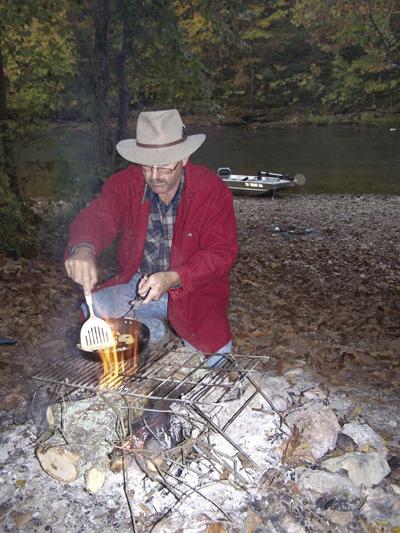
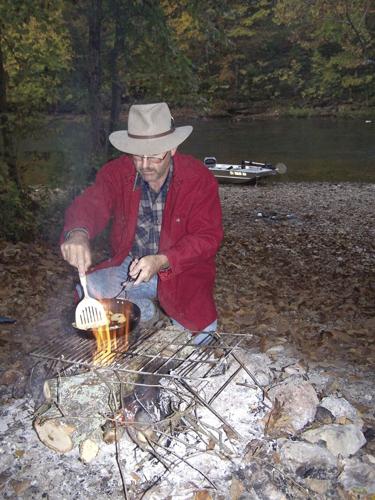
My stories continue to support the mysterious environs of the Eleven Point; a bear encounter while cooking trout on shore and a giant buck that suffered serious ground shrinkage after I shot it are only a couple of other instances of mystery. However, what should one expect from a river with a name of suspect origin…a 11-point buck killed on its banks, 11 prominent pointes within a short distance, and an explorers compass that pointed 11 different directions. All so mysterious.