During a teleconference call at the Salem Community Center @ the Armory June 25, the county commission, local health care providers and pharmacists gathered to ask questions and attend a webinar with representatives of the St. Louis County Prescription Drug Monitoring Program.
The program, a proposed ordinance that would track prescribed and filled schedule two through four opioids, would allow healthcare providers and distributors to see the prescription history an individual has had for up to two years. The program works throughout counties, but only in the counties that are currently part of the PDMP program.
The PDMP ordinance, established in March 2016 in St. Louis County, became the first local-based PDMP in the country. All other states, excluding Missouri, have a statewide drug-monitoring program. With the success the program had in its implementation, St. Louis County decided to modify the program so any other county in Missouri could join, with the fully-fledged program going live in April 2017.
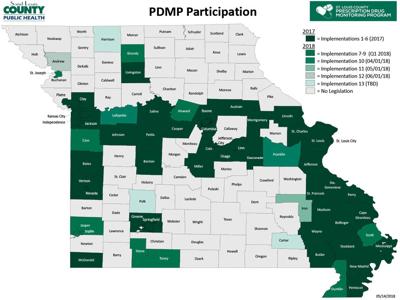
Since then at least one county has been added to the program each month, with 61 counties in Missouri having joined. One county adjacent to Dent, Reynolds, has committed to the program.
Emily Varner with St. Louis County Public Health and the Prescription Drug Monitoring Program coordinator spoke with the group about the potential benefit that the program could bring to the county, as well as the technical aspects for what it would mean to follow the potential ordinance.
“Unlike a lot of our public health work where placement matters, that’s not really the case for opioids,” Varner said. “Opioids are hitting any and every county in our area. They are hitting everyone, not just one pocket.”
Varner provided statistical maps and data that showed opioid-related deaths in the St. Louis area, as well as overall Missouri statistics of opioid death. She explained that with the PDMP other local programs could tackle other corners of drug addiction and abuse. This includes the Community Resources United to Stop Heroin, which involves schools and law enforcement to tackle heroin addiction in Missouri.
“The PDMP has three main goals,” Varner said. “One, to improve controlled substance prescribing. Two, to inform clinical practice, and three, to reduce the number of people who use, abuse or overdose.”
In a previous report by The Salem News, local pharmacists and pharmacy owners were interviewed to get their take on the proposed ordinance that would track opioid prescriptions. Jan Gott, Country Mart Pharmacy, and Sherman Odom, Vandivort Drug, had met with the commission previously to ask questions and express their views on the program. Gott and Odom were both proponents for the program, with Odom expressing concerns over distributor cost and time that would need to be dedicated to following the ordinance. Discussion at the meeting between local providers and pharmacists revealed that a variation of the program was “user friendly and quick to use,” said Madison Chapman from Walmart Pharmacy.
The program is currently funded by a grant from the Department of Justice. One of the concerns raised at the meeting was a plan for funding following the grant expiration in September 2019.
“We intend to apply for additional amounts of grants (from the Department of Justice) and hope to continue to receive funding for all of our jurisdictions,” Varner said.
If an ordinance were to be passed by the county commission, a user agreement would need to be signed and followed with St. Louis County guidelines. The agreement, which can be nullified at any time and for any reason, requires a $264.61 annual fee to be part of the program. Enforcement, which some counties have none, is completely in the hands of the individual counties.
Varner discussed the overall layout and interface that prescribers and distributors would need to interact with in order to report on each patient. The program does release a timed report to individual jurisdictions involved with the PDMP to show collected data of prescriber and distributor numbers without the patient’s information, for privacy reasons. Varner did reveal that an annual report was being compiled for the first time through prescriber and county data for all counties involved, but would still retain the privacy of individual patients.
In the event of an abuse of prescriptions – in St. Louis County’s case, three prescriptions over three pharmacies – the program admins, not local providers, review a patient’s history to determine a course of action. After a red flag is raised on a patient for possible abuse, both prescribers and distributors would be able to see the warning. A question raised at the meeting was whether a three-pharmacy, three-prescription flag system would be affective due to the size of the county, which Varner revealed the individual county could adjust the number.
If an ordinance were to be passed for the PDMP, a period of time would allow all healthcare providers in the area to allow for an adjustment to the new program and software before the actual program would go live. This is to help acclimate providers to the new part of their routine with reports, as well as becoming accustomed to the software itself, Varner explained.
Another question raised at the meeting was which schedule that the PDMP abides by for codeine reports, which Varner explained would need to be reported under a PDMP implementation.
Attendees to the meeting were Kendra Mobray, Dennis Floyd, Michael Loveday, Teel Wisdom, Darrell Skiles, Dennis Purcell, Gary Larson, Shirley Larson, Sherry Lea, Barbie Fulton, Craig Tatom, Hershel Moser, Madison Chapman, Sandra Headrick, Yvonne Prince and Stan Podorski.