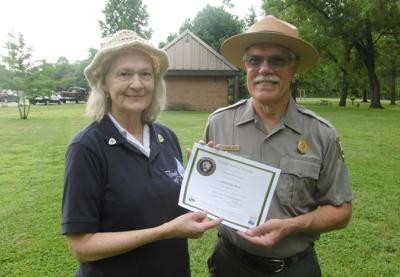
Steelville Community Park and Recreational Area was certified June 2 as an official site of the Trail of Tears National Historic Trail. The designation came following a ceremony presided over by officials from the City of Steelville and National Park Service.
Deloris Gray Wood, President of the Missouri Chapter of the National Trail of Tears Association, provided the research which led to the park’s certification. She detailed her findings to the crowd June 2 and set the scene of how the Trail of Tears would have appeared as it passed by in the late 1830s.
“Lt. Cannon of the U.S. Army led 365 Cherokees through here in 1837 and 1838 to establish a northern route,” Gray Wood said. “They were followed by 10 detachments that passed by Steelville in the winter of 1838 and 1839. That’s 10,000 people who people came through here.”
At that time, Gray Wood said the land on which the park is now situated was the homestead of Henry E. Davis. She discovered that documentation by going through records from the National Archives.
Her research reveals Cherokees camped on Davis’s land and bought supplies from him and other area homesteaders. After departing, the Cherokees traveled north to the Snelson-Brinker Cabin and then passed by the Massey Iron Works going west through Phelps County.
Gray Wood said the northern route was pioneered by the Cherokee endured significant hardships and death during a forced march through Arkansas the previous summer. She recited several passages from the military log of Lt. Cannon as evidence of the Cherokees’ suffering on the Trail of Tears. Entries from December of 1837 report the party was forced to bury several of its dead in Crawford County and they had “scarcely room on the wagons for the sick.”
Historian Frank Norris of the National Park Service commended Gray Wood for her dedication and skill in researching the Trail of Tears.
“This is an undeniably important historic place, however, it has taken Deloris and her sleuthing to be able to show to specifically be able to show why and how it’s important,” Norris said. “For a long time, we who follow Trail of Tears matters have known 15,000-plus Cherokees where moved against their will from the south Appalachian mountains of Georgia, North Carolina, Northern Alabama and Eastern Tennessee because the Indian Removal Act of 1830 told them they needed to all go to Indian Territory.
“They chose different routes to come this way and they formed 17 detachments. This road right here was by far the most important. They came up the along present day State Highway 8, and because of Deloris’s research, we now know a number of them camped on this ground, and we also know they bought subsistence rations. So this is an important place, it was a key part of their movement west. It took three to six months for these various detachments to walk the 800 to 1,000 miles between the south Appalachia to Indian Territory. Steelville deserves to be recognized for its important role in history as part of the northern route of the Trail of Tears.”
Norris said the site’s recognition means it will be marked on official Trail of Tears maps and the City of Steelville is eligible to receive support to develop interpretative features such as signs and monuments. Crawford County Commissioner Rob Cummings concluded, “This is an event that needs to be remembered because it’s a sad moment in our nation’s history.”