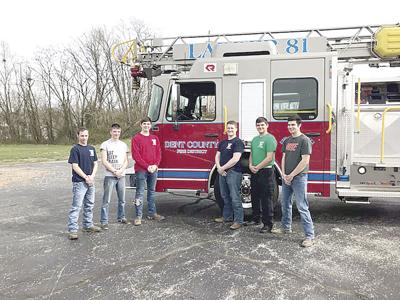
Home fires, brush fires, vehicle accidents and first responding are a few among the many services that the Dent County Fire Protection District offers, and now six local teens are among the crew that makes these emergency necessities readily available in our area.
Joseph Atkinson, Jonah Gargus, Isaac Stogsdill, Trevor Brooks, Austin Stokes and Jerry Bettigrew are the lucky teens who are all active in the Junior Fireman program, a program that first began in Dent County in 1994.
Fire Chief Brad Nash was one of the first teens accepted into the program in 1994, a senior in high school at the time. He credits the program for sparking his interest in becoming a firefighter, as well as bringing multiple individuals within the department into the ranks permanently after they graduated. This new group of teens, however, are the first in five years to be a part of the DCFPD team.
“We had several individuals who joined the department because of the Junior Firefighter program,” Nash said. “We got into a situation about five years ago that it was getting really hard to get anybody to participate in the program, and some of the ones we were getting were having issues showing up and that type of thing. So, we kind of disbanded the program for a few years. Within the last six months or so we’ve had several juniors come up and ask us about the program.”
Nash said that a group of teens initially approached him after they took an interest in firefighting courses at the Rolla Technical Center, a vocational school for high schoolers. After speaking with the teens about their interest in the program, DCFPD decided to open its doors to junior firefighters once again.
“It started with just a couple of them, but within three weeks we had five,” Nash said. “We kind of had to cap it off, because any more than that and it would get too hard to handle because they have strict guidelines they have to follow.”
Even as workers in the fire department, the teens are not exempt from school-time duties and the responsibilities they carry. Nash explained that he checks the grades of the junior firemen periodically to ensure that their schooling is top priority, as well as making sure they are maintaining a professional public image.
“(It) gives them motivation, because normally they like to be here,” Nash said. “We preach school comes first. At their age, school is their main job.”
Emergencies can happen at any time, but for the junior firemen there is a specific timeframe when they can respond to calls. They are not allowed to leave school early, and as soon as 10 p.m. hits they must go home to prepare for school the next day. Nash also stated that if the teens are found to be causing trouble in the town the fire department “nails them hard.”
“That’s a big thing for us, and a big thing we preach to them,” said Nash. “We get a good response from the parents for being so strict on them. There’s a lot of times where they listen to us more than they listen to their parents. We watch them close. We tell them that this is a small community, we want everyone to have a positive outlook on the fire department, and everyone knows who is on the fire department for the most part. So, if they are out in town causing trouble or driving too fast or whatever, that’s a negative reflection on the fire department and we are not going to do that.”
Jerry Bettigrew, 17, and a sophomore at Salem High School, is one of the six boys involved with the program currently, having been active for three months. Bettigrew says that his main interest in joining the program was to kickstart his future military career as fire protection for U.S. Airforce, but it also helped that his friends were involved with the program as well.
“My friends first told me (about the program) and I was like, whoa that’s cool!” said Bettigrew.
The tight restrictions that the boys must follow in the Junior Fireman program also work as a type of mentorship for the teens, something Bettigrew appreciates.
“It’s pretty nice to have, but I’ve always been a good kid and kept my grades up,” he said.
Nash laughed, but nodded his head and said, “He does pretty good, I can’t complain about his grades at all.”
So, what exactly do these teens do to assist the fire department? Oftentimes the same thing that fully-fledged firefighters do.
“As soon as they start (the program) they can start responding to fires,” Nash said. “Depending on the call, they are able to go if there are seats available. For house fires, that type of thing, they can do any kind of exterior work, but we don’t allow them to go in the house. After the fire is put out, and we are kind of looking around to see where the fire cause is, if it’s safe we will let them go in, but for the most part we don’t allow them in the house at all. Car accidents and first responder calls I try, if any way possible, not to let them go to those calls. Unfortunately, especially in car accidents, there’s just stuff that you have to deal with and have to see that I don’t want them exposed to at this age. They are able to do quite a bit.”
Nash also explained that the teens participate in the regular trainings that occur the first and third Thursdays of each month, as well as engage in any other special trainings that the department holds.
“It helps us out a lot, especially the big fires,” Nash said. “When we had the Pershing fire, we busted our butts out their all day long and then when the kids got out of school it was so nice to be able to have them come in when it was time to pick up hoses. They were able to step up and give some of us older guys a little break.”
The current group of teens can continue with the program until they graduate, something Bettigrew stated that he wishes to do. Nash said that as the current junior firemen graduate and move on to higher learning, the military, their career paths or even into the fire department as fully-fledged firemen, they will look at bringing in more kids to the program to fill their places.
“We have a great group of guys. It’s like a family down here,” Nash said. “For the most part, the guys that are here try to help (the junior firemen). Is that our job? Not really, but (we do) anything we can to help these kids out. I think this is an outlet for them where they can get in and blow off some steam, and they are doing something good for the community as well, so it’s kind of a win-win.”
Bettigrew stated that his favorite experience in the program so far is riding the big firetrucks, but he laments that the teens are not allowed to drive them.
“We have good insurance, but not that good!” laughed Nash.