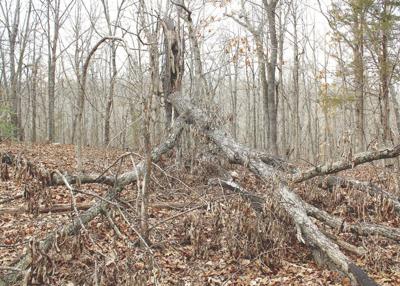
Sometimes problems in nature have unnatural origins. Such is the reality of oak decline, a unique Ozarks’ problem which threatens to change Missouri’s forests as we know them and potentially rob future generations of the natural heritage of hiking and hunting that has helped define us.
There are many factors that contribute to oak decline. Armillaria fungus rots roots and hypoxylon forms cankers on stems. Insect pests like caterpillars and stick bugs strip away tree foliage. Drought conditions and late frosts add additional stress to vulnerable trees. One of the biggest factors for oak decline, however, is time itself, and in the case of our black oaks, the past is coming back to haunt us.
The Ozarks’ forests may seem like a primeval wilderness, but the truth is more complex. The original local environment was a more mixed setting, featuring a greater area of woodland. Made up of great pines and oaks which spread out over the landscape, the woodlands featured a more open canopy that allowed sunlight to hit the ground. Such was the aim of the native tribes of the time who favored woodlands over forests because they fostered more wildlife. Thus, it’s widely believed they maintained their chosen habitat through intentional controlled burns of the landscape.
By the late 19th and early 20th centuries the United States industrial economy was growing rapidly, but with every city founded and home built, Missouri’s forests shrank. Most of the old growth trees either went into fueling charcoal blast furnaces for iron smelting or were used for railroad ties and building construction. For a time, the Ozarks boomed like no place else on earth. The world’s largest charcoal blast furnace was located at Nova Scotia in Dent County, and the world largest sawmill was not too far away at Grandin in Carter County. However, these sites – and other sites like them in St. James, Leasburg and Sligo – consumed acres upon acres of trees each day they operated.
The end result was that within two generations time our forests were harvested to exhaustion. This excess of yesteryears is what set the stage for the Oak decline of today, because many of the trees that make up the Ozark forests we know now first sprouted during the regrowth immediately after deforestation.
“What came back then were these faster-growing black and scarlet oaks,” says silviculturist John Bryan of the US Forest Service. “The new stands were very dense compared with the natural forest that preceded it, with little pine and an overabundance of black oak compared to slower growing white oak. That’s basically unnatural, we don’t have that situation forest wide, but in some areas we have over 90 percent black oak. Black oak is so prevalent in some areas it’s almost a monoculture.”
An oak tree might seem like it would last forever, but like all living things it goes through a life cycle, and for trees in the fast-growing red oak group, which includes black and scarlet oaks, that life cycle is not all that different from you or I.
“Scarlet oak is typically considered mature at about 60 years of age, black oak at 90,” Bryan says. “Once you’re up there around one hundred, they’re going to be damaged by insects and susceptible to drought and decline.”
The oak trees’ life cycle may be natural, but in the case of the Ozarks, an unnatural number of oak are reaching their end at the same time. Combined with the lingering effects of the 19th century’s exploitive land use, our shallow, rocky soils and various natural stressors have yielded a population of trees predisposed to all simultaneously decline and die. That means the forest we love could morph into something less bountiful if nothing is done.
Bryan says not managing oak decline could affect our ecosystem in fundamental ways. Roots and tree canopies help maintain soils, and without some kind of ground cover soil potentially erodes, which could affect water quality. The buildup of dead wood can also fuel devastating forest fires. The mass die-off of oaks, specifically, also means less mast (or food for wildlife) as the shade-tolerant varieties of maple and black gum that would replace them don’t produce acorns. That means less hunting opportunities.
“The mast from the oaks would be reduced, which is pretty key for wildlife,” Bryan says. “Turkey and deer are pretty closely associated with mast producers.”
The scale of this problem has several potential implications. Bryan has run forecasting software called FVS, or Forest Vegetation Simulator, on data from about 250 plots in Carter County.
“Ninety percent of the black oak fell out in a no management scenario,” Bryan says. “There was 50 percent in the next 10 years, and up to 90 percent in the 40 years after.”
Bryan is not alone in this analysis. Data from Forest Inventory and Analysis gathered by the research branch of the Forest Service,show an increase in black oak mortality over the period from 2010 to 2015. Additionally, data gathered in Missouri via aerial detection flights lined up with his simulation. The flights showed tree mortality in Missouri had a peak in 2012, a drought year with 75 to 80 percent of that mortality in black oak.
“We wouldn’t be trying to make the case that this was an emergency if it wasn’t,” Bryan says. “We aren’t just saying that the sky is falling, the sky really is falling.”
Just as there are multiple causes to the problem of Oak decline, the Forest Service is pursuing multiple strategies to deal with the issue.
“Cutting the oaks before they die can encourage coppice sprouting, commonly known as stump sprouting,” Bryan says. “What we stated in our Purpose and Need of the Forest Health Initiative project is we would like to harvest them now before they die, because they will not coppice sprout if they die. The root system will send up new sprouts allowing the tree to regrow given the chance. This is more efficient than growing a new tree from an acorn and allows the root system of the oak to live on and maintain the soil, preventing erosion and runoff into the streams. The newly sprouted trees are also more resistant than old trees to insect and fungal pests. Additionally, thinning the stands to favor pine and white oak over black oak help increase the diversity of the stands and make them more resilient in the face of drought. Reintroducing pine into the Ozarks helps restore the natural biodiversity our forests had before the deforestation.”
Bryan says shortleaf pine is the only pine native to the Ozarks, and that it was once widespread through the region.
“The range of pine has been greatly reduced during that era of exploitation,” Bryan says.
Establishing stands with a higher presence of white oak and shortleaf pine will further help in restoring the Ozarks to the more natural state desired by forest managers by increasing biodiversity. One strategy to achieve this is looking to the past and adopting use of controlled burns to help avoid the risk of forest fires and create a more woodland setting. Encouraging this management will further improve the health of local ecosystems and be the strongest barrier to the continued deterioration of Missouri’s wilderness.
Oak decline may seem like a daunting threat, and while it will prove a challenge, history shows such problems are never insurmountable. The deforestation of the past left us with an even greater environmental dilemma, but subsequent efforts by the US Forest Service, Department of Conservation, the Civilian Conservation Corp and a legion of concerned citizens helped to reverse the tide of exploitation. Just as we are today dealing with the legacy of mismanagement, the next generations of Missourians will inherit the legacy of our stewardship.
“It’s a challenge to deal with the implications of our past actions,” Bryan says. “We reflect and learn from past actions and realize forests are never static over time. Something that happened over a hundred years ago can still make a big difference to what’s happening today, but now we have a century of learning to help guide our management for future generations.”