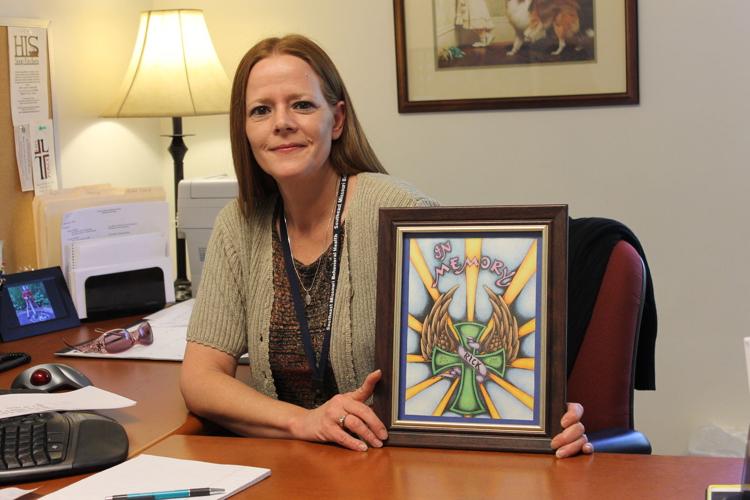
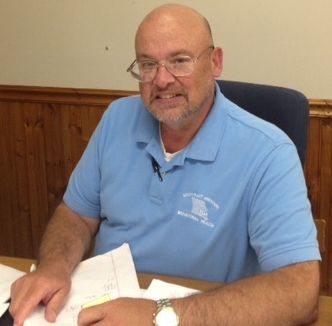
Assistant Director of Southeast Missouri Behaviorial Health, Kimberly Limbaugh, holding a painting made by a former patient. “These are really good people with really bad habits,” said Limbaugh. “But the artistic talent I’ve seen come through here? Just look at this…”
Morphine boosts dopamine levels 200 percent above baseline, nicotine even more to about 225 percent. Cocaine shoots levels of the neurotransmitter about 350 percent above baseline, while amphetamine skyrockets dopamine to 1000 percent of its starting point. As heroin is generally considered four to five times stronger than morphine, it would presumably boot the chemical up to levels similar to amphetamine (1000 percent of baseline). And studies have found methamphetamine to increase dopamine in the synapse at a rate 3 to 8.5 times higher than that of straight amphetamine (3000 to 8500 percent higher than baseline).
One of the more notable pieces Limbaugh has come across during her tenure at the center. She choked up a bit while pulling it out to display. But it's not the only piece of artwork on display, far from it. In the gathering room used on Friday afternoons for spiritual meetings, similar paintings cover the walls.
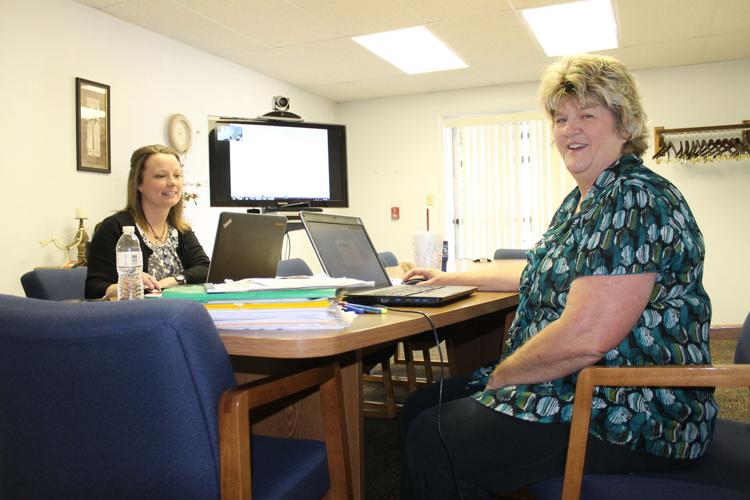
From left, Angela Toman, Director of Administration and Brenda Felkerson, Director of Accounts Management. Both have been with the agency more than 20 years, and both positions are agency wide, not just focused on Salem, though both live here. The Telehealth program is open to any patient who would like to conference with their physician via the system, provided the physician has the equipment on their end as well. Arrangements are made with the physician, who phones the appointment in to the Hart building.
Dan Adams, a 27-year veteran of helping others fight addiction, was originally a school teacher. “I saw my students starting to get hooked,” said Adams, “and I decided to do something different with the rest of my life.”
Assistant Director of Southeast Missouri Behaviorial Health, Kimberly Limbaugh, holding a painting made by a former patient. “These are really good people with really bad habits,” said Limbaugh. “But the artistic talent I’ve seen come through here? Just look at this…”
Tyler McConnell
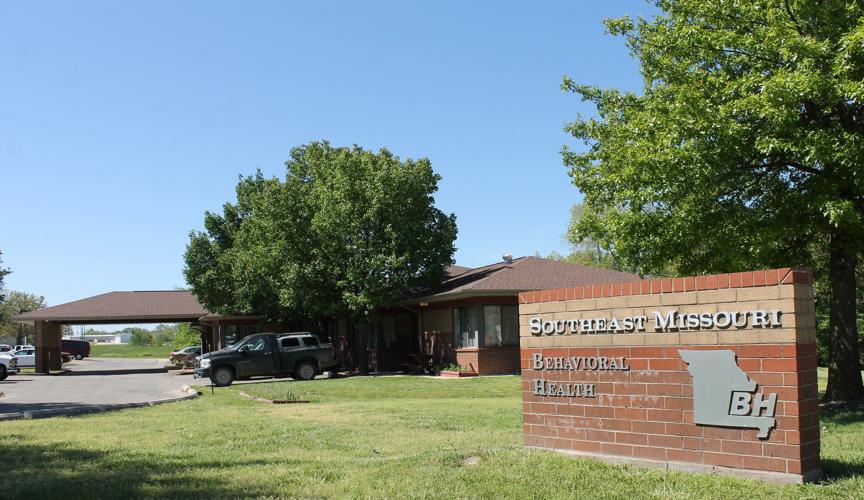
Southeast Missouri Behavioral Health's main facility in Salem is located at 203 N. Grand St.
Part I in a three-part series on the drug problem in Salem and Dent County. Part II can be read here.
Live in town long enough and you’ll hear it, if you haven’t already. . . “The treatment center is one of the main reasons we have a drug problem in this county. All it does is bring criminals and drug addicts here and set them loose in the community.”
Curious as to the reality, and the extent of such rumors, The Salem News set out to find the truth. After a tour of Southeast Missouri Behaviorial Health’s main facility at 203 N. Grand St., its satellite office in the Hart building next to City Hall, a Saturday evening at Narcotics Anonymous in the Bank of Salem Courtesy Room and a Sunday morning at Primer, New Harmony’s 9 a.m. service for recovering addicts, along with talks with local law enforcement and numerous interviews with those in recovery, it became obvious that treatment center or not, addiction is a problem that has, and will continue, to plague our community for years to come.
It’s a problem that affects everyone. If not directly, then usually only just a friend or a family member removed.
It seems that two options exist: 1) to lock up those caught in the throes of addiction and the easy money to be made by preying on it, or 2) to educate, both those trapped inside and those of us looking in, about how to fight back against this devastating, brain-hijacking disease.
With only five percent of the world’s population, the United States holds 25 percent of its prisoners, and over 500,000 of those are incarcerated for nonviolent drug crimes. Over the past 40 years, the war on drugs has cost more than $1 trillion and accounted for more than 45 million arrests. Today, there are more people behind bars for nonviolent drug offenses than were incarcerated for all crimes – violent or otherwise – in 1970, according to the award-winning PBS-aired documentary, “The House I Live In.”
In 2010, a study found that 8.9 percent of Americans had used illicit drugs in the past month. With a population of 309 million, if all of those individuals had been incarcerated, about 30 million Americans would’ve been placed in prison – five million more people than live in Texas.
Dan Adams, a 27-year veteran of helping others fight addiction, was originally a school teacher. “I saw my students starting to get hooked,” said Adams, “and I decided to do something different with the rest of my life.”
Tyler McConnell
Dan Adams, Director of Care Coordination at Southeast Missouri Behavioral Health (known locally as the treatment center), has been helping addicts get off drugs for 27 years. During a talk lasting more than an hour, most of the time was spent discussing the chemical nature of addiction. “You need three things to survive in this world,” said Adams. “Food, shelter and dopamine.”
More than just answering the age-old question, “Why do you think they call it dope?”, dopamine is in fact the brain’s main motivational neurotransmitter – the gas that powers our proverbial human cars. Without it, we would never get out of bed. In fact, we’d never do anything. When lab rats’ brains are altered to quit producing dopamine, they won’t even walk across the cage to feed themselves. They literally starve to death in the corner.
National Institute on Drug Abuse
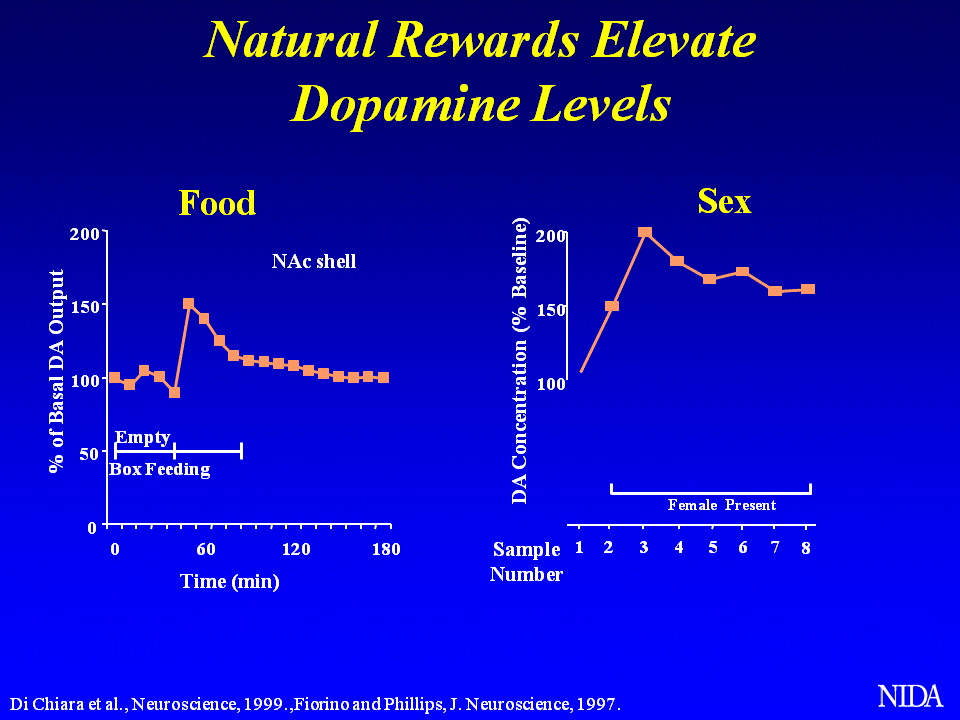
Dopamine plays a central role in numerous mental disorders, including ADHD, Parkinson’s and yes… addiction. Nicotine in cigarettes acts as a reuptake inhibitor that floods the brain with dopamine. Other pleasurable activities give us a shot of the chemical: a succulent piece of chocolate cake, a laugh with a friend, your favorite song on the radio, or sex with a loved one. But even the latter pales in comparison with the power of addictive drugs that act on the dopamine system and reward pathways. Amphetamine produces 800 percent more dopamine in the brain than sex does, and our brains are not quick to forget it.
Dopamine doesn’t actually make us feel good, other neurotransmitters, like serotonin, do that. But it’s what makes us want. And if you tickle the dopamine receptors with 800 times the power of even the most intimate of human activities long enough, it can be a hellish experience to try to leave that behind. It becomes a war against your own mind, far more difficult than someone who simply says, “Well, why don’t you just quit?” can possibly understand.
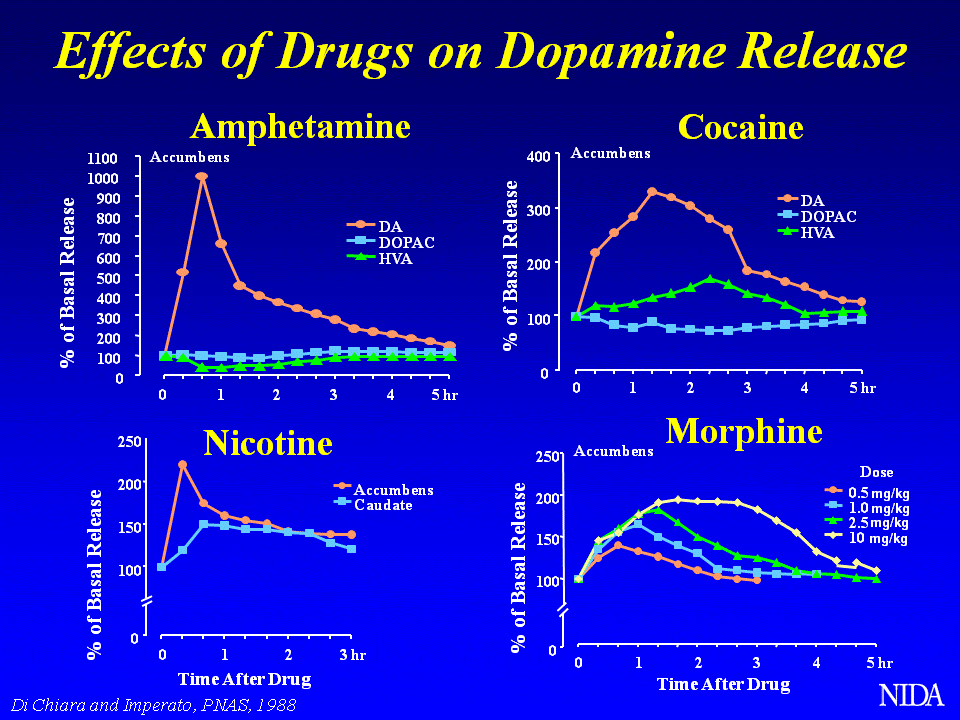
Morphine boosts dopamine levels 200 percent above baseline, nicotine even more to about 225 percent. Cocaine shoots levels of the neurotransmitter about 350 percent above baseline, while amphetamine skyrockets dopamine to 1000 percent of its starting point. As heroin is generally considered four to five times stronger than morphine, it would presumably boot the chemical up to levels similar to amphetamine (1000 percent of baseline). And studies have found methamphetamine to increase dopamine in the synapse at a rate 3 to 8.5 times higher than that of straight amphetamine (3000 to 8500 percent higher than baseline).
National Institute on Drug Abuse
On the law enforcement and judicial side of the equation when it comes to the treatment center, officials seem somewhat hardened, although not without hope. Salem Police Lieutenant Marty Farrar thinks a move away from the epicenter of the city would solve most of the problems.
“It’s a simple solution,” says Farrar. “Move it (treatment center) about four miles out of the city limits. That way, people will think twice about just walking out the door.”
Prosecuting Attorney Andrew Curley is most concerned about the criminals who have been brought to Salem through the treatment center, and rattled off four or five names. But overall, as he was quoted in a past story in The Salem News regarding the evolving heroin problem in the community, as much as he’d like to focus more on treatment, his options are limited.
“It is currently a manageable problem… but we don’t have the resources I would like to treat addiction, and heroin is a whole new ballgame,” said Curley. “It is simple mathematics for dealers. There is a profit to be made here. Our economy is not phenomenal, so this is a place where drug use happens. There is a high profit margin. Dealers can buy for $5, and bring the drug back here and sell it for $20 or $25,” said Curley.
And when Sheriff Rick Stallings was asked during a tour of the Dent County Jail, which was built to house 25 inmates but is currently fluctuating between 40 and 50, what’s his best guess for the high incarceration rate when Salem’s population hasn’t grown by more than a 1,000 individuals since it was built in 1978, he said:
"I think it's poverty, like the article (in The Salem News) a few months ago pointed out. We used to have industry here: coat factories, shoe factories, even a Coca-Cola bottling plant. You could find a job and make a decent wage. But now? If you're poor and your options are limited... I think a lot of them turn to this lifestyle in the hopes of making ends meet.”
Salem Police Chief Keith Steelman admits, “We have some trouble from the treatment center, sure. Have we caught people with drugs who have smuggled them in there before? Well, yeah. But we’ve caught kids who have done the same in high school, restaurants, Walmart… we’re not shutting any of those places down. I won’t blame the center, and no one from this department will do so. … Salem does just fine making its own trouble makers.”
The treatment center had 916 patients admitted in 2014, according to statistics gathered by Adams and other staff members. Seventy-six percent of those patients completed that part of treatment with an average stay of 15 days. There were 779 outpatient admissions that same year. The Salem service area for SEMO-BH is comprised of offices in Salem, Rolla, Houston, Centerville, Waynesville, Cuba and Owensville. In 2014, the Salem Service Area admitted 1,695 individuals for services, and 1,181 were from Dent and surrounding counties. The remainder came from counties throughout Missouri for treatment, and only four percent of this total were from the St. Louis area.
“While some may think of us as providing services to the criminal justice system,” said Adams, “we are a provider of choice for Blue Cross/Blue Shield, Humana, United Healthcare, Cigna, and others. So when a customer of those companies requests services, they are often referred to our crisis stabilization program.”
The center also offers programs far from what is usually imagined by the general public.
From left, Angela Toman, Director of Administration and Brenda Felkerson, Director of Accounts Management. Both have been with the agency more than 20 years, and both positions are agency wide, not just focused on Salem, though both live here. The Telehealth program is open to any patient who would like to conference with their physician via the system, provided the physician has the equipment on their end as well. Arrangements are made with the physician, who phones the appointment in to the Hart building.
Tyler McConnell
“Children with autism from Southern Missouri come to the Salem Center and use our telemedicine system to link with their physicians at the Thompson Center, saving their family a trip to Columbia,” said Adams.
When asked specifically how many of those treated at the center from outside the Salem area stay in the Salem area afterwards, he replied, “I don’t have that data, but it would be a small fraction of a percent that would stay for any length of time. The two organizations in Salem who will house our clients do not do this permanently, only until they are back on their feet. … If anyone has data stating otherwise, I’d love to see it.”
The completion rate is 76 percent. Recidivism seems high, but if you compare it to type I diabetes you will see it is about the same, and the recidivism rate for asthma is higher than for addiction.
One of the more notable pieces Limbaugh has come across during her tenure at the center. She choked up a bit while pulling it out to display. But it's not the only piece of artwork on display, far from it. In the gathering room used on Friday afternoons for spiritual meetings, similar paintings cover the walls.
Tyler McConnell
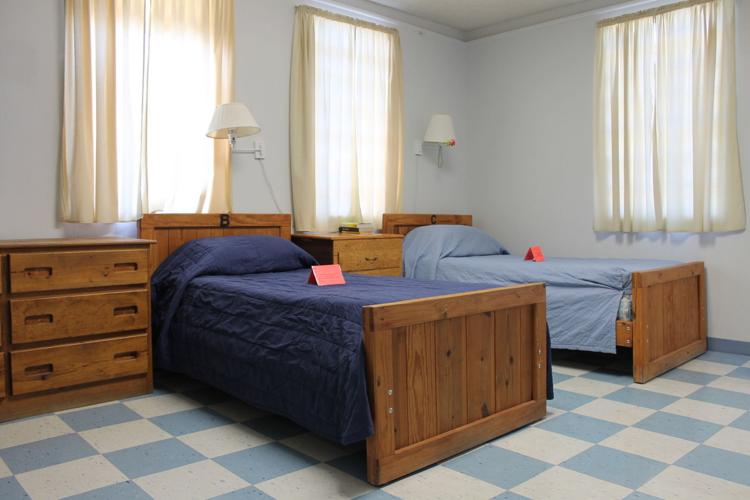
Assistant Director Kim Limbaugh, who gave a tour of the facility, wants the community to know that their goal is to help, not hurt the community.
“We’re here to give people a chance and a place to put their lives back together,” she said. “That’s our purpose. That’s our mission. And that goes for right here in Salem, Dent County, and all of Southeast Missouri. It’s a place to start a life over, for the better.”
In a study conducted by the Glenmary Research Center in 2000, 94.6 percent of Salem residents identified as Christian. To some, it would seem that in a community so densely populated with Christ-following believers, many would rally around the proverbial woman at the well. Which is, as Salem United Methodist Church Pastor Doug Walter says, exactly what he believes should happen.
“In John 8,” says Walter, “Jesus finds a woman caught in adultery, but it's essentially the same thing. ‘We're going to stone her!’ they cry. And he says, ‘Okay, let's do that. Let's stone her. And I tell you how we're going to do it. The one of you who's without sin, you throw the first stone,’ and they all just walk away. So the first person in Salem who's without sin, let them cast the treatment center out. Other than that... It's about grace. It's about loving people where they are, and it may take people several times in a treatment center to get well, but they can. And they certainly can't if we don't help them.”