Today’s story is the first of a two-part series on a recent field day at the Wurdack Research Center.
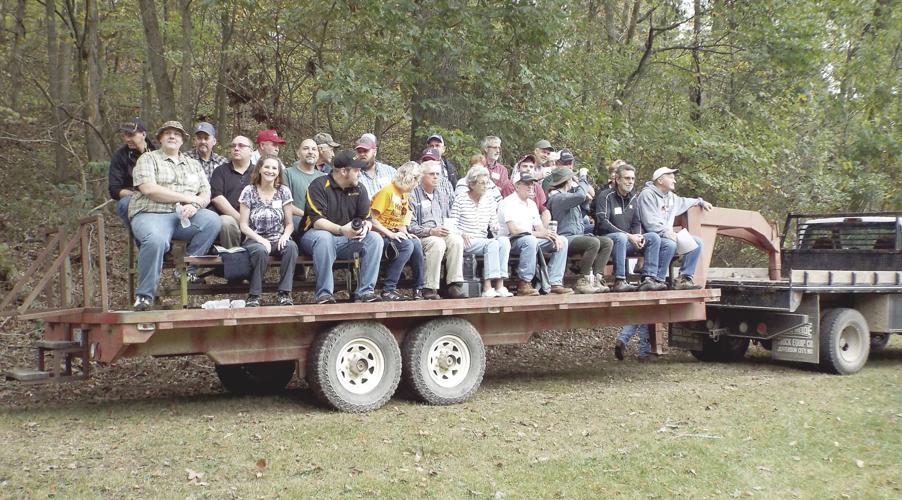
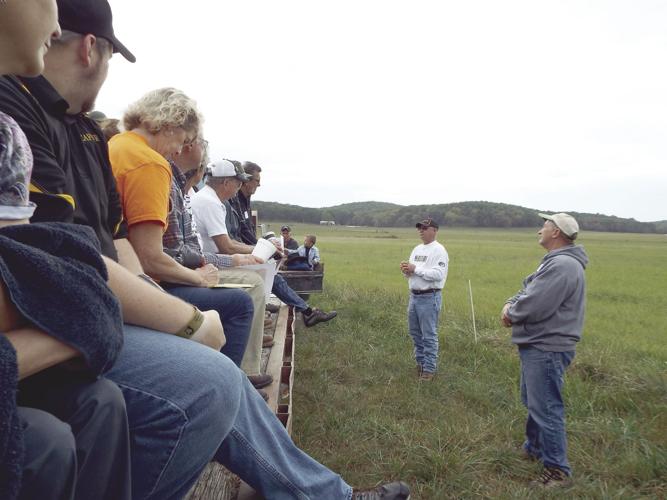
It was a field day for the public at the Wurdack Research Center Oct. 6. The MU College of Agriculture, Food and Natural Resources, in conjunction with MU Extension specialists and special guests, presented tours on a wide range of topics. Several of the presentations were conducted via a wagon tour for participants.
The day prior, over 600 Future Farmers of America and 4H students from the south central region participated in a field day designed especially for them.
The Wurdack Research Center is located on approximately 1,200 acres of farm and pasture land, with the majority of the acreage being upland hardwood forest. This center is one of 17, 14 of which are located around the state, 10 of which host field days. It is the only MU research center located in the Ozarks, and is completely self-sustaining and managed by Brent Booker. It is located in Crawford County just outside Cook Station.
All centers are in cooperation with each other due to the diversities and similarities of Missouri climate and production.
Wurdack Research Center has test fields and test timber stands. It seeks to incorporate preservation, both beauty and historical with advancement and production.
“The work being done here is applicable and a great way for educating the public” says Christopher Daubert, new Vice Chancellor and Dean, MU College of Agriculture, Food and Natural Resources.
There is more awareness by the public about where and how our food, in this case, the beef industry, is produced. Timber research and preservation is of local interest given it is a large part of the economy.
The first stop on the wagon tour was with superintendent Bruce Burdick of the Hundley-Whaley Research Center. Burdick has worked closely with Dusty Walter, superintendent of Wurdack, and Booker in research of fescue establishment and results. This project concerned fescue renovation cover crop yields, with great results although not consistent.
Stephen Lyczak, MU forestry graduate student, continues a project on the survival, growth and management of the shortleaf pine.
He will revive the research on 3,000 trees from the George O. White Nursery in Licking which were planted in 2010. Of those planted, 2,400 trees are still surviving.
When asked why the numbers of trees dropped off, Lyczak explained. “During 1800-1920 tree stands were completely stripped because they were such a high value item. The shortleaf pines are one of the best for wood quality and strength. The forests were stripped to support the population’s westward expansion building railroads. Pine doesn’t reproduce very well on its own, but these planted stands are showing evidence of reproducing.”
The questions and discussion included the market and the ecosystem impact of the shortleaf pine.
Continuing across the farmland, the wagon stopped with Rusty Lee, MU Extension agronomy specialist, to discuss fescue pasture management in promoting grazing quality and quantity. Lee supplied visual sources in a PowerPoint presentation, obvious technology in the field.
This research project was initiated by Harry Copes, who is a farm and land owner in Montgomery County. Copes brought about the idea of using a crimp roller for seed head suppression on fescue. Research was done with the crimp roller, which is traditionally used with cover, row crops, versus a rotary clip, versus Chaparral chemical control. While testing and data were collected with surprising results during the growing season, forage quality from a large quantity of frozen samples will be tested over the winter.
Economics, quality, quantity and labor intensiveness were all monitored with this project.
Kim Smith with the Crawford County Health Department discussed tick-borne illness and prevention. Smith’s presentation included not only the more well known diseases but also the newer, Bourbon virus and the development of a protein meat allergy from tick bites. “Do not squeeze the tick, says Smith, and Deet wipes for prevention outweighs the risk.”
Due to expanded mobility and travel, more foreign mosquitos are entering the US and therefore we’re seeing more mosquito-related diseases.
Regarding rabies, Smith’s advice is “If it’s not yours, don’t touch it.” A person does not have to be bitten to contact rabies, it can be transferred just by the saliva of a contaminated animal.
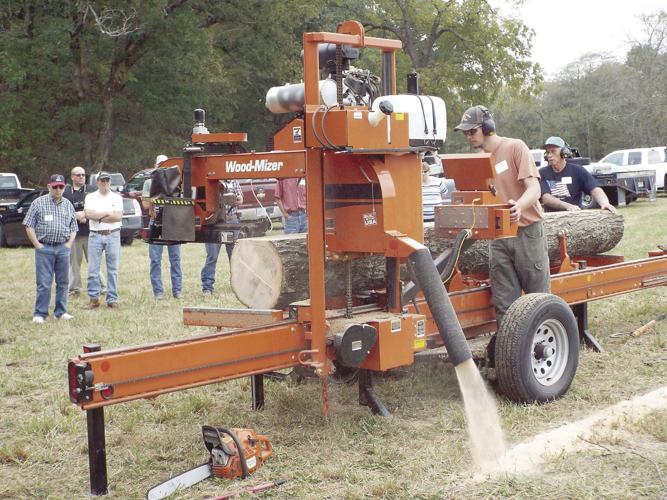
The next stop was with Roger Branson, Red Rooster Sawmill operator and his help for the day, Thomas. Branson was displaying the operation of the portable mill and custom cutting of logs. While cutting bacon boards, or live edge material, he paused to explain and answer questions. Branson covered aspects of timing in regards to sap, sizing, and dry time.
David Calandro, wildlife specialist with USDA covered many aspects of wildlife damage management. “The USDA offers worldwide help with wildlife issues, ‘Protecting people, agriculture and wildlife’,” said Calandro. Native expansion into Missouri by armadillos and black vultures was discussed. The extermination campaign of feral hogs was touched on. The state office for wildlife services in Columbia can be helpful in regards to best eliminating Starlings, which are very destructive and can cause major monetary loss in the cattle industry. Wildlife management for bears, mountain lions, coyotes and deer should all be addressed with the Department of Conservation or the appropriate agents in your area.
Challenges of rural Missouri that are opportunities was the presentation of Kelly Smith from the Missouri Farm Bureau. Smith urges rural Missourians to be active with elected officials in regards to legislation that directly effects them. The Secure Rule School Tax which helps fund schools and county roads is derived from the harvesting of US forest land present in counties. This tax needs to be reauthorized by Congress for continuation of monies that affect 29 counties in Missouri and 97 school districts, it affects 700 counties nationwide.
Broadband service in rural areas at a reasonable cost is necessary for the utilization of newer farm equipment systems, as well as continued economic development in many areas.
Smith also discussed property rights and eminent domain. Specifically with the Green Line Express high voltage direct current line being proposed by a privately owned for profit Texas company supplying renewable energy. Smith says, “Landowners should maintain the right of negotiating monetary compensation per year as opposed to a one time payment, as with eminent domain.”
The presentations at the Wurdock Research Center Field Day were informative, enlightening, entertaining and applicable for the intelligent and inquiring participants.
The day concluded with lunch and prize drawings.