
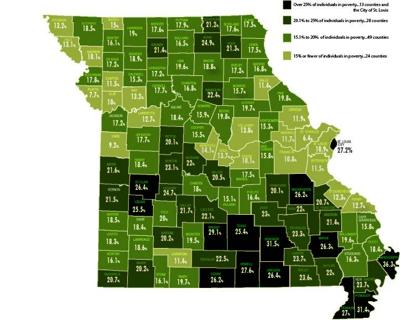

There are over 3,600 people living under the poverty line in Dent County, and many of them will cycle through the Sheperd’s Nook Food Pantry at the Lifeway Center. Lifeway serves 1,500 to 1,800 locals every month with fresh food, goods and supplies they would otherwise not be able to afford.
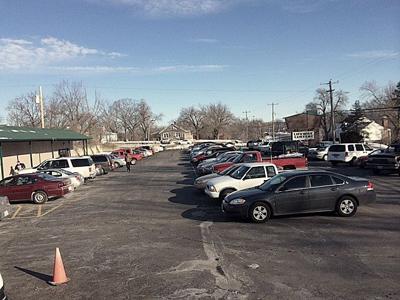
During the cold, foggy mornings of early February there were hundreds of people at the pantry. The parking lot was filled to capacity with dozens of vehicles having to park along the adjoining side streets. Every chair was taken inside the building. The waiting crowd spilled into the parking lot, where many sat in cars or congregated at the front doors. Poverty is a complex topic, and hard to understand. But within the walls of Lifeway, and among its patrons, the base nature of poverty is revealed as simply having limited choices in life.
“Last winter we received a donation of candy for Christmas that we had set out for the children,” says Bill Stack, one of the founders of the Lifeway Center. “We put it in our non-commodity section where folks have the choice of picking three items from the selection. We thought that the candy would fly off the shelf because of the kids, but instead the children kept choosing toilet tissue. They said they knew their families needed it.”
The crowd that came to the pantry the first week of distribution in February was a cross section of society. There were seniors, young parents, children, disabled, the unemployed and workers not able to make ends meet on their salaries. The talk in the parking lot among the visitors was sophisticated for our small town. In lieu of hopelessness, or spreading blame, the topics discussed when asked about hard times focused on the usual suspects: jobs, wages, inflation and rising costs.
“There’s not enough to go around,” says one man in a baseball cap and a well-trimmed goatee as he loads his supplies into an old van. “There’s no jobs, and the jobs that are here don’t pay but minimum wage. I work. But I have a couple kids at home, they need to eat, that’s why I’m here.”
Two retired seniors carefully arranging pasta and bread in their trunk were immaculately dressed and living on social security.
“We just can’t afford to pay for our food and everything else on our income,” one said. “The prices are just too high, and we only get so much.”
One woman sitting in the backseat of a station wagon next to a walker with worn tennis balls on the end had one thing to say to critics, “Don’t tell me to get a job. Do I look like I can work?”
These were just a few of the voices carried by the frigid breeze that morning, and there was a legion of people. From the conversations with visitors, volunteers and local experts on the issue, one thing stands out more than any other. and Stack summed it up best.
“Our middle class is shrinking, and it’s no fault of their own,” he said. “When we started the food pantry 14 years ago I knew the name of everyone who came in, but now the problem has grown so large I just can’t keep up. … We have seen a large increase among people who are working, sometimes multiple jobs, but not earning enough to cover all the bases. We have also seen people moving to town who have lost everything where they used to live due to job cuts. They came here due to a lower cost of living and are just trying to survive.”
In addition to helming the food pantry for over a decade, Stack also holds a half dozen accreditations in financial planning and understands not only the view from the trenches but the larger forces that bring people to Lifeway.
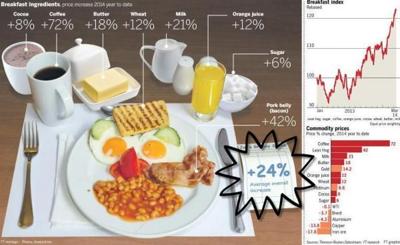
“Most data the government reports, and the media parrots, are rosy projections designed to make people feel good, but are nearly useless in reality,” he said. “While we are told ‘the budget deficit has been cut in half,’ it conceals the dangerous fact that the debt has nearly doubled in seven years (now over $18 trillion), which greatly hinders our security and economic future. … Inflation is reported to be 1-2 percent as now defined, when in reality, it is 9-11 percent as it used to be defined. This means that $1 last year is only worth $0.90 this year.
“Cost of living adjustments to pensions are usually based on the inflation rate the government reports, not the real inflation rate people experience, so people fall further behind each year. Unemployment is also reported to be 5.8 percent as now defined, when in reality, it is 21-23 percent as it used to be defined. Pretending there are no problems does not make them go away – it only prevents them from being properly dealt with.”
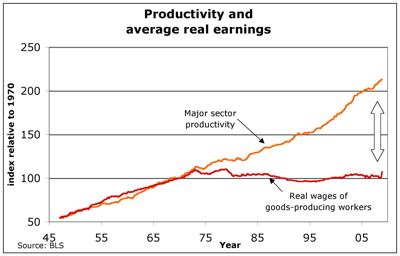
One of the biggest problems currently driving people to Lifeway is also stagnant wages. Since the Industrial Revolution wages increased with productivity in perfect correlation to one another, which led to the storied middle class era of the mid-20th Century. However, this relationship ended in 1979, and US workers have not gained any real value in their wages in spite of efficiency, profits, and stock values growing exponentially within that same period thanks to advancements in technology.
Todd Richardson of South Central Community Action has also bared witness to the upswing of people falling into poverty from the middle class.
“A lot of people locally are at a place now where they are going to get as good a job as they are going to find with their education, but they just don’t have the resources to cover their basic needs,” he said. “The ground beneath them has eroded away. The foundations of the middle class, like industry jobs, are gone from this area. You can say they should move, but that’s like uprooting a tree and hoping there’s a better spot to plant it someplace else that they’ve never seen.”
Visiting Lifeway or any other food pantry during opening hours gives visitors a more textured view of poverty.
Volunteers at the Lifeway Center say they had no idea of the scale of the problem prior to getting involved. One volunteer said he could not believe there were hundreds of people waiting for food right here in the United States. He’s been taking a couple days off every month since to keep coming back to help.
Although Lifeway’s operation spotlights the extent of the problems in Dent County, its leadership and volunteers reveal the solution: giving people hope through community teamwork.
“Legislation is not the only answer,” says Richardson. “Local teamwork can have a faster more effective impact. Churches, businesses, schools and other institutions working together in coalitions are what can really make the difference at the local level.”
The Lifeway Center is supported by a team of eight churches, seven individuals, four businesses, two local banks and multiple foundations that have been donating funds monthly. By sharing resources, these organizations have kept Lifeway’s doors open, the shelves stocked, equipment well maintained and the utilities paid, which is no small feat for a large building with an industrial-sized freezer. According to the Ozarks Food Harvest, the Lifeway Center is in fact the largest food pantry in operation in the 30-county area OFH serves in southern Missouri.
Among the many visitors who were impressed with the pantry’s operation was Joe, a new resident to Salem who moved in January from St. Louis. It was his first time at Lifeway.
“In the big city it seems like every church has its own little food pantry, but here it’s like one big supermarket,” he said. “They also let you choose what you want instead of just giving you a handout.”
The benefit of this community teamwork goes far beyond the simple sharing of resources. The comradery and genuine joy among the volunteers at Lifeway transcends the work at hand and instills a deep, family-like connection between the clients and workers.
“I’m a conservative with a military background,” says Stack. “Elizabeth here (the volunteer working the front desk) is a black woman from Chicago who was active in the Civil Rights Movement. But we are both on the same team.”
“It’s amazing,” Elizabeth adds. “It doesn’t always take money to make a difference. It takes will and a human heart full of love for our fellow mankind.”
A grey-haired woman with a cane and glasses standing nearby expressed her appreciation at the treatment she receives at Lifeway.
“When you come here they don’t make you feel like nothing, the people here all have a servant’s heart,” she said.
Stack continues, “One of our theme verses from scripture is Romans 15:13, which says, ‘Now the God of hope, fill you with all joy and peace in believing; that you may abound in hope, through the power of the Holy Ghost.’ It is much easier to provide hope to others when you have some yourself. We are all living in the same town and economy as those coming to receive help, and somehow we have an abundance of time and resources to share with them. It is our hope that the blessing we have found in serving God overflows to become a blessing in the lives of others as well. He is a never-ending source of refreshment that does not run dry, similar to the many spring-fed rivers that grace our region.”
In spite of all the systemic problems that exist in our economy and in our region, here is something that works. Thousands are fed every month, and the volunteers and the patrons leave happy.
“If we want to effectively address the issue of poverty we have to adopt a strengths-based perspective,” says Richardson. “We have to find what is working well and build on that. I work with a lot of struggling people, and they tell me they always get the most help during the Christmas season. Everyone is charitable and looks out for one another. Whenever I think about that I always wonder why can’t we take the Christmas spirit and make it last all year. Right now, it’s like having all these thirsty people by a hydrant and only letting them have a drink once every day.”
Like the Christmas spirit, Lifeway’s operation is not with us every day. It is open Tuesday – Thursday during the two first two weeks of the month. When in operation, it is one of the best community efforts in the region in concern to fighting poverty. The issue, however, is much larger than any one organization can address. Anyone visiting the food pantry next month will recognize in the faces of the hundreds assembled that many people are struggling, and it may take the teamwork of an entire community to save them.
Readers who would like to volunteer or make donations towards the Sheperd's Nook Food Pantry at the Lifeway Center can learn more about these opportunities at http://www.lifewaycenter.com/