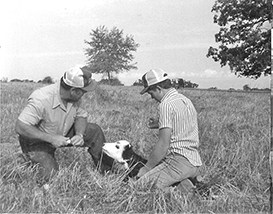
The following article appeared in the February 2012 edition of Missouri Beef Cattleman, where it was announced that George Barnitz of Lake Spring had earned the annual MCA Pioneer Award.
The Missouri Cattlemen’s Association Pioneer truly is one. George Barnitz can trace his agricultural roots back to 1867 when his great grandfather purchased the original ground that's remained in the family for 145 years.
“His family has been here forever,” says Ken Lenox, neighbor and farming partner. “I've known him all my life. Our fathers worked together on projects, and our grandfathers were doing all kinds of partnerships, just like George and I.”
As young men they went separate ways to find their way in the world. Lenox joined the Marines and headed to South America, while Barnitz, a few years older, took a job in South Missouri with University Extension. But then they came home.
“I got out of the Marine Corp in '65, bought the farm from my dad in '69 and then went into partnership with George in 1972,” Lenox remembers. “We were both ready to come back and ready to go into farming.”
Of Lenox, Barnitz says, “He's a fine partner and an awful good friend. He's like family. No - he is family.”
Though the lifelong friends live only two miles apart and have property and machinery in common, they also operate independently in South Central Missouri. The Barnitz Farm story picks up in 1977, when George took over the cattle business after his father passed away. Today, he and his son, Frank, manage 450 head of commercial black and red Angus, calving in spring and fall.
Barnitz Farms also custom-backgrounds calves for South Ozarks Premier Beef Marketers and operates its own saw mill.
Barnitz says nearly everything has changed over the years, except for a big old barn his grandaddy built in 1868 and the constancy of cattle.
“We were here when milking was one of the things everyone did, a lot went to chickens, then feeder pigs was the really sure money for a long time here in the hills,” Barnitz says. “You could run them with a minimum of cost. They paid the way when the kids were growing up. Now the hogs are gone. But the cattle have stayed pretty steady.
“The numbers and scope of the cattle operation, though, is significantly different. Today we have the equipment to handle more; and we can do it with the same or less labor. My dad had purebred Hereford. In the 50s, the maximum we could run was about 40 cows. Now it's something over 400. We've maybe only added about 250 acres to the original property, but we took timberland that was not producing and changed it to grass and improved the good stands of timber. We did a lot of spraying and bulldozing to add considerable more pasture.”
Unlike many who tilled up meadows this past year to plant corn or soybeans, Barnitz's intimate knowledge of the soil quality across his 2,400 acres helped him stick to grass.
“A lot of our land is not suited for crops,” he says. “Even as high as corn prices are now, we still can't compete with the more fertile soil that other farmers have.”
He's not too worried. He says his wife Liz and son Frank are great managers, and he's enjoying the cattle actually making money the past couple years.
“The beef cow business is not a real high profit thing, but we've about tripled our pasture and the production has increased by that much,” Barnitz says.
In good years and lean, Barnitz says it's what he loves.
“Really, just being able to do the things that you want to do and still make a living on it – that's the most successful thing I've done,” he said.
That success has been duly noted from outsiders as well. Barnitz is the recipient of numerous awards acknowledging his expertise in tree farming, soil conservation and beef cattle improvement as well as honors for volunteer service. He helped blaze the way for Missouri's Cattlemen Foundation by “being lucky enough to be on that first board.” And he remains active at every level of MCA and touches lives and impacts destinies with his foresight and hands-on involvement.
“The whole community respects him,” says Lenox. “If a neighbor is in trouble, George is the first one to show up and give help and support.”
Lenox adds that Barnitz has shaped generations for the better with his honesty and advice. “It's an untold number of students and youth that George has worked with. Not just in cattle, but teaching them integrity and how to make a decision. Coming to a decision in cattle judging is the same critical thinking we can use to pick a mate, or purchase a new pickup or farm. It's all a process. That's where he was an expert at working with the youth.”
“You just do the things that you need to and try to help anybody you can,” says Barnitz. “If I can help the next generation along, it just makes it that much better.”