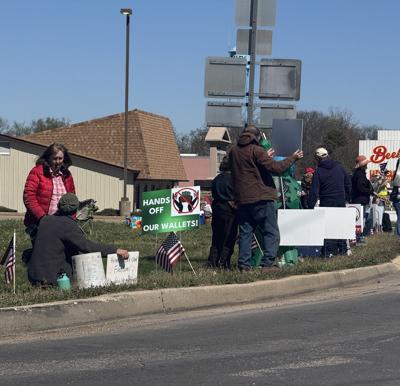
Salem, MO - On Saturday, a telling microcosm of the American political divide formed at the intersection of Highways 32 and 19.
As part of the nationwide "No Kings 3" mobilization—a movement organizers estimate has drawn millions across the country to protest recent executive actions—local demonstrators gathered in Salem, drawing both supporters and counter-portesters to the roadside.
For the organizers of the event, the goal was to push back against what they view as executive overreach. Rick Osa, chair of the Dent County Democratic Club, pointed specifically to recent U.S. military strikes in Iran and domestic executive projects as catalysts for the gathering.
“First and foremost, [the goal is] to raise awareness that the current administration is doing a lot of illegal and, frankly, corrupt things, and they're doing it in our name,” Osa said. He added that the movement is looking ahead to upcoming municipal and primary elections. “We certainly aren't anti-America. There's a lot of patriotism here, a lot of former servicemen... But we're definitely against the current administration.”
That perspective, however, was not met without disagreement. Dent County has historically leaned heavily Republican, with President Trump receiving more than 83% percent of the vote in 2024. As the rally progressed, there was staunch pushback from counter-protesters who felt the demonstration was misplaced, particularly following recent U.S. service member casualties linked to the conflict with Iran, as well as a long history of what they characterize as political pandering and grandstanding.
The ideological clash at the crossroads was most visible in the starkly different ways demonstrators viewed patriotism and military service. For counter-protester Morgan Jessen, the rally fundamentally disrespected the military.
“I honor those service members—they died defending the freedom for people to protest like this,” Jessen said. “But if we hadn't acted when we did against Iran, who knows what could've happened in the next few months?”
That sentiment was directly challenged by veterans marching within the protest. Dave Davison, another veteran demonstrating with the rally, pushed back against the idea that supporting the troops requires supporting the administration's military directives.
“He does not represent the troops with that statement. This 'No Kings' rally... represents the troops as much as [it represents] the people standing here,” Davison argued. “As a veteran, I disagree with the things that [President Trump] is ordering those troops to do. It creates havoc.”
Another veteran at the protest echoed concerns over the administration, stating, “One of the major reasons that we served was to ensure the right to vote—and I feel like
that’s being threatened. I also don’t vote for draft dodgers. That’s personal for a lot of veterans.”
Yet, beneath the sharp disagreements over foreign policy, a surprising parallel emerged: both sides expressed a profound distrust of political institutions.
For the organizers of the rally, this distrust is aimed squarely at the current administration, which they view as acting with unchecked power. But for Jessen, that same disillusionment with traditional politics is exactly what makes President Trump appealing.
“The government has been overstepping its bounds for a long time,” Jessen stated. “The big thing about Trump is that he's not a politician—he's a businessman. He's going to tell you what he thinks. Politicians don't do that—they don't tell the truth... I think the American people need a president who will fight for them and be honest, instead of making promises and not delivering. At least Trump follows through on what he says.”
Beyond foreign policy and executive style, the demonstrations also highlighted anxieties over domestic issues. Kourt Tiefenthaler, a Salem resident who previously ran for Dent County Commissioner as a Libertarian in 2020, attended the rally to voice fears over potential state-level cuts to Medicaid. While legally able-bodied for now, Tiefenthaler faces the prospect of losing healthcare access if the cuts advance.
“If that were to go into effect now... I would just automatically have no healthcare,” Tiefenthaler said. “How do you prove you're disabled if you don't have the healthcare to do so?” Tiefenthaler drew a line between these localized concerns and the broader national protests, arguing that federal spending on executive projects creates a disconnect while ordinary citizens struggle.
When asked if there is a way to bridge the gap between these deeply entrenched sides, demonstrators offered mixed outlooks on whether the current political climate allows for common ground.
Jessen expressed a weary view of the partisan landscape, suggesting that extreme polarization has made dialogue nearly impossible. “Right now, everyone is either far left or far right, and there's no common ground,” he said. “People rely on what others say instead of looking at the facts themselves... honestly, I don't know what would fix it.”
Conversely, the rally’s organizers argued that the issues driving their movement are actively crossing party lines. Osa noted that shared economic and international anxieties are beginning to blur the traditional red-and-blue divide. While acknowledging that Salem remains deeply conservative, he added, “I think they're very upset with the cost of gas. They're also very disappointed that a 'peace president' who promised no foreign wars has gotten us involved in what could be a very costly one.”
Tiefenthaler echoed this sentiment, suggesting that everyday citizens often share more in common than the political movements they are swept up in, pointing to their own political evolution. "I used to vote libertarian all the time, and now this will be my first year voting straight down the ticket Democrat."
The varied perspectives at the crossroads weren't exclusively political. A group of local women stood near the rally holding signs with religious messages. Amy Parson, one of the demonstrators, stated her group's goal was to spread love, though she expressed strong disapproval of the "No Kings" rally itself, labeling it a "hate group."
Even among the sharpest disagreements, however, there were brief glimpses of a desire for basic decency. “I can respect anybody as long as they're respectful to me,” Parson said. “Even if someone is disrespectful, I'm still going to respond with love... Everyone is allowed to believe what they want.” When asked about the nature of the demonstrations, Jessen remarked, “They have the right to protest—that’s fine. But I also have the right to come out here and protest their protest.”