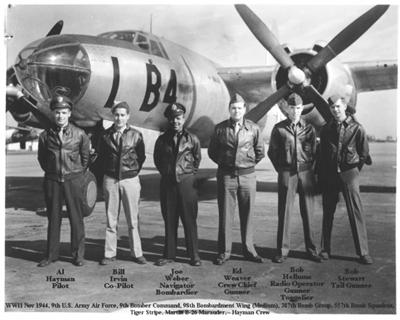
From July 4 through last week, The Salem News published a series recognizing World War II veterans with Dent County ties. The series was sponsored by The Bank of Salem and can also be found at thesalemnewsonline.com. Today’s first-person story written by Al Hayman just before he died March 7 at age 95, is the first in a series taken from Hayman’s remembrances. The following are memories from his service in the European Theater of Operations, involving the Rhineland, Ardennes, and Central Europe Campaigns as well as the post V-E Day occupation operation. He was a pilot in the 9th U.S. Army Air Force Command, 9th Bombardment Division, 98th Combat Bomber Wing (M), 387th Bombardment Group (M), 557th Bombardment Squadron – flying a B-26 Martin Marauder Medium Bomber, Squadron designated KS “Tiger Stripe.”
I was born Albion Seth Hayman at my parents’ home in the small town of Brookton, Washington County, Maine, in the far northeastern woods. I was known there as “Kinks” because of my curly blond hair. I was the second of six children born to Seth Harry Hayman, a World War I combat veteran.
After high school, I found a job in Houlton, Maine, driving a truck for Atlas Plywood Corp. The logging trucks were old Internationals and beat up. After the logging job ended, I received a scholarship to attend the University of Maine at Orono. That year nearly all my friends left to go into military service before the school year ended. I enlisted in the U.S. Army Air Force as an Army Private on May 15, 1942. They informed me at the swearing in that I would be called to duty soon.
Waiting for call up in the summer of 1942, I got a job as a ship-fitter at Todd Bath Shipyards in South Portland, constructing and building World Was II Liberty Ships. I was finally called to duty in February of 1943. First stop was the Boston Armory where I was inducted into the Army. We newly inducted enlisted men were sent by train to Atlantic City, New Jersey and because of ROTC they made me drill instructor. I did KP there one time, too, washing pots and pans. We shipped out of Atlantic City by train and went to Syracuse University in New York where we studied college courses in weather and also trigonometry. We were reclassified from privates to Aviation Students. While there we took 10 hours of dual flight time in Aeroncas and Piper Cubs at Rome, New York Air Base.
My initial flight was with a “mad man” who did stalls, spins and hedge hopping. I got air sick and threw up all over the inside of the airplane. No further problems while flying after that.
We finished Flight Cadet Training April 14, 1944, got our wings and decond lieutenant gold bars at Pampa, Texas, were then discharged and then enlisted again April 15, 1944 and placed on Active Duty as a Second Lieutenant in the U. S. Army Air Force and received two weeks leave at Pampa. During that leave Fae and I were married in Maine April 23, 1944, because of the waiting period in Missouri. Returning from leave I took the train to Del Rio, Texas (Fae later) and Laughlin Field for training in the B-26 bomber.
I recall one flight that I took when my instructor went to sleep in the nose. I saw a nice puffy cloud and decided to check out all that weather knowledge I had learned. I flew into the cloud and got a heck of a beating. It was all ups and downs that I couldn’t control with the throttle; with rain and ice beating on the plane. The instructor in the nose got soaked. We finally got clear of the cloud and landed. The instructor was angry and several holes were exposed where the leading edge of the wing had been taped to cover the holes for gun posts. The plane looked like it had been beaten with a ball-peen hammer. The instructor ordered me to take the plane back up and I refused until they patched the holes. He finally agreed.
As part of our training we did a lot of on-the-deck flying. One of my buddies led us down into a ravine while two of us were flying on his wings and we couldn’t get down in the ravine with him—it was too narrow. We also had fun getting windmills to rotate fast from our prop wash and could run goat herds all over yonder.
We finished our crew training at Lake Charles and were shipped as casuals to Savannah, Georgia. We stayed there about a week and then were shipped to Camp Miles Standish south of Plymouth, Mass. There some Major appointed me supply officer to get everybody equipped for overseas, thankfully the beginning and end of my Quartermaster duties. From there we were shipped to Fort Dix, New Jersey then in New York City boarded the Ile de France, a luxury liner that had been stripped down. We crossed the Atlantic in about a week.
I guess you could say my first combat experience was at the end of that week when we passed through the Irish Sea as we arrived at Glasgow Scotland in late November 1944. On the way across the Irish Sea British destroyers were dropping depth charges beside and behind, near and far from our ship because enemy subs were detected. We were landed by lighters at the end of a dock and had to carry all of our dunnage to a train about a quarter of a mile away. We then went by train to Newcastle Stoke on Trent and were housed in stone barracks with no heat and snow outside on the ground. We stayed there a week or so and then were flown by C-47 aircraft transport to Field A-71 at Saint-Quentin in Northern France in early December and later to a former wheat field in Beek Holland near Maastricht with a steel mat runway.
I was at this point assigned to the 9th U.S. Army Air Force Command Wing. We were to provide the army ground forces with support by bombing rail yards, bridges and munition plants. When we arrived at A-71 the squadron was just returning from a mission and red flares were flying all over the place, indicating wounded on board and the planes were running off the sides and ends of the runways. It was a shocking second introduction to combat.