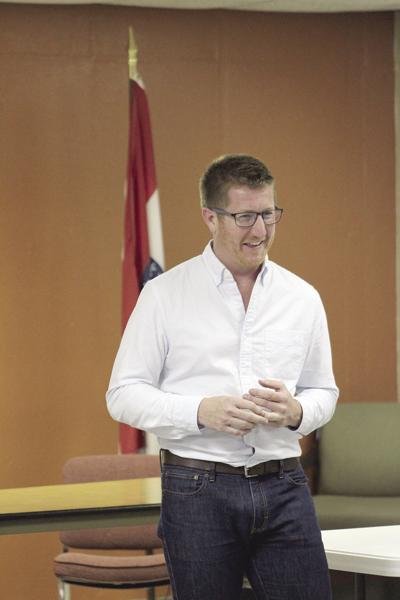
Ryan Dillon spent the first day of October like he has most days the past 23 months, on the campaign trail. He opened the day in Salem, and after a brief pit stop in Rolla, headed to Waynesville to host a town hall with local voters. It was the 20th town hall Dillon has hosted in the 16th District as part of his latest listening series. A total of 36 are planned before election day.
After a career of working behind the scenes for other politicians, Dillon is stepping into the candidate role for the first time. He invited Phelps County Focus to join him Oct. 1 to learn more about who he is and why he wants to be a state senator.
“I think it’s fitting we’re interviewing in this car,” Dillon says on the way to Waynesville. “I’ve spent a lot of time in here, and it’s reflective of this campaign. I have crisscrossed this district many times and have made an effort to visit each of its cities multiple times. Each day, I continue to be inspired by the people I meet.”
Dillon graduated from Rolla High School with the Class of 2002 and later obtained a degree in political science from Westminster College in Fulton.
“My first post-college job interview was at the annual Missouri State Fair ham breakfast. I was there to talk with Rep. Ike Skelton,” Dillon says. “The interview went well. At the time, I didn’t understand the magnitude of speaking with someone who would become the chairman of the House Armed Services Committee. I think it was because he was such a gentleman, and more like a grandfather. Later, I was driving home from the interview when he called me to say ‘Welcome to the team, you start Monday.’ I literally packed everything up in a couple of days and moved to our nation’s capital at the age of 22.”
Dillon says Skelton’s approach to being a rural Democrat has defined his own approach to leadership.
“One of the things I learned from Ike was how to build bridges to effectively implement public policy,” Dillon says. “He was able to bring the most conservative members of the Republican caucus and the most liberal members of the Democratic caucus to the table and say, ‘Look this is what we have to get done for our men and women in uniform.’ To watch him in that environment and to learn from him is one of the most profound experiences of my life.”
Dillon began as a staff assistant in Skelton’s office and was later promoted to its administrative director. However, after 34 years in office, Skelton was defeated in the Tea Party wave of 2010. Dillon remained in his employ through his transition to private life. Later that year he took a job in the U.S. State Department working with Ellen Tauscher, the Under Secretary of State for Arms Control and International Security Affairs.
“When I worked with Secretary Toucher she had just returned to work after surviving a bout of esophagus cancer,” Dillon says. “My impact really came with helping her balance her health with her workload. She always gave 110 percent, and it was a busy time with tensions in Eastern Europe and the strategic arms limitation talks going on.”
Dillon later left the state department to take a job working with Rep. Russ Carnahan. In that role, he helped craft the first epilepsy awareness legislation in Congress. It meant a lot to Dillon as he’s had the disease his entire life.
“I had my first seizure at two months old and was diagnosed with epilepsy at 14 years old,” Dillon says. “I’m proud to say I worked with Congressman Carnahan and Congresswoman [Joann] Emerson to craft and introduce the first epilepsy awareness bill ever introduced into Congress. The reality is one in 10 Americans will have a seizure in their lifetime and one in 26 will be diagnosed with epilepsy. That’s why awareness is so important, and knowing seizure first aid is even more essential.”
After Carnahan’s defeat in the 2012 primary election, Dillon worked at the Washington D.C.-based nonprofit Human Rights Campaign. He then returned home to Missouri in 2015 to pursue a graduate degree from American University through online courses. He’s specifically studying international relations, global security and terrorism.
After a year of courses and substitute teaching to pay the bills, Dillon decided to reenter the political fray.
“I knew in November of 2016 that this was going to be an open seat. After that I began reflecting on my personal experiences of growing up in Rolla and Phelps County and my professional experiences working for Ike,” Dillon says. “I’ve always had this dream to run for office, but I knew it would have to be the right race at the right time. I want to be able to have an impact on my community and effectively advocate for policies I believe in. With Fort Leonard Wood here, and based on my experience with the armed services committee and in the state department, I think I am a good fit to be an advocate for this district.”
Before the town hall, Dillon deferred to give any campaign promises to The Phelps County Focus, saying instead that he’s focused on Nov. 6. To the town hall’s attendees, however, Dillon laid out many of his top policy areas.
“There are a lot of concerns and challenges in our communities when it comes to public education, access to affordable patient-centered healthcare, infrastructure, jobs and combating the heroin and opioid epidemic. My approach is to listen and respond. I want to understand the challenges of the public-school teacher who is doing more with less, or the person who has a preexisting condition, like I do,” Dillon said. “I believe good ideas transcend partisanship, and my job as a state senator will be to bring folks together to have a conversation about what we can do. I always tell people a pothole isn’t a Republican or a Democrat. I think people are looking for solutions right now.”
The Waynesville town hall wrapped up after an hour of discussion. Dillon thereafter headed home eastbound on I-44 as the sun set to the west. He would be teaching seventh grade history the following day.
“Teaching helps reinforce why I am running in this election,” Dillon says. “It breaks my heart every Friday when I see that first grader take home that plastic bag of nonperishable food and knowing that’s their only lifeline to Monday. That’s not okay, and that should not be our normal. When those kids walk through that door they should have more opportunities than I had when I went to school there.”