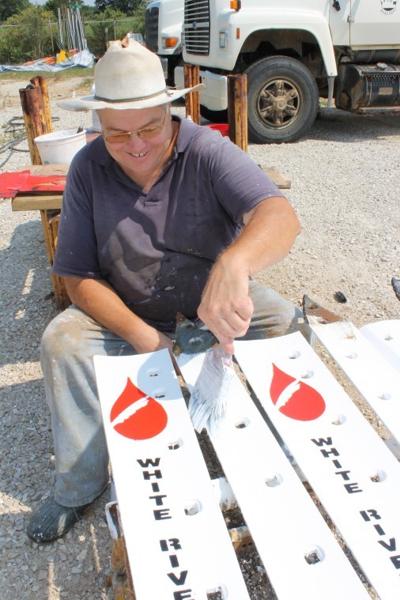
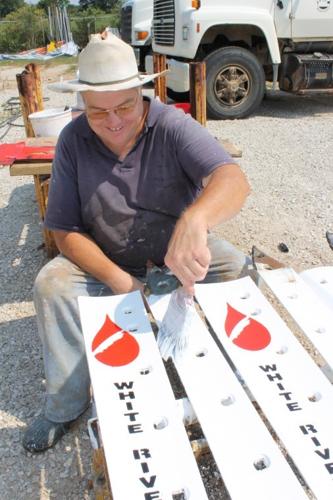
Dennis Hayman is relentless in his volunteer efforts to re-establish the White River Trace-Trail of Tears through Dent County.
Hayman, a member of the Dent County Historical Society, began seeking funding for the project a year ago and has been working on this volunteer project all summer.
He painted and is now finishing installation of new signs marking the trail for future generations.
"Seventy of the markers are already installed. I should be finished within the next week," Hayman said Tuesday. "It's been an educational venture, and the trail will always have historical importance."
The Dent County Commission provided 74 used grader blades for the project and the Dent County Tourism Tax Committee authorized $1,500 for paint and materials for the trail markers and two signs commemorating the Trail of Tears. The Salem Area Chamber of Commerce funded the project initially until Tourism Tax funding was appropriated.
Hayman is donating his labor. He had assistance installing some of the signs from his father, Al Hayman, and from a county community service worker.
Hayman submitted an application for funding of the Dent County Historical Society project to the Tourism Tax Committee about a year ago. Originally he planned to replace just the two deteriorating signs commemorating the Trail of Tears located on Hwy. 19 North and at the Indian Trails Conservation Area. He then decided earlier this year that all of the original 65 trail markers needed to be replaced. Most were unreadable and some were missing or damaged.
"The Trail of Tears (White River Trace) was the first official road here by act of Congress," Hayman said.
He began preparing the old grader blades for installation in early July. The blades required extensive rust removal, then painting and and a tear drop and a feather design was stenciled on the markers and the Dent County Tourism Tax logo also was included.
Hayman said his next project is to seek Tourism Tax funding to place two additional commemorative marker signs in other locations of the county.
The trail through the county is one of the branches of the Trail of Tears, which brought many Cherokees on their forced 1,000-mile trek to Oklahoma. In 1838, the Cherokee people were forcibly removed from their lands in the Southeastern United States to the Indian Territory in Oklahoma, which resulted in the deaths of approximately 4,000 Cherokees.
Historians documented that Peter Hildebrand's group of 1,766 Cherokee made the trip through Dent County, some stopped here and many old families are proud of their Cherokee heritage. The Cherokee family of Billy Wade (Watie) Watson settled in Dent and Shannon counties in the 1840s and descendants still remain in the area.
The local trail winds from Indian Trail State Park southwest to the Ephraim Bressie Farm on Spring Creek north of Salem. It leaves the county at about Maples.
The trail was originally marked in 1986 by members of the Dent County Historical Society. The project was researched and coordinated the late Bob Runner and Ed Ray, and Al Hayman, Ed Gill, Ken Fiebelman and Kathy Love. The project was partially funded then by a grant from the Missouri Committee for the Humanities. Deloris Gray Wood currently serves as president of the local group.
Dennis Hayman says that while there will always be dispute about the exact location of the trail, he placed the new markers on the original locations that were determined by Historical Society member research and the 1844 Missouri map. He also made sure additional markers were placed where the trail crosses public roads in the county.
Hayman, a retired Washington Pentagon electrical engineer, moved back to Dent County in 1996. His parents, Al and Faye Hayman, have long been supporters of efforts to re-establish the Trail of Tears trace here. The Haymans were among other veteran members of the Dent County Historical Society who helped locate and mark the trial during a lengthy project in the mid-1980s.
Hayman said once the project is complete he plans to have all of the information documenting location of each trail marker and a compilation of historical data about the White River Trace portion of the Trail of Tears available on the Salem/Dent County website.