Research has shown that a great education consists of two key elements among others, a quality teaching staff and the classroom environment. A new Salem R-80 School District cell phone policy is very much inclusive of a non-disrupted learning experience, according to principal Marty Anderson.
“The primary purpose of the district wide cell phone policy is to protect and preserve a non-disruptive learning environment,” says Anderson. “Very secondary, as a residual benefit is getting our kids ready for work. As our mission states, Prepare, Strive, Succeed, and we believe that we need to prepare our students to be work ready with skills needed for employment. Students must be able to stay on task throughout the day.”
Employers agree that this is an issue that is prevalent in the work force, employees having the ability to stay on task and maintain their concentration to complete the job. R-80 is being proactive in teaching responsibility and self-control in regards to cell phones and electronic devices, according to Anderson.
Anderson, a 12-year veteran principal, says R-80 has had a cell phone policy in force prior to 2015, but the upcoming school year policy and procedure is more defined to allow the students to make choices while remaining within the guidelines.
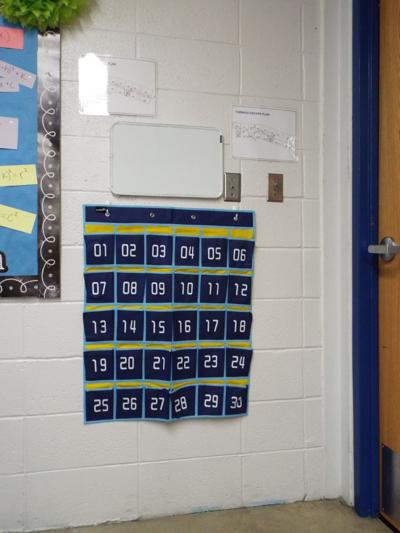
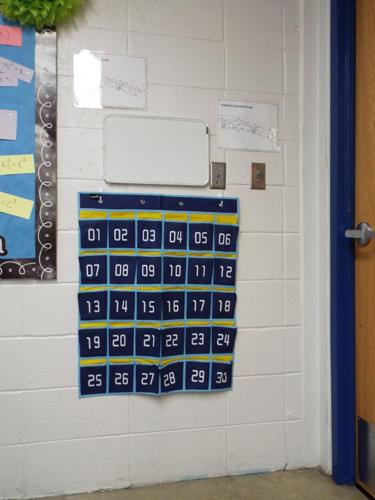
This year utilizing a Cell Phone Caddy is a new option for students to help stay in compliance with the cell phone policy and procedure guidelines. The caddy is placed in what is called the cell phone zone, also new this year, which teachers have been asked to place in front of the desk where there’s no traffic.
“Students can choose to put their phone in the phone caddy,” Anderson said. “It’s a safe zone, or not, either way is fine. It works really well, everybody can keep their eye on their phone, and it prevents issues with the phone walking away, although we have never had any problems with phones walking away. Each classroom will have a cell phone zone.
“The cell phone zone is a voluntary deal. We want to give students a strategy, that if they choose to utilize it, then they can’t be in violation of the cell phone policy. A lot of employers do this. What we want to do is teach responsible behavior, maybe they can be responsible with it in their pocket, but this is an option. Let’s say that the phone vibrates, it’s in their pocket. That’s a cell phone violation, if it’s in the phone caddy and it vibrates, no disruption, no violation, because they’re making an effort.”
The cell phone and electronic device policy remained the same as it had been for several years, only changing last year to let teachers choose to allow cell phone usage for academic purposes.
In part to alleviate the need for individual cell phone usage, R-80 has initiated a three-year 1:1 technology plan.
“Beginning this academic year we’re bringing in some 140 new Chromebook computers for the ninth grade students,” said Anderson. “What that does is drop our ratio to 1:2, one computer for every two kids this year. So we don’t need the cell phones to be used for academic purposes. The second year of the initiative ninth, 10th and 12th grade students will be assigned a Chromebook. As of year three all high school students will have an assigned Chromebooks.
There’s still a way to communicate with students. Direct communication up to 8:09 a.m., 25 minutes during their lunch period and after 3:06 p.m., or all the parent would need to do is call the high school office at any time during the day in order to communicate with their student.
“Roughly three and one half hours is what we’re asking them to depart from that technology,” says Anderson. “When they exit the cafeteria, they are to put it away until 3:06 p.m. when they exit their last class, again roughly three and one-half hours without the cell phone.”
Some employers have a policy that if you use your cell phone on company time you will be terminated. So can the student have the self-discipline not to use the cell phone? Anderson hopes this policy helps them to develop that self-control.
There is protocol and procedure for cell phone and electronic devices. All confiscated phones will be sealed in a 6 x 9 envelope. It gives the student and parents’ peace of mind that their phone has not been violated while out of their possession.
“The middle school has the same policy and procedures regarding cell phones and electronic devices,” said Scott Roberts, Salem Middle School principal.
Roberts estimates is 95-99 percent of middle school students have a cell phone and says the majority of discipline issues at the middle school are cell phone related because the student has forgotten to turn the phone off.
Clear communication about the new policy will be repeated multiple times for the middle school students as well as high school students.
“The cell phone policy is a learning curve for our kids because by the time they get to me, they’ve had a cell phone for some time, some as young as eight or nine years old,” Roberts said. “Our society today almost makes cell phones a top priority, almost as important as bread and water.
“The new policy should not be a problem for my sixth graders as it will be brand new, but it will be very different for my seventh and eighth graders. I feel they will adjust and adapt within the first month, and then I don’t anticipate any problems.”
To read more about the cell phone policy go to salemr80.org.