Few people flush their toilets and whilst washing their hands contemplate a complex system that requires precise engineering and even more precise biology to achieve. After all, who wants to think about all that crap, or where it goes?
But someone has to think about it. That’s exactly what they think about every day at the wastewater treatment facility, and it’s the least the rest of us can do to think about it from time to time.
From the moment you flush your toilet, the waste begins a journey that takes it from your home’s plumbing system and into the city’s pipes where it summarily flows to the wastewater treatment facility, where it is subsequently cleaned up and eventually outflows into Spring Creek—even for those of us who might realize the importance of such a process that’s generally where our understanding ends, but there is a process with many steps that make this possible.
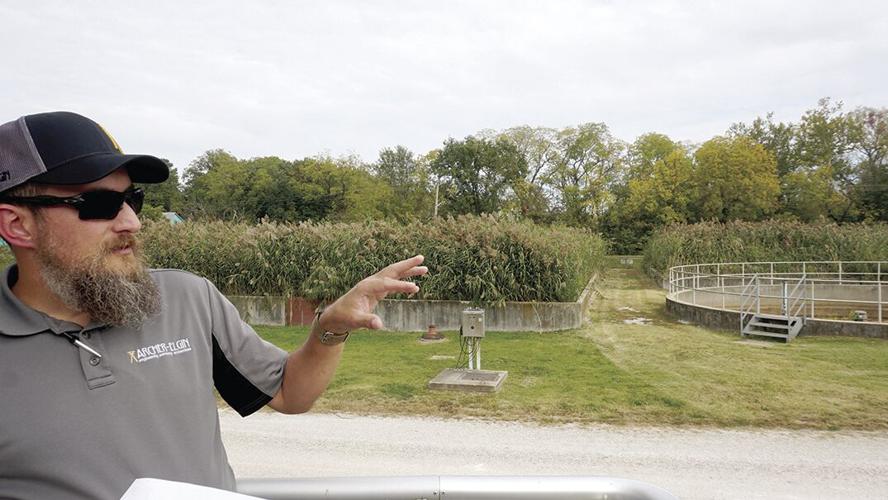
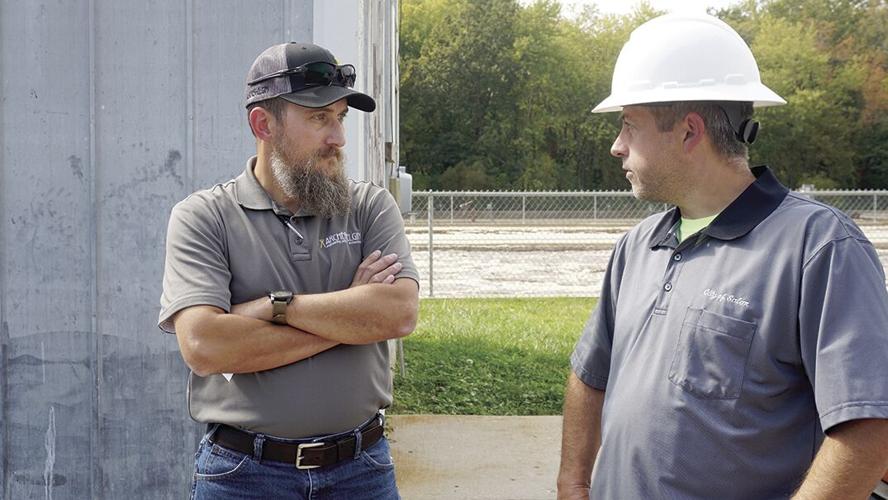
Ken Campbell of Archer-Elgin Engineering gave The Salem News a tour of the wastewater treatment facility.
Raw sewage enters the plant by way of the Influent Pump Station, where it is immediately filtered of any large debris that could damage the pump equipment—debris such as rocks, dimensional lumber, bed sheets, etc.
Smaller solids, such as rags, feminine hygiene products, needles, and grit, pass through the trash basket and are pumped to a slightly higher elevation with wastewater through the headworks. From there the wastewater is gravity-fed through the rest of the facility.
Coarse solids are removed from the raw wastewater with a mechanically cleaned fine screen.
The coarse solids are washed and dewatered for disposal at a landfill.
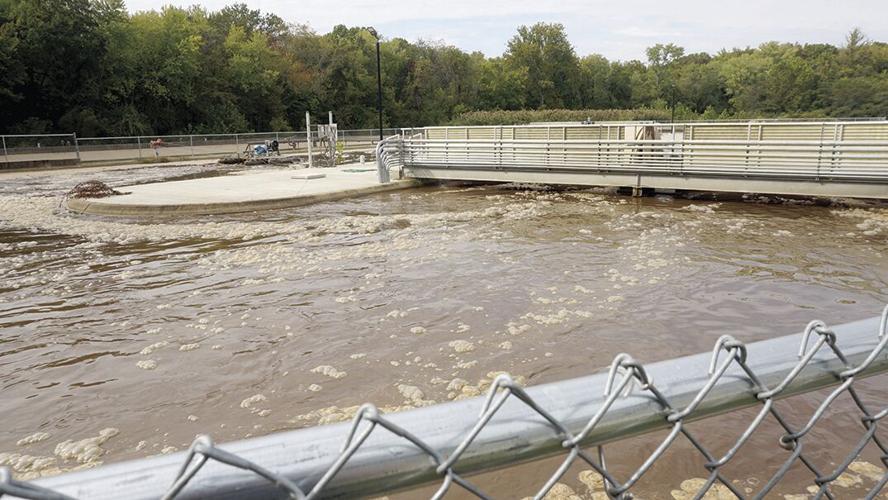
Next, the wastewater runs through the “oxidation ditch” which looks like an aquatic dog racing track.
After passing through the oxidation ditch, the sewage is at a stage called “mixed liquor” which Campbell explained consists of bacteria, archaea, protozoans and metazoans (i.e. biomass), as well as wastewater with carbon, nitrogen, phosphorus, sulfur compounds. The biomass consumes the carbon, nitrogen, phosphorous, etc., to clean the water and produce more biomass.
Next, that “mixed liquor” runs through a “flow splitter”, where management can control how much of it runs into each of three secondary clarifiers. These clarifiers are intended to be very still, allowing the liquid to separate from the “sludge”.
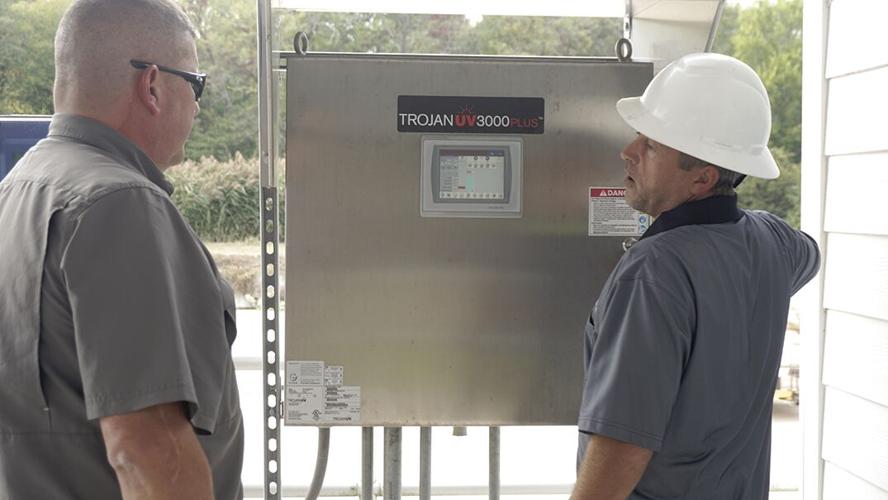
From there, the liquid runs to the intermediary pump station where it runs through ultraviolet radiation—the final step before effluence enters Spring Creek.
“UV radiation is utilized for disinfection as it does not require the use of dangerous chemicals that can cause harm if released to the environment,” said Campbell. “The radiation unzips and damages the DNA of pathogenic organisms so they cannot reproduce. This assures a reduced likelihood that parthenogenic organisms are discharged to the environment,” he said.
“Waste biomass (“sludge”) is sent to the aerobic digesters where the biomass cannibalizes itself,” said Campbell.
“This stabilizes the biomass, reducing the quantity of parthenogenic organisms, limiting purification potential, and eliminating vector attraction,” said Campbell. The digested sludge is then sent to sludge reed beds, where reeds are used to take-up heavy metals and dewater it. Dewatered sludge can then be applied on land as a solid.
The Missouri Department of Natural Resources is obligated by federal law to put the effluent limits identified in the TMDL in the city’s next discharge permit. If the City of Salem does not meet the effluent limits in their discharge permit within the allotted timeframe, it will be subject to significant daily fines of potentially thousands of dollars for each day they are out of compliance. If this occurs, the city’s user rates would have to be increased to pay for the fines.
Currently, nitrogen and phosphorous loads of the treated wastewater are higher than Environmental Protection Agency guidelines require.
According to Ken Campbell of Archer-Elgin Engineering, the planned upgrades will reduce nitrogen and phosphorous loads to Spring Creek which can cause algal growth that depletes dissolved oxygen and harms the aquatic ecosystem.
“Phosphorus is a limiting nutrient,” said Campbell, who then explained that coagulant would be “added to the mixed liquor to facilitate its precipitation in the secondary clarifiers,” he said.
In short, upgrades will lower the phosphorous and nitrogen levels of treated wastewater released into Spring Creek.
In detail:
“Polishing shall occur at new tertiary surface filters,” said Campbell.
According to Campbell, nitrogen removal will be achieved by cycling the oxidation ditch aeration equipment through aerobic (oxygen present) and anoxic (oxygen not
present, but nitrate present) conditions. By changing environmental conditions
in the oxidation ditch, we can manipulate the biomass to utilize different
nutrients.
“Tertiary filters shall remove residual solids that cannot be removed in the secondary clarifiers. The solids will contain residual nitrogen and phosphorus components that will also be removed.
The wet weather treatment train shall be disinfected and blended with main
treatment train effluent,” said Campbell.
Over the past five years the City of Salem has $4.4 million invested in Phase 1A & 1B.
Phase 1 included a new intermediate pump station, new UV disinfection, a new
headworks facility, various hydraulic improvements, a RAS/WAS pump station replacement, aerobic digester aeration improvements, and rehabilitating the sewer collection system.
The total cost estimate for Phase 2 is $9.5 million—with 2A expected to cost approximately $5.1 million and 2B expected to cost $4.1 million.
Phases 1 and 2 are intended to meet disinfection limits and the requirements of a 2012 Voluntary Compliance Agreement, steps toward TMDL compliance and rehabilitation of the aged equipment and infrastructure of the existing WWTF. The intent for Phase 3 is to fully meet the limits presented in the TMDL. The City has proposed to MDNR to complete Phase 3 by 2048. This will provide time for the City to pay down the debt from Phase 1 and 2, allowing room in the rate structure to secure additional debt for Phase 3.
“We are in a unique time for wastewater funding,” said Jeff Medows of Archer-Elgin Engineering.
“There are a few potential opportunities for grant funds in the next couple of years. The City has applied for $5 million in State of Missouri ARPA grant funds, which if awarded, would apply to Phase 2A, with the balance being paid from the City’s sewer account.
“Next, the City will apply for MDNR’s State Revolving Fund (SRF),” Medows explained.
This would require the citizens of Salem to pass a Revenue Bond Issue.
“With an approved bond issue, the City would be eligible for a loan where 70% of the interest rate is subsidized by the government, as well as water quality incentive grants and affordability grants through the SRF program,” said Medows.
According to Medows the amount of the SRF loan would be dependent on whether the City receives the ARPA grant.
The long and the short of this matter is that upgrading the wastewater treatment plant is an inevitable process that takes many years to accomplish, and is a process that requires significant long-term planning on part of city staff and officials.