A fiscal crunch that threatens to consume Missouri’s remaining general revenue surplus reduced — but did not eliminate — budget earmarks that send money to politically favored projects and organizations.
The Missouri House on March 31 gave first-round approval to four spending bills for state maintenance and construction projects which were greatly pared down from previous years. The appropriation measures add $2.5 billion to the $50.4 billion operating budget sent to the state Senate last week.
But instead of almost 250 earmarked items, the number approved last year, or almost 400, the number of special appropriations in the budget approved in 2024, the capital spending bills debated March 31 contained only 10 new earmarks. Most are new, but some are items revived, at a reduced amount, from a bill that had more than 100 earmarks that the House refused to pass at the end of last year’s session.
Even that smaller number, for the most conservative lawmakers, was too much.
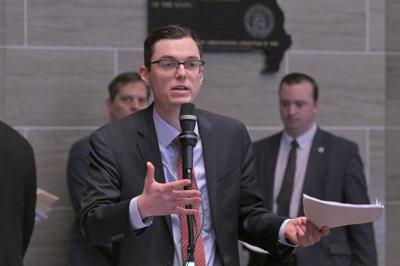
“We don’t have a revenue problem, we have a spending problem, and that’s what it comes down to today,” said state Rep. Tony Harbison, a Republican from Arcadia. “We don’t have the money to fund these projects.”
Most of the $2.5 billion is spent in a bill that uses remaining funds from Missouri’s $2.7 billion allocation from the American Rescue Plan Act, a COVID-19 recovery bill passed in Congress in 2021. The bill includes $1.3 billion of those funds, plus $324 million of general revenue. Most of the projects in the bill were originally appropriated in 2021 and the bill’s total represents the remaining money to finish construction.
The next largest chunk is $638 million, including $137.2 million in general revenue, for major maintenance needs at state facilities.
The bill allocating funds for new construction is the smallest in years, just $123.8 million total, with only $27.3 million from general revenue. The bill includes a handful of items that were in the failed $513 million bill from last year.
The largest item in the bill is $104.1 million for major renovations of the Capitol Building.
Lawmakers put $134 million from that bill into a spending bill passed in June during a special session called to provide incentives for the Kansas City Chiefs and Royals to remain in Missouri.
Items that were in the failed bill from last year that made it into this year’s construction budget include $250,000 to help rebuild a sheltered workshop in Salem destroyed by a fire in December 2024, $1 million for the Springfield Discovery Center and $4 million for downtown redevelopment in Cape Girardeau.
In last year’s failed spending bill, those projects were allotted $2.5 million, $2 million and $20 million, respectively.
New items added in the House Budget Committee include $2.5 million for renovating a building at the Sikeston Career and Technology Center, $3 million for a joint wellness center operated by the St. Louis Police Foundation, $1 million for the Ronald McDonald House in Kansas City and $250,000 for a law enforcement training center in Lee’s Summit.
Lawmakers started sprinkling earmarks into the budget in large numbers in the 2022 session and the trend continued through last year.
The state treasury accumulated a surplus that peaked at $8 billion at the end of fiscal 2023. As of Feb. 28, the total remaining was $3.9 billion, but projections for declining revenue this year and sluggish growth in the future show the surplus declining to about $265 million on June 30, 2027.
“Unlike the last several years, we’re seeing less of these,” said state Rep. Dirk Deaton, a Seneca Republican who chairs the House Budget Committee. “That’s going to be expected just because of the fiscal budgetary constraints we’ve talked about.”
The four bills debated March 31 included an appropriation measure to continue projects currently underway. That bill is usually routine, but state Rep. Stephanie Hein, a Springfield Democrat, said lawmakers should consider cutting projects that haven’t been started.
She said there were $11 million worth of projects that have yet to begin.
“As we move into tough financial times,” Hein said, “I would encourage future bodies to really keep an eye on this bill as we are holding general revenue in place for some of these projects to get off the ground.”