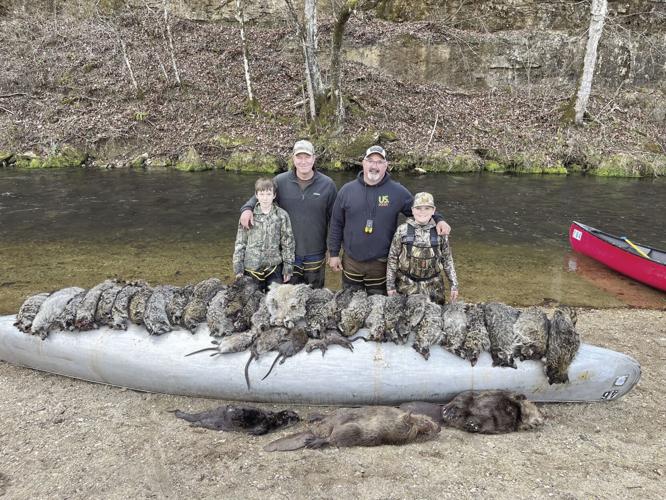
Tim Cahill (second from left) submitted photos from a recent trapping trip he took near Montauk State Park with his son, Phillip, and friends, Brian Glenn and Justin Fleener. The group had a substantial haul of racoon, beaver, muskrats, and other furbearers.
Tim Cahill (second from left) submitted photos from a recent trapping trip he took near Montauk State Park with his son, Phillip, and friends, Brian Glenn and Justin Fleener. The group had a substantial haul of racoon, beaver, muskrats, and other furbearers.
Trapping of animals has likely been a part of Ozarkian culture since humans first began inhabiting the area. Once, Native American tribes and early European settlers relied on the practice for the very clothes on their backs. As trade routes opened up to the west, the furs became a powerful economic commodity, with expedition parties traveling up north along rivers such as the Missouri in hopes of bountiful trapping.
Today, the need for the practice as a condition of survival is a thing of the past for most in the United States. Modern agricultural practices yield an excess of cotton, wool and a variety of synthetic fibers that we use in our winter gear as opposed to beaver pelts. Though fur is still considered a luxury fashion item, the status of trapped pelts as an economic commodity has fallen far from its peak. However, trapping is still an important part of conservation practices, and there are those who keep the skill alive.
Tim Cahill of Phelps County, formerly of Salem, shared some photos from a recent trapping trip he and his son, Phillip, took with friends Brian Glenn and Justin Fleener. The group trapped from below Montauk to Baptist Camp on the Current River, according to Cahill, and reportedly found great success.
Cahill retrieves an animal from one of his sets.
Submitted Photo
“In two nights, we caught 54 raccoon, three beaver, three muskrats, two otter, and one mink,” wrote Cahill in his submission to The Salem News. “Thought that might be neat to put in the paper to let people know this kind of stuff still happens.”
While no longer a common practice, trapping is still a rewarding pastime that can be enjoyed by Missouri outdoorsmen. The Missouri Department of Conservation offers several trapping seasons each year, with dates, species, and bag limits listed on each year’s Summary of Missouri Hunting and Trapping Regulations. This year, badger, gray fox, and red fox can be trapped from Nov. 15, 2023 to Jan 31, 2024. Bobcat, coyote, mink, muskrat, and river otter may be trapped from Nov. 15, 2023 to Feb. 29, 2024. The first season for trapping opossum, raccoon, and striped skunk has already passed, though the second season began on Nov. 15 and will run until Feb. 29, 2024. Beaver and nutria may be trapped until March 31, 2024, and rabbit season runs until Jan. 31, 2024. The summary lists further limitations and bag limits. Some species which may not be taken include jackrabbits, mountain lions, spotted skunks, and weasels.
According to the trapping section of Missouri Department of Conservation’s (MDC’s) website, Missouri, unlike other states, does not require trappers to attend a trapper education class before they are allowed to trap, and that might make it difficult to “learn the ropes”. The website offers a variety of information on the topic of trapping, including directions to other online resources, to help new trappers get up to speed.
According to the MDC, beginning trappers should start out with basic gear needed to trap one or two species.
“Buying new equipment for a variety of species can be expensive, so you should learn to be successful with basic gear before you invest too much. As you gain experience you will develop a better sense of the gear needed for other types of trapping,” reads the website.
New trappers will need several items to get started. State Law requires the trapper to have his or her name and address or conservation ID number attached to each trap in a permanent way. A laminated or weatherproof tag with permanent marker may be used. Trappers will need trap stakes and grapples for the specific furbearer and soil conditions they will be encountering. Pliers and cable cutters are needed for trap adjustments and cutting and bending wire. A hatchet is needed to cut limbs, drive stakes, chop ice, and make certain types of sets. Wire or aircraft cable, (3/32”- or 1/8”) can be used to make submersion sets or fasten traps. A walking stick (or trapping staff) is needed for many things, including checking water depths when wading, detecting underwater dens, retrieving traps from water, or dispatching animals caught in some types of trap. Other recommended items include a trowel, pack basket, bucket, or heavy bag; A couple of good knives, a dirt sifter, catchpole, waders, and gloves.
There are several types of trap setups available to trappers. Foothold traps, also called “leghold” traps, are designed to catch an animal by the foot and restrain it. Body-gripping traps, also known as Conibear traps, are the most commonly used killing trap; When an animal triggers the trap, two rotating jaws close. In Missouri, these are most commonly used in water to trap mink, muskrat, beaver, and otter. Cable restraints, another kind of trap, are made from a loop of multi-strand steel cable, which the animal steps into, tightening the trap. Cable restraints are recommended by the MDC for coyotes and foxes in Missouri. Cage traps, sometimes called box traps or live traps, are used to take animals alive. These can be used safely in areas where the likelihood of accidentally catching a domestic animal are high.
To learn more about trapping and how you can get started, and to get your trapping permit, visit the Missouri Department of Conservation’s website at mdc.mo.gov. Special use permits are required to trap in conservation areas. MDC offers free trapping clinics throughout the year to educate the public on the practice. According to MDC, classes vary, but many offer hands-on trapping, skinning, and fur preparation experience. For information on free trapping clinics, contact your regional MDC office.
John Hewkin has been a sports fan since he was a kid. He’s played, coached and been a fan of sports. I was a sports writer for 15 years before moving back to Missouri, but to this day you will still find me in my man cave a lot of nights and weekends watching something that requires a ball.