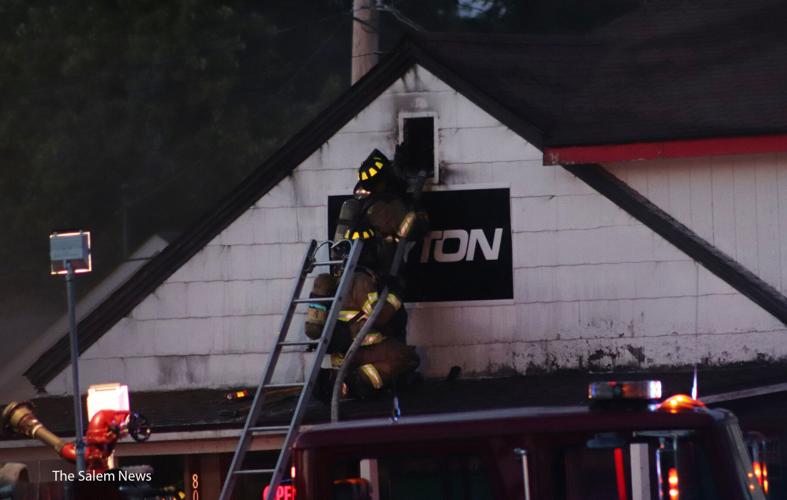
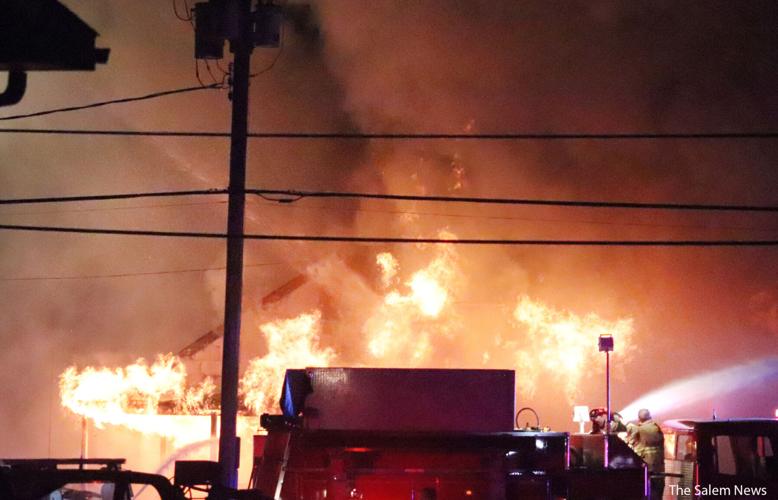
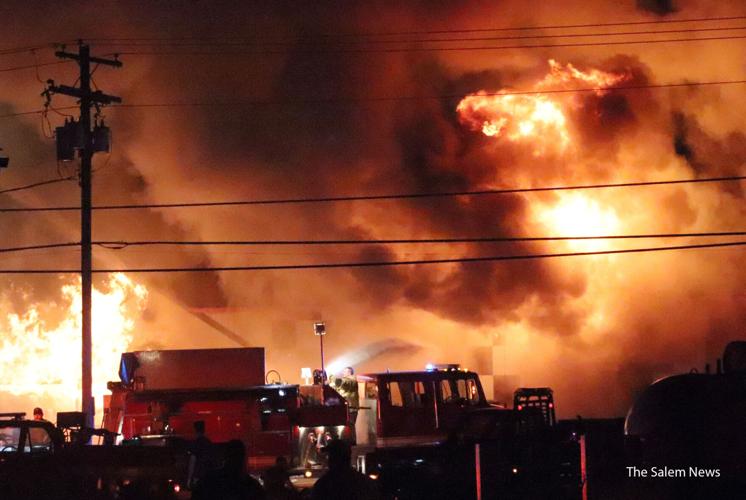
What started out as a small stream of smoke emitting from the eaves of Dewayne’s Tire Services in Salem on the evening of Friday, Aug. 11, rapidly became a massive fire, consuming most of the building, and prompting a large emergency response from multiple fire districts and other agencies. Responding crews faced hazardous smoke, explosions, and some close calls as they battled the blaze.
Dent County Fire Protection District Chief Brad Nash told The Salem News about the challenges faced by emergency workers. He said traffic was a major concern as crews tried to relay customer’s vehicles out of the lot, away from the fire.
“We had a huge issue with traffic, even though the Sheriff’s Department, the Highway Patrol, and the Police Department were doing a bang-up job trying to close down streets and all that. We just had so many onlookers. We had to call in the tow companies to come in and remove all the cars and everything that was in the parking lot and around the building. They were dropping some of those off [in a nearby field]. They were also dropping them off on MacArthur, where the shoulders were really wide, dropping them off there. There were just so many people around, they couldn’t get through to get the cars dropped off and get back to the fire scene.”
According to Nash, the number of bystanders and those driving past added another level of complication to an already complicated scene.
“You had explosions going on, so you’re trying to not only fight the fire, but then you have to protect the public; and everyone wants to see what’s going on. So, you’re trying to constantly push them back, or try and find law enforcement, and get everybody pushed back to where it’s safe,” said Nash. “I know the city put some stuff out on their Facebook page [saying to stay away from the area], and it just didn’t really seem to do much good.”
Nash said that as firemen fought the blaze, police held back traffic, and wrecking crews moved cars, some local residents, like people from nearby Phil-Mart, brought snacks and water for crews, and the owners of Chilton Oil Company opened their building for personnel to use the bathroom and cool off.
“That was a huge plus for us,” said Nash. “So, we’re trying to manage all of that, and then the situation with all the onlookers and everything, man, it made it difficult.
As the building burned, firemen faced several close calls, one being the large explosion that occurred during the fire. Nash said that type of explosion is called a “backdraft” and occurs when an oxygen-starved fire is suddenly provided with oxygen. Two firefighters barely made it out of the building in time.
“Fortunately, the guys that we sent inside the building were two of our captains, so they have a lot of years of experience under their belt. They were inside the building, and then we had the crew that was up on the roof. We saw the smoke changing colors and really starting to push out those holes, so we got them down real quick, and then before we could get the guys out, one of our guys saw the smoke basically rushing in, instead of out, and he reached up and grabbed his partner in front of him, and jerked them out of the door, and as soon as he did, that’s when it exploded,” said Nash.
Nash said another issue faced that day was hazardous fumes from the burning material inside the shop. Thick black smoke could be seen in plumes rising from the shop during the fire.
“A business of that type, I mean, you have kind of a rough idea of what kind of materials they have on-site. You know, but you don’t know exactly, so that’s always a tough situation,” he said. “The guys wanted to get in there and get the fire put out, and we’re constantly going behind them. You either have to get an air pack on, or you’ve got to get out. You can’t stay in that smoke and eat that stuff.”
Being an automotive shop, oil and other flammable petroleum products were stored within the building, according to Nash. He said the oil caused environmental concerns for crews, who placed hazmat dams along the parking lot and street to try and stem the flow of contaminated water into waterways and drains. Firefighters inside the building faced a different threat from the oil—that resulted in another close call.
“We had a crew there from Rolla City Fire Department,” said Nash. “They brought their aerial truck down. But they were in the back, in one of the storage rooms, working on putting out some fire, and there was an oil drum back there that had oil in it. And when they hit that with their water, the 55-gallon barrel actually exploded. When it did, it completely covered them in oil. It didn’t burn them! I really don’t know how. To me, the only way that would happen is if the oil that was in that barrel got so hot, it expanded the barrel, and then as soon as that cold water hit it, that’s what caused it to rupture.”
Now, in the days and weeks following the fire, Nash said that DCFPD is having to evaluate equipment for contamination from the unique hazards that could be present from fire at a garage.
“A lot of our gear that we had when we were over there, we’re going to have to get it checked out, to see if it’s going to be useable anymore; because of all the chemicals and all that type of stuff that was in the fire that you normally don’t have in a regular household environment. We’re going to have to get some testing done, and talk to our insurance company and all that, to see what we’re going to end up having to do there,” said Nash.
He said a full set of gear, not counting air packs, costs around $5,000 to $6,000 per set and 14 sets are in question following the fire.
“That doesn’t count all of the hose that we have that was laying on the ground. It’s got a woven cover on the outside. It’s material, basically, so all of that oil soaks into those hoses, and they’re going to be in the same shape. We’re probably going to end up possibly having to replace those as well, because I don’t know if we can clean them good enough to get the oil and stuff out of them,” said Nash.