

Alderman Shawn Bolerjack pitched a 1% general revenue sales tax increase during the meeting of the City of Salem Finance Committee Jan. 3 in the Salem Community Center @ the Armory.
The past few years of financial hardship have required the city to transfer a large amount of money from the utility operations fund to the general fund to balance the budget. While it is common for cities to do this, it’s an annual strain on the utility budget that comes at a time of aging infrastructure, new EPA regulations and budget cuts.
The city is trying to secure funding for its Phase II sewer treatment upgrades, dealing with high energy prices and other factors that are driving up electric rates, and the utility reserve is at concerning levels. The finance committee is looking for ways to lighten the financial load.
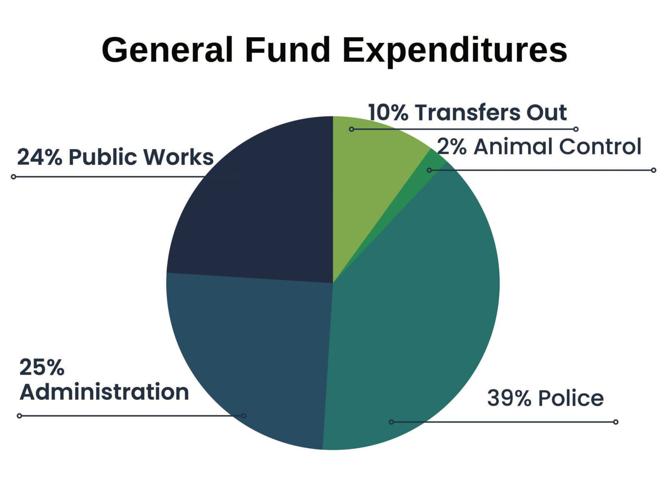
Bolerjack gave an overview of the general fund revenue and expenses budgeted for the current fiscal year. The current 1% general sales tax revenue was conservatively budgeted at just over $1.25 million. Other revenue, including things like property tax, permits, licenses, fees, franchise taxes, is budgeted at $582,312. General fund expenditures (see graphic 2) are budgeted at $2,963,671, with $340,146 budgeted to transfer to other funds like the cemetery and economic development. This would leave the budget for the general fund in the red by $1,468,905.

(Graphic 2) A pie graph showing Salem's general fund expenditures by percentage.
The Salem NewsTo offset this, transfers are made from the sewer, water, and electric operating funds in the amounts of $37,029, $40,367, and $900,000 respectively. After these transfers, the general fund is still short $491,509. Fortunately, the city has received federal ARPA (American Rescue Plan Act) funds which have balanced this fiscal year’s general fund budget. However, this was a one-time payment, and no more funding is coming.
“It is common for cities to receive funds for governmental operations from the utility operations through a payment in lieu of tax or through a franchise tax,” read Bolerjack’s presentation notes. “The idea behind this transfer, is that a private utility would pay a franchise tax to operate in the city, using city street right-of-ways in lieu of owning easements. It is only fair to the city to make a payment in lieu of the franchise tax to the city’s general fund. After these transfers, this still leaves the general fund in the red, if you remove the ARPA funds.”
The city and the finance committee are now faced with the challenge of balancing the budget moving forward.
To get the general fund back into the black once the ARPA money runs out, Bolerjack and others suggested increasing the current 1% general sales fund tax by an additional 1%. According to calculations by Bolerjack, the increased tax revenue would leave the general fund at -$216,305, a significant improvement from -$1,468,905. After the transfers from the utility funds, the ending balance would be back in the black at $761,091.
According to Bolerjack, one of the goals of passing the 1% tax increase is that the increased revenue would allow less money to be transferred out of the electric fund. Bolerjack suggested the transfer amount from the electric fund could be as low as $239,810 by fiscal year 2028.
City officials and the finance committee know that this comes at a time when the public may not look favorably on the idea of increasing the sales tax rate. The term “hard sell” was used more than once. However, they believe there is only one choice, given the circumstances. There was a discussion about “continuity of service.” This doesn’t just refer to park services, Christmas lights, and community events. When a city runs out of money and must cut services, the actions taken can be aggressive and lead to real hazards and inconveniences to citizens, members said.
“If the 1% additional sales tax is not approved, we’ve seen the numbers earlier, we’re looking at at least $500,000 we’re going to have to cut. That would affect the level of services we provide,” said Bolerjack.
“If we have to cut $400,000 or $500,000 out of the budget, the reality is we could cut entire departments and not get there. So, in addition to cutting staff, we’d be cutting services available to the public, and I don’t think that’s something any of us want to do,” said city administrator Sally Burbridge. She went on to talk about the specific services that start to fall by the wayside as a city makes cuts.
“It would probably be delays in pothole and street repair when things happen, it would be probably delays in service from the police department when you send a call in. Those are realities if we have to start cutting at those levels. I know that sounds drastic, but I think it’s a reality check we all need to be aware of.”
Police Chief Joe Chase spoke about Detroit as an example of what happens when a city fails to maintain continuity of service. According to Chase, Detroit began to remove every other streetlight bulb to reduce utility costs. Due to “medieval” budget cuts, Chase said that Detroit’s police force was stretched so thin that they stopped sending officers to respond to low-level crimes. Salem is not to the point of losing or cutting basic services yet, but those at the meeting shared the sentiment that actions must be taken now to ensure that Salem can maintain its current level of service to citizens as federal COVID relief funding runs out.
“The rainy day is coming, it’s just what do we do now?” said Chase. “We’re going to have to do something, or you’ll see an electric truck up there taking out every other streetlight bulb or something. There’s going to be something that happens. Something has to happen.”
According to the presentation, transferring less money from the electric fund would have beneficial consequences, not just for the city’s bottom line, but for the citizen’s bottom line as well. Increased money would allow the electric department to build up its reserve fund and could eventually make local utility rates more comparable to nearby service providers. Bolerjack also pointed out that there were no cost-of-living increases for city employees built into the budget for the current budget year, and that the increased revenue might give an opportunity to raise pay for police officers and other city employees.
“We need to be able to attract qualified employees and retain our current employees,” said Bolerjack. He would go on to say that the 1% increase would set the city up for financial success in the future.
Reaching a future of financial success for the city will require judicious action and “belt-tightening” in the meantime. Another topic of discussion that night was the annual fireworks display. Alderwoman Kala Sisco was enthusiastic about the event and had many ideas for future iterations. However, this year, Sisco and others said it would be unfair and inappropriate to hold the event this year during a time when the city is struggling financially.
“We need to definitely set something very soon,” said Sisco. “It’s a great time, we all enjoy it, but I just don’t think it’s fair to have to lay off staff but still have a firework display.”
“If we’re looking at the city footing the bill, given that we’ve been cutting staff positions, I can’t recommend that we go forward with this,” said Burbridge.
Sisco quoted the cost of the annual fireworks display event at around $18,000, money that city officials say simply isn’t there this year. It’s not only a matter of the fireworks themselves, but also the manpower it takes for the city to host an event, the cost to rent the venue, the cost of city cleanup and maintenance at the venue, and more. The venue alone costs $1,500 to rent.
Revenue-generating ideas were suggested by several people, including food trucks, live music and other activities and attractions. However, the timeframe to get these things secured is too short to implement any of the ideas this year. Sisco said many food trucks are booked a year in advance, and Burbridge said that bids usually go out in January.
“We tried to have it completed to a point with an idea before January so we could come before all of you with an idea. Unfortunately, we tried two or three meetings, and nobody showed up,” said Sisco.
The finance committee voted to recommend that the city cancel the fireworks display for this year.
Another issue facing the city this year is water infrastructure upgrades. Aside from regular maintenance and replacement of parts, the city must also find funding for its Phase II sewer treatment upgrades as required by new EPA rules.
City officials said that although the city fought hard against what some called “unattainable standards,” they now have no choice but to continuously upgrade to try and meet the ever-increasing federal rules.
To fund the upgrades at a price tag of $9.5 million, the city is looking at placing a bond on the April ballot, and $5 million in funding has already been secured in the form of an ARPA grant. This leaves around $4.5 million left for the city to find.
If the bond passes, the city can apply for a $2 million State Revolving Fund grant, as well as a $750,000 Community Development Block Grant.
The city faces a tricky situation: In order to secure the necessary grants, the city must successfully pass the bond in order to obtain necessary matching funds for the grants. However, this is a gamble, because the grants, while likely, are not guaranteed, and the bond funding alone will not be enough to cover the full project. Without the bond, the city will not get the grants, and without the grants, the bond will be unnecessary since the project cannot be completed with the ARPA funds and bond alone. If the city can successfully bond out for the required amount, and get grant approval, the whole project will be covered.
This would leave the final closing amount for the bond at $1.7 million.
The committee voted to recommend placing the bond on the April ballot. The recommendations from the finance committee will be given to the board of aldermen to continue the process.
“Our citizens need to know we’re not just doing this because we’re thinking ‘Why not.’ It’s mandated,” said committee member Sherry Lea.
“That’s the other piece of this. This is coming down as EPA federal regulations, we don’t have a choice. We’ve got to do the upgrades,” replied Burbridge.