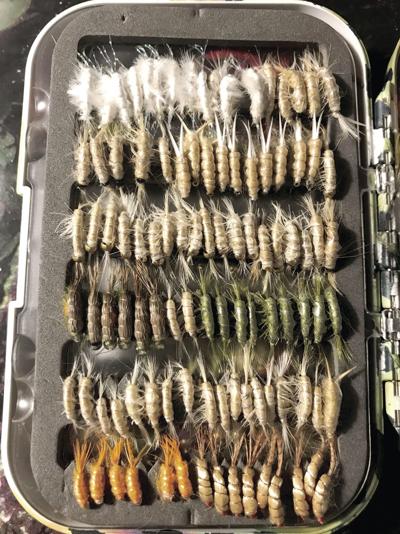
Fly fishing is a great pastime. However, as a fly fisher develops skills and time passes, the amount of flies one accumulates can become a bit overwhelming, unless they are well organized.
Trying to figure out how to organize a bunch of fly boxes isn’t rocket science, but it can be a daunting task, at least on the first attempt. In the end, however, you will be thankful to have your fly boxes well organized. There is nothing worse than being on your favorite trout stream and not being able to locate the one fly pattern that just might save your day.
Arranging your fly boxes by fly type may be the most logical and easiest way to organize your flies, especially if you fish the same bodies of water most of the time. As a resident of Missouri, most of my time is spent fly fishing Ozarks streams. Even though each of the rivers I fish feature a few local favorites, there are many flies that will work on every one of those streams. Organizing my flies by types is a great way to go, in this instance.
I utilize a lot of nymphs on Ozarks streams. Organizing my fly boxes by the type found from the river bed up makes good sense. Start with larva and pupa imitations. Line up like flies next to one another (i.e. all Copper Johns, all black RS2s, etc.) Organize them from smallest to largest, until you have filled a panel , or the entire fly box. Clear fly boxes make identifying the flies you want very easy. Labeling boxes is another great way to recall names of flies.
Once you have your nymphs organized, dedicate a panel, or an entire fly box to worms, eggs, and crustacean imitations. Worms run long, so place them in every other slot. On the next row, place the worms in alternate slots, thus creating a brick like formation from row to row. This arrangement will help you get the worms out of the box slots easily.
Crustaceans, mostly scuds, will fit nicely in with the worms, or if you have hundreds of them like me, they will fit well and look good in their own box. I also pack boxes with shrimp, crayfish, and other aquatic insects with exoskeletons.
Next, I like to place egg patterns with the other bottom patterns. I don’t keep a lot of egg patterns, but there are times when they produce well when nothing else seems to work.
Dry flies are very popular in the Ozarks. These insect imitators float on top and come in a wide variety of patterns. I organize them by similar patterns and line them up in rows according to size and colors. I try to avoid crowding them too much, so there is plenty of room for tails, wings, soft hackle and the fluffy parachute posts on top of some of these flies.
Terrestrials, including grasshoppers locusts katydid and cricket imitators, tend to run large. There are a lot of species in the terrestrial group, including ants, beetles, leafhoppers, etc. They start out small. Arrange these flies the same as your dry flies: Like-insects, smallest to largest, row-by-row, leaving room for hackles, legs, wings, tails and other dressings.
Streamers often run large and, therefore, need special handling. They will not fit well into small boxes. Some of the standard streamers, like Wooly Buggers can be placed in a standard go-to streamer box, the larger, exotic, articulated, almost bird-like streamers will need a larger home, an oversized box, which will need to be carried in a daypack raster than a hip pocket.
Fly fisherman know what kind of fly fishing their day holds in store for them. For example, when heading out to Current River river in spring, it’s a good bet the fish fare will be of the small morsel variety. That doesn’t necessarily mean just tiny nymphs; it will likely include a few midge, baetis or BWO hatches. Keeping a fly box filled with nothing but small nymphs and dries keeps an angler from having to carry too many boxes.
Later in the summer, when fish are looking up at larger drakes, stimulators and hoppers a box full of big flies — inclusive of big attractors and terrestrials — might be all a fly fisherman needs.
Since certain flies are known to hatch throughout the year, arranging my flies by season isn’t my favorite approach to the matter.
Regardless, whether you organize your flies deliberately by season or not, fly boxes tend to naturally align with the seasons anyway. Therefore, many anglers choose to just run with this method by default. This makes for an easy storage formula. You can arrange by calendar seasons: spring, summer, winter, fall. Or go with a tad more fly season specificity: late winter/early spring, late spring/early summer, late summer/early fall, late fall/early winter. The blessed fly anglers who travel more than the average Joe, often arrange fly boxes according to the local fly flavors that are more indigenous to the regions which they frequent most often. I have several fly boxes arranged for the most common areas I fish, including the trout parks, Ozark rivers, western streams, Alaska, and the Yucatan. Most are arranged using the techniques discussed earlier. And just because I have them arranged by region doesn’t mean I can’t intermingle different area-targeted boxes in my pack. These method often works well for me. Another variation on the regional organization style above is the more specific by-river method. Every body of water I’ve ever fished has a local set of flies that work well there from year-to-year. Setting up your fly boxes specific to the various bodies of water you fish can be a good way to go. This method is also a good way of recalling which flies worked the last time you visited a specific river.