
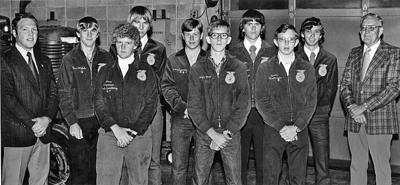
Today’s My Story is written by retiring ag teacher and FFA advisor Bob Parsons. Submit a My Story on any subject to salemnews@thesalemnewsonline.com or P.O. Box 798, Salem, MO 65560.
In November of 1970 I made my first trip to Salem, and on that seemingly uneventful day I signed a contract to become one of two agriculture instructors at Salem High School. Like I said "uneventful!" I was taking a job in the Ozarks in a town neither my wife nor I had ever visited. My ultimate goal was to teach in Salem for one to five years and return to Northeast Missouri to either farm or teach in a school close to where I was raised in Shelby County.
I remember vividly several individuals telling me "if you stay here seven years you will never leave." Well, 40 years later that forecast obviously was true in our case. Bear with me while I explain how we got here.
When I left the family farm and entered the University of Missouri in 1966 I was unsure what I wanted to major in, so I started in General Agriculture. Not very specific, but you will see that did have a bearing on us coming to Salem. I was able to take whatever courses I wanted, but really didn't have much direction. As I made friends from throughout the state I learned about Vocational Agriculture and Agriculture Education. Oh, by the way I did not have Vocational Agriculture (Vo-Ag), as it was called then, at North Shelby High School. It was a brand new program with a beginning teacher offered for the first time my senior year, and I didn't think I would need it. Like they say "hindsight is 20-20!" Dave Schneider and Ken Lockridge had become good friends and they encouraged me to change my major to Agriculture Education. So in the spring of 1968 I went to the Ag Ed Department and started my pursuit of the degree. During 1969-70 one of many turns of events took place that started us towards Salem. B. Oscar Brown came to Mizzou for a one-year term as Instructor in the Ag Ed Department. I took methods classes under Mr. Brown and our relationship began.
I received my BS in Agriculture Education in the spring of 1970, but had student teaching at Knox County High School to complete in the fall of '70, so I dual enrolled in graduate school with the intent of getting a Masters Degree in Practical Arts and Vocational Technical Education. Then Mr. Brown called. Jim Walker, who had replaced Mr. Brown while he was at MU and had stayed as the program expanded to two instructors, had the opportunity to move to a job closer to home. "Would I be interested in interviewing?" Two factors influenced my decision. First, during the time B. Oscar was at Mizzou I learned so much from him and I knew there was much yet to learn. Secondly, Salem was the only mid-year opening in Missouri at that time so I jumped at the opportunity. I drove to Salem, was interviewed by Mr. Irvin Johnson, Heather Johnson's grandfather-in-law, and signed a contract that very day. A personal note to young men and women. DON'T ever do that without consulting your spouse! Enough said on that matter. Then in December, Meredith and I came to Salem to look for a house. Mr. and Mrs. Brown got us in touch with Bob and June Polk and we rented a house from them. In 1978 we purchased the house from Bob and June, and we still reside in that home today.
So, Feb. 1, 1971 I started teaching at Salem. The 70's were very, very eventful. Our sons Tom and Tim were born in 1971 and 1976. The department experienced tremendous growth. We were adding or changing teachers every few years and student numbers were growing by leaps and bounds. Dan Yoest joined B. Oscar and I in 1973-74 for one year. Dan Prosser replaced Yoest and was here from 1974 through 1977. Lee Freeman was added to the staff in 1975 and taught Agriculture and Industrial Arts until 2007. After 31 years at Salem High School, B. Oscar Brown retired in 1977 and had been full time adult and Young Farmer Instructor from 1975 through 1977. Jim Schulte replaced Prosser in 1977 and was on staff until 1980. Marty Frick was Schulte's replacement from 1980-1983. Tom Strain, a former student of Lee and mine joined the staff from 1983 through 1986. I was the sole full time instructor from 1986 through 1998. Freeman taught one or two Ag Ed classes from 1992 through 1998.
In 1998 the student numbers had grown to where Freeman was returned to full time Ag Instructor and the Ag Ed and Industrial Arts Programs were combined. Lee retired in 2004, but continued part time to teach two or three classes until 2007. By the spring of 2007 student numbers had increased again and Heather Johnson was hired as a full time instructor. Heather, along with her dad Randy Wisdom, had both been my students. As you've read an obvious question arises! Why did student numbers fluctuate during these four decades?
A number of factors have been the reasons, but I feel two were most responsible. In the 70's and early 80's we were upgrading the curriculum and adding new courses. Vocational Agriculture was no longer cows, plows and sows. The first commercially available computer, a Radio Shack TRS with 48K of memory, was placed in the Ag Department in the mid 70's thanks to support from several financial institutions. Then the catastrophic farm economy of the mid 80's struck. Top news stories were about foreclosures on farms that had been in families for generations, farmer suicides and other gruesome related events. What parent wanted their child taking courses in the dead-end industry of Agriculture? In 12 years enrollment in Ag Ed classes had dropped from a high of 205 students and 4 instructors in 1975-76 to a low of 60 students with one instructor in 1987-88. But there is another factor that has influenced the numbers just as much if not more.
The number of credits required to graduate has continued a steady climb upward. In fact 9th graders now only have 1 or 2 periods out of the 7 to enroll in elective courses such as Ag Education, Family and Consumer Sciences, Business Education, Weight Training, Technology Education, Art, Music, and more. And 11th graders attending Rolla Career Center have no room in the three classes they are enrolled in while on the R-80 Campus.
Let me share some positives from the last four decades. First, I have to list having my own sons in class at the top. That experience gave me the opportunity and time to teach them many skills and abilities that being an Agriculture Instructor that many times had school related responsibilities seven days a week had not allowed. Another highlight was the addition of females to the program. Technically girls were admitted to Agriculture Education and FFA in 1969, but the first females did not enroll at Salem until about 1973 or 74. Since that time their numbers and involvement have grown to the point that they now make up about one third of the enrollment and hold 50-60 percent of the officer and committee chair positions. Similarly, females have become a vital part of the nearly 500 Agriculture Instructors in Missouri, and currently makeup 20-30 percent of that total.
Adding the Greenhouse and the corresponding class in 2001 has been another highlight and has provided another opportunity to broaden the agriculture spectrum.
The most significant result of my 40 years of teaching has been the accomplishments of my students. Nearly 20 former students have become teachers, including six who are or have been Agriculture Instructors.
At least 175 children of my former students have entered the Ag Education Program and joined the FFA. I currently have one student that is the granddaughter of a former student. Both the husband and wife of thirty-seven couples were Ag Ed/FFA students.
As I end My Story there are a few areas I want to visit. First of all I sincerely believe that everything that has occurred during my life has happened for a definite reason and design. Many, many trials and tribulations, as well as successes, of my students bear witness to that fact. I have worn many, many hats besides those of an agriculture instructor and FFA advisor. Those have ranged from serving numerous community organizations to holding every leadership position in the Missouri Vocational Agriculture Teachers Association. I served as President of MVATA in 1976-77 and 1999-2000. Only two other individuals, J.L. Campbell 1924-1926 and W.L. Barrett 1926-1928, filled the position twice. I have served on the Dent County Health Center Board of Directors since 1991 and as its chairman since 2003.
Secondly, to the lady that told me once "oh, you're not local" I want to tell you how deep my roots go in the Ozarks. In 1898 my great-great grandfather and great-great grandmother, Robert N. and Deliah Dingle, moved from Dora in Ozark County to Plevna in Knox County in Northeast Missouri. They carried with them in that covered wagon their two infant daughters and all their belongings. Grandpa Dingle was a small man and a blacksmith by trade. He and Grandma raised five daughters and a son. Every time I reflect on their accomplishment I have the utmost respect for my ancestors and my Missouri Ozark roots. I may not be local, but my roots go deeper than many.
Last, but most importantly, I must thank my wife Meredith for her 40 years of support of Agriculture Education, FFA and me. She has been my confidant, sounding board, and encourager and when needed my toughest critic. She is the number one reason that I have My Story to share. I have been blessed to have her as my wife. In today's society very, very few teachers have had the opportunity to serve so long in the only school system they've ever taught in. Thank you to Meredith, Salem and Dent County for My Story.


