Please purchase a subscription to read our premium content. If you have a subscription, please log in or sign up for an account on our website to continue.
Scattered clouds with the possibility of an isolated thunderstorm developing this afternoon. Gusty winds and small hail are possible. High 78F. Winds S at 10 to 20 mph. Chance of rain 30%..
Tonight
Cloudy this evening. Scattered thunderstorms developing after midnight. Low 68F. Winds S at 10 to 15 mph. Chance of rain 50%.
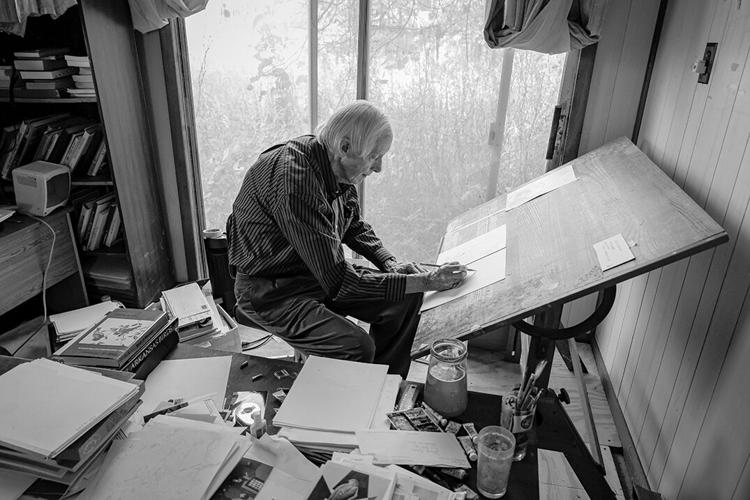
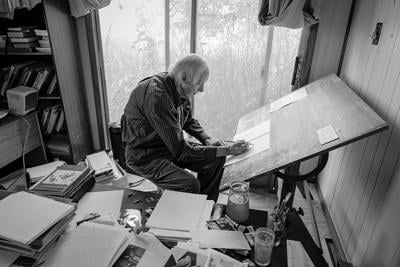
Lifelong Salem resident David Plank has been painting songbirds since he was in grade school, and has been making use of this same drawing table since building his studio in the mid 1970s.
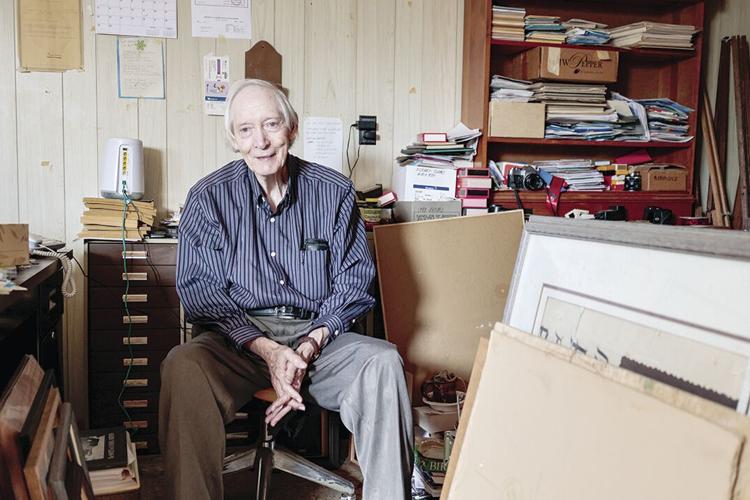
David Plank’s studio on Golf Course Road is a treasure chest of songbird artistry. Plank has sketched and painted thousands of birds. His artwork has been the cover of 10 editions of Bird Watcher's Digest. A member of the Society of Animal Artists, based in New York, one of his works was selected as the 1980 Missouri duck stamp.
Lifelong Salem resident David Plank has been painting songbirds since he was in grade school, and has been making use of this same drawing table since building his studio in the mid 1970s.
Decades before David Plank became one of the country’s best and most recognized bird artists, he was in an open field near his house sketching birds. He didn’t know why he liked sketching birds, he just knew he liked sketching birds.
One of the neighborhood parents stood at a window watching the pre-teen Plank sketch and commented to his wife, “that boy will never amount to anything.”
Years later, that comment was relayed to Plank, who still chuckles when he tells the story.
By some standards, perhaps Plank didn’t amount to much. He lives in the same little house he lived in with his mom when he was a toddler. He says he doesn’t have a fat checking account. Outside of three years in the U.S. Army serving as a photographer in Germany after World War II, he has lived almost his entire life in that little house on Dent County Road 3220, known these days as Golf Course Road.
But David Plank has been one heck of a bird artist, sketching and water painting his way to fame, if not fortune, in the world of bird artistry.
“I’ve been very fortunate,” Plank says with the humble attitude he is as well known for as his water color paintings of birds.
Over 80 years of bird artistry
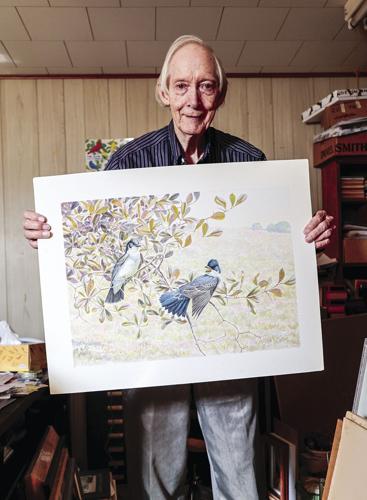
David Plank has sketched and painted countless Eastern Kingbird’s, his favorite bird.
Photo by Donald Dodd
David Plank reached into one of the drawers of one of the cabinets in his studio that holds some of the thousands of sketches and water color paintings he’s made of songbirds. One by one he thumbs through the contents until he finds a water color painting of an Eastern Kingbird. He pulls it out and shows this visitor, who spent a little over an hour with him last week discussing everything from birds to his days at The Salem News.
“This is an Eastern Kingbird,” he says. “They are also known as Bee martins. It’s my favorite bird.”
One by one, Plank pulled out a sketch or a painting. He named each bird, and every piece of his work had a story to go with it. The Eastern Kingbird was one of the first birds he’d drawn.
“They winter here and go to the Amazon in the winter,” he said.
He pulled out a colorful painting of an Eastern Towhee originally drawn at Shawnee Mac west of Salem. He went to another spot in his studio, built in the 1970s, and found a sketch of multiple birds he’d made in the eighth grade.
“My first memories are birds,” Plank said, pointing at the eighth-grade work. “I guess growing up out here, birds were everywhere.” He looked back at the drawing, exclaiming, “It was awful.”
His sketches and drawings got better, though. Without any training, the self-taught bird artist stayed at it, and about 80 or so years after his first sketch, Plank now amounts to one of the best bird artists ever, especially of birds found all over this part of the Ozarks.
This Sunday, Oct. 13, David Plank will be 90 years old. He has literally spent a lifetime as a bird artist; a great bird artist.
Plank has traveled to and sold a lot of his paintings at art shows and galleries across the country. His artwork has been the cover of 10 editions of Bird Watcher’s Digest. A member of the Society of Animal Artists, based in New York, one of his works was selected as the 1980 Missouri duck stamp. But songbirds were his first and only real love from about the third grade until today.
It’s those songbirds that have made him a regular at galleries for over 30 years and in local shops for even longer.
It was at the Springfield Art Museum years ago that he experienced one of his greatest moments as a bird artist. The museum purchased 16 of his paintings for a permanent exhibit.
“I’ve enjoyed all of it, really,” he said of his career. “I did enjoy the art museum exhibits in Springfield, especially. Some people don’t see wildlife art as art, and they recognized that down there.”
A lot of his paintings were sold at The Frame Shop in Rolla, closed now and formerly owned by Dave and Donna Roberts. His work adorns the walls of countless homes in the area.
“I guess what got my work really started, first recognized, was in the north half of Missouri,” he remembers. “They were having a Ducks Unlimited show in Kansas City, and a lawyer from Kansas City interested in my work called me and said, “What’s a guy who is a member of the Society of Animal Artists out of New York City doing in Salem, Missouri. I said, ‘well that’s where I live.’”
Addicted to songbirds
David Plank’s studio on Golf Course Road is a treasure chest of songbird artistry. Plank has sketched and painted thousands of birds. His artwork has been the cover of 10 editions of Bird Watcher's Digest. A member of the Society of Animal Artists, based in New York, one of his works was selected as the 1980 Missouri duck stamp.
Photo by Donald Dodd
There were no art classes in the two-room schoolhouse David Plank attended, yet he persisted with his art career and never really considered anything else.
From grade school through today, art is the love of his life. He never gave up on it.
“The kids these days who take art in school are much more advanced, much better than I was,” he says of his early days of drawing songbirds. “I was just so intent on doing what I wanted to do I just kept at it. At that age, if I had recognized how bad it was, I probably would have quit. I just had such a desire. I was fortunate enough to survive.”
A woman once attended a gathering at a Springfield gallery and told one of the hosts that she use to paint but quit, but that if she knew her work would have eventually been as good as Plank’s, she would have never quit.
“That’s the thing about what I do, you have to be addicted to what you are doing because you can’t predict how far this will go,” he says.
Plank’s artwork didn’t come close to paying the bills for the first few decades of his life. He didn’t go full-time at it until 1973, when he was 39 years old.
After his three years in the Army — Planks’ basic training was done at Fort Leonard Wood — he went to work at The Salem News and worked there 11 years. When the newspaper was on Main Street, he ran a Linotype machine. When the office was moved to its current location on North Washington, he operated offset presses.
His sister, Shirley Nash, spent a career at The Salem News as a graphic designer and was instrumental in helping her brother with prints of his bird paintings, among other things. “She let me use her computer when I needed one, too,” Plank says with a grin.
He needed someone like Shirley because, as he admits, technology isn’t his thing. Says Plank: “I have a couple cellphones somewhere that someone gave me. I never learned to use them. I once had a Tracphone I did use. Came in handy.”
Tina Jones, who has been the bookkeeper for Salem Publishing, owner of The Salem News, for over 40 years, remembers the Plank days at the office well.
“When it came time for him to pick out one of his paintings for a show, he’d have every one of us take a look at the choices and let him know which we thought was best,” she reminisced. “We had to go down there one at a time, he made sure of that, because he didn’t want one of us affecting one of the other’s opinion on which was best.”
Plank finally did well enough often enough to leave the paper and make a go of it as a bird artist. “No regrets,” he says today.
It was by chance that he got his first big break to make the move to a full-time professional artist.
“A couple University of Missouri professors came to the newspaper one day when I was working,” he said. “They had been down to Akers Ferry (on the Current River), and I had a few small paintings down there. They saw those and then came by the newspaper. They set up a show for me in the (Columbia) public library.
“A fellow came in (to the show at the library) and had a gallery downtown, and he said ‘We’ve been looking for something to upgrade our gallery, and I think we’ve found it.’”
The rest is songbird painting history.
“The guy was very aggressive. He would call someone up and say, ‘Hey, I’ve got a new David Plank painting and I am going to bring it out and hang it in your living room. And he’d do it,” says Plank as he relays the story.
His artist career grew from there.
And what a perfect spot this part of the Ozarks is for a bird artist. Public lands are everywhere, and the five acres alone where he lives include a spring branch that has not only been the source of inspiration and sketches for, well, over 80 years, but a refrigerator for the family’s milk when he was a youngster.
Shawnee Mac, Indian Trail and White River Trace conservation areas. Mark Twain National Forest. Ozark National Scenic Riverways. Bonebrake Center of Nature and History. And so much more. Places that play host to songbirds for all or part of the year and are a short drive from Plank’s home are too numerous to mention, much less count. He could not have picked a better place for song birding than the place he has spent the better part of 90 years sketching birds in what he calls “their natural position.”
Still drawing, still loving it
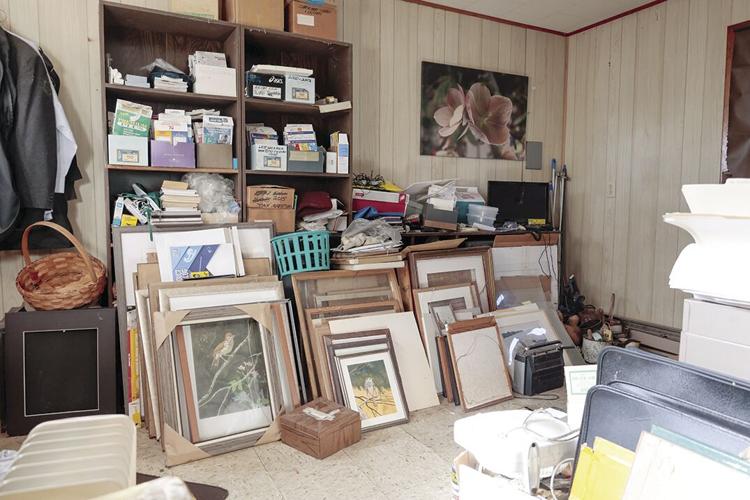
David Plank, who turns 90 this month, still spends a lot of time in his studio.
Photo by Donald Dodd
David Plank is likely the second most famous artist with ties to Salem. Ozarks-born artist L.L. Broadfoot has the distinction of being the most famous.
The late Broadfoot, born in Shannon County in 1891, moved to the West Coast, then returned to Salem in the 1930s. He published the book, “Pioneers Of The Ozarks” in 1944. The pages of his book are filled with Broadfoot’s original works, which are Ozark pioneers and landscapes, many of them charcoal character portraits.
Broadfoot had a gallery near where Salem dentist Steve Watson’s office is now, and when Plank was a young boy his father took him there to see it. As Plank grew older and worked at The Salem News, Broadfoot lived a street away from the newspaper office.
“He spent too much time trying to be famous,” says Plank today. “Bob (Vickery, The Salem News owner) would see him coming down the street and say ‘Here comes Broadfoot, he wants us to put something in the paper.’”
Achieving fame has not been at the top of Plank’s list. He shies away from the spotlight, preferring his work get the spotlight.
A few years ago, Plank was honored in Salem with an exhibit at the Ozark Natural and Cultural Resource Center, organized by longtime friend and ONCRC director Jerry Craig.
There has also been a banquet held by the Dent County Retired Teachers Association. The fellowship hall of Salem United Methodist Church was packed. Plank was recognized for his work, including paintings that for years had been displayed locally by the Bank of Salem.
“He’s the easiest going guy I know,” said fellow artist and friend Dan Woodward of Rolla during the banquet.
Not to mention talented. There are people who have collected Plank prints for decades.
“Some of them I don’t even know, who bought regularly at galleries,” he said. “I don’t have a record of people who bought at galleries.”
And bought, they did.
Plank pulled more sketches from his files as he talked songbirds and paintings. “I’ve got a thousand more of those, I guess,” he said as he looked at one of the sketches. He’s lost track of how many paintings he’s done. And how many different types of songbirds sketched? He figures 30 or 40 different species but doesn’t really know for sure, saying “it could be more, I never really thought about it.”
The numbers or the dollar value that have added up don’t really seem to matter to David Plank. When he’s dead and gone all of his collection in the studio will go to the Missouri Historical Society.
It’s the process, the love of doing it, that seems to be most rewarding.
His cabinets and wall space are full of field drawings. He does a complete pencil drawing for a painting then applies the water colors. He places the field drawing on the wall as a guide.
“I visualize what I want to do,” he says. “It’s hard to explain, you just visualize what you want. It’s just something I started doing, and I really don’t know why. Somehow I was just able to visualize what I wanted.”
As Plank continued to talk about his hobby turned lifelong passion, he turned from reflection to today. He’s still drawing. Still selling. He’s working on a book idea that he already has the paintings for.
“I never really run out of any ideas,” he said. “There are birds all around me.”
Plank bemoans the fact that artwork of any type in this technology-driven world with a dicey economy does not sell as it once did.
Selling more or less of his bird paintings doesn’t seem to be what drives David Plank, though, who at 90 is healthy and independent.
He carries on because that’s what he loves to do, with a gallery here and there and a few paintings available at places like That Special Touch in Salem.
Toward the end of the interview last week a bird loudly chirped in the front yard. No doubt David Plank knew what kind of bird it was, and was just itching to get out there and sketch it.