Carl Williams, owner of The Village Gallery, originally didn't like woodworking at all. He took general shop his freshman year at Salem High School in the early 1970s and wasn't a fan. Then, when his senior year rolled around, he needed a class that would fill some time, so he signed up for Leon Seneker’s advanced woodworking class, and it was then that he fell in love with the craft. Not only did he grow to like it, but he found out he was good at it, too, a necessary combination for fulfilling work. That year was a 180 degree-turn from his freshman year; he won woodworking awards for his creations.
“I just loved it,” said Williams. “Mr. Seneker really encouraged me to consider it as a vocation, as a business to pursue.”
After graduating from Salem in 1975, Williams took off for College of the Ozarks to get some industrial arts classes under his toolbelt. When he was done with college, he took a job in the mines and did woodworking out of a small shop in his home for eight and a half years – building conference and dining room tables, along with other woodworking projects.
The Village Gallery, a cabinet shop located in the Masters Industrial Park, was started in the early part of 1983, an extension of his home business with its first little showroom in Viburnum. He was itching to have his own full-scale business though, and when the opportunity to buy Henry Roberts’ cabinet shop opened up, he jumped on it. “So we went from really a furniture business in the beginning into a cabinet business,” said Williams.
The shop settled into its present, long-standing location at No. 2 Carnett Industrial Drive, just east of town – named after Dr. Bob Carnett – in September of 1987 after moving from Third and Iron streets. Since then, the shop has seen an incredible amount of success for a local business – shipping products much further east than Viburnum. “We've literally worked all over the country,” says Williams. “At one point, that even led to us exporting to Japan. We have about 10 kitchens around Tokyo, all because of a connection that we had with somebody who liked our work.”
The team is currently building a job for a kitchen in San Francisco, and has another project going in Colorado. “We've got cabinets in probably 15 states,” says Williams. “The interesting thing is that it’s always word of mouth. It’s always a connection that we've had with someone. We haven’t advertised; it’s not Internet sales. It’s relationship sales. Every one of the projects that are out of state is connected to a project that we've done in the past.”
Williams certainly doesn't take all the credit himself. After the initial interview for this story, he got back in touch to make sure his talented crew of woodworkers was recognized. “Another reason that makes my job so great is the awesome team that I work with here,” said Williams. “Their skill and positive approach make what I do absolutely the best.”
Many of his crew members have been with him for literally decades. Mark Huitt, a trained drafter who joined the crew in 1995, gets the customers’ initial ideas from Williams. The two design together, and then Huitt draws up the Computer-Assisted Design (CAD) file to get the project moving. Huitt says that, usually, the initial draw up suffices, but sometimes Williams encourages further finery.
“Sometimes I'll give it to him and he'll say, 'Nah, dress it up some more!,’ says Huitt laughing. “So I'll have to go back and change some stuff.”
Once Williams and Huitt settle on a design, Mike Adams, the shop foreman and project manager, takes the CAD file and starts delegating the work in pieces to the rest of the crew. Adams has worked with Williams for 25 years. When asked how he learned the intricate art of cabinetmaking, he chalks it up to the old-fashioned way – just like The Village Gallery makes their cabinets.
“After you work at a place 20-some odd years, you sort of know what to do,” he says. Every member of the crew interviewed cited the ability to be creative in their work as a major reason the job remains rewarding, even after so many years.
The team recently scored a creative contract to build the bar for the new Public House Brewery in St. James, with its creative steampunk atmosphere, a recent highlight. Big jobs and small (kitchen jobs alone can range from $5,000 to $100,000, depending on just how fancy customers want to get) the shop puts out about 50 kitchens a year, hundreds of bathrooms, entertainment centers and specialty furniture pieces produced on top of that.
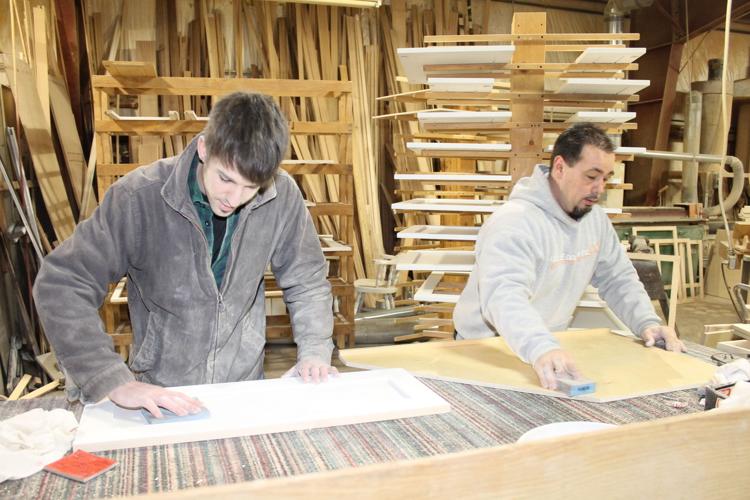
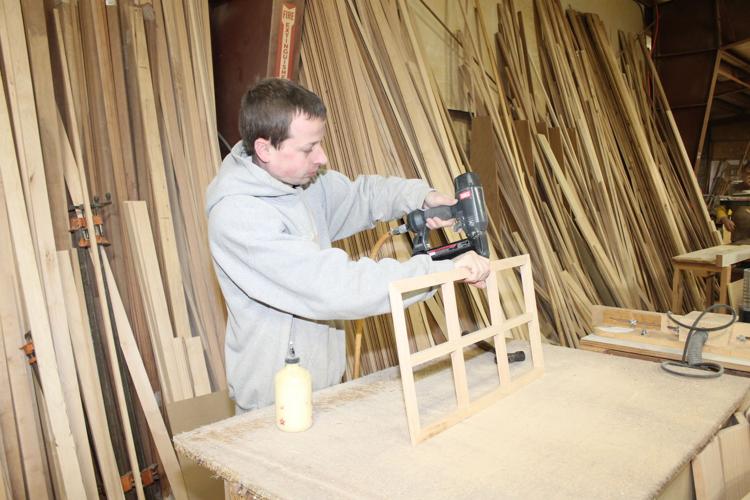
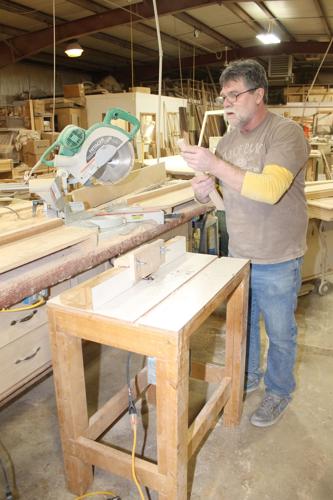
Other members of the crew hard at work that day were assistant foreman James Bradshaw and cabinet makers Terry Sutton and Michael Sileo. After the shop team finishes up the cabinet, long-time installers like Terry Satterfield and David Smith make sure it looks nice and secure in its new home.
Another interesting facet of the family business is that Carl’s wife, Missy, who does all of the front desk ordering and keeps the books, has worked with him from the very beginning. They both agreed that working together every day has brought them closer together, a feat most couples wouldn't be able to brag about.
“We’re blessed,” says Missy. “I mean, to be able to spend so much time together... most people work at separate jobs and they see each other for a few hours at night. And we get to be together most days. It’s been fun and we've truly enjoyed it.”
The happy couple will be celebrating their 40th wedding anniversary in 2018.
Missy Williams, who’s had a ton of success on her own selling Nerium on the side – an anti-aging cream that recently snatched her a new Lexus – says her husband doesn't get stressed very often. “He’s pretty cool,” she says. “I have no idea how he does it.”
Williams’ calm demeanor gives it away. The Zen-like cabinet maker is right at home in the shop he built 27 years ago. He loves his job, and he loves what he does – and that makes all the difference.
“I love the outlet for creativity that it gives me,” says Williams. “And just the interaction with people – that's where the energy comes from…We just made a leather-inlaid custom desk for someone the other day. And one of the guys commented, ‘You know, what we do around here is, we make the antiques and the keepsakes of tomorrow.’ And that's pretty cool.”