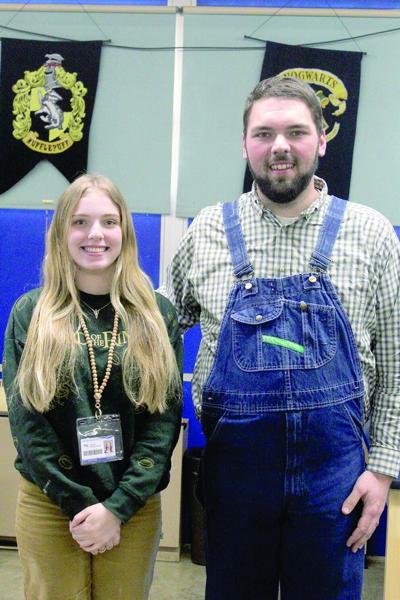
The Missouri Forest Products Association (MFPA) held its annual meeting in Jefferson City at the Courtyard Marriott on Jan. 14—in conjunction with the Future Farmers of America (FFA) state competition. The FFA Public Speaking Contest winner was given an opportunity to present their speech at the MFPA annual winter meeting. The goal of the contest was to encourage young leaders to be more aware of the forest and wood processing industry and to advocate for sustainable management and sound stewardship of Missouri’s forests to benefit current and future generations.
First, the students compete at the area level, then the district level, and then they can compete at the state level. Maggie Hogan, Salem High School junior, shared that she had a long history of participating in the competition, meaning a whole lot of practice honing the craft of public speaking. For her freshman and sophomore year, she won the area competition but wasn’t quite able to make it past the South-Central district. This year, however, Hogan was able to make it past the area, district, until she was finally able to win statewide.
“I would love to work in the private sector of the Missouri Wood Products Association and be an advocate for these practices,” shared Hogan.
Hogan’s career goals have fluctuated over the years. In early childhood, she wanted to be a paleontologist, then she wanted to be a teacher, a nurse, or even a forensic anthropologist. (She joked good naturedly that she didn’t even know how to spell that last one.) It wasn’t until her father got a job at Independent Stave Company, a barrel supplier in Lebanon, that she realized how vital the logging industry is for the American economy and the culture in Missouri.
Now, her future contains agriculture, be that with an associate or bachelor’s degree, with a natural resource specialization.
“Like, if you go to Meramec Springs Park at Old Iron Works Day, logging in this industry is so connected to the roots and the foundation of our state,” explained Hogan. “So, it piqued my interest as a history and science nerd and as someone that likes to talk a lot—this is definitely a subject that you can expand on.”
FFA does more than prepare students for a life in agriculture—it gives them valuable hands-on learning opportunities, as well as gives them experience refining their public speaking skills. For the competition, Hogan prepared with plenty of research and a whole lot of studying. She utilized a few different resources—OSHA accident reports, as the topic this year was logging safety, and the Missouri Conservation website; not only that, but she also completed boots on the ground research.
“I had to do a lot of human interaction. I talked to a logger, Scott Jadwin. He was a really big help. He helped me get into the industry,” shared Hogan. “And then, of course, I talked to my dad—he actually let me see a big piece of equipment called a log debarker. I got to click the button and run it. It was really cool.”
FFA Instructor Dalton Sanders said that it’s been great to see Hogan’s growth throughout her experience of FFA.
“It’s pretty neat to see how they progress—even after not making it to state year one and year two, some students would have gone, ‘oh, I’m done with this’, but Maggie was determined and she got it done,” said Sanders.
Although Hogan won the competition, it doesn’t mean she wasn’t scared. During the area district competition, she would give her speech in front of small town loggers who were approachable and easy to connect with—at state, she was giving her speech in front of billionaires and representatives of big corporations and described she was “petrified.” After she gave her speech, she was able to speak with legislators and senators and was even able to speak with someone who works in the Department of Justice in DC.
Overall, it was an encouraging event for her.
“This was the event that really showed me that this is where God needs me, and this is where I need to kind of settle down roots and be in this industry,” explained Hogan, “I also have learned a lot in this. One of my friends got second place at the state competition, and we're still in contact, and he told me that the reason that I was different was because my speech sounded like a conversation instead of an informational.”
Public speaking, explained Hogan, isn’t just delivering information—it’s a conversation that everyone should feel they are a part of.
“That’s really the big thing that I learned over all of this, is making other people part of the conversation,” reviewed Hogan.
To see more of Hogan and hear about the competition, watch the video