
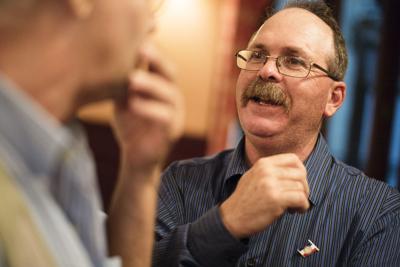

Former legislator Frank Barnitz took a trip far away from Dent County in March, being asked to travel along with the U.S. Agriculture Coalition for Cuba, one of the first entries into the country for American officials in nearly half a century. In 56 years, to be exact.
Diplomatic relations between the two countries had been severed since 1961. In late December 2014, President Barack Obama declared that those relations would open back up, culminating with the building of an eventual U.S. Embassy in Havana.
Barnitz brought along his unique combination of talents as a long-time farmer in the Ozarks, as well as a former state policy maker. He was perfect for the team.
"It was a huge honor to be asked," said Barnitz. "During my time there, I realized just how much both countries have to learn from each other."
Barnitz shared a presentation concerning the interesting details of his trip at the Salem Rotary Club’s weekly meeting in the Salem Community Center @ The Armory April 20. According to the presentation, the goal of the expedition was to end the embargo and expand opportunity for stronger agricultural exports. There were 95 attendees made up of representatives from agribusiness, commodity groups and the state government. Gov. Jay Nixon was going to attend, but due to the death of Tom Schweich, Missouri's auditor and a candidate for governor, the first lady, Georganne Nixon, attended instead.
Twenty-two states were represented, and they went on six farm tours, including Cuba's world-famous tobacco farms. The national press and the Ag symposium attended as well.
The representatives interacted with Cuba's key sectors, including the Cuban government, egg cooperatives, Cuban farmers, and U.S. diplomatic officials.
Professional photographer Mark Tomaras went along for the trip and took hundreds of photos which can be viewed on page 1B today, thesalemnewsonline.com and online at http://marktomaras.photoshelter.com/#!/index.
Meetings were held with key movers between the two governments, including Juan Jose Leon Vega, Director of International Relations for the Ministry of Agriculture; Josefina Vidal Ferreiro, General Director of the U.S. Division for the Ministry of Foreign Affairs; Leonardo Gonzalez, Director of International Relations for the Small Farmers Association; and Alejandro Mustelier, President of Alimport, the government-controlled purchaser that supplies citizens with staples such as milk, rice and beans.
“Nothing gets into or out of Cuba without Mustelier’s approval,” said Barnitz.
The discussions focused on relationship building between the two nations. Contrary to what many Americans might believe, Cuba is cautious about opening itself up to untethered free market relations with capitalist America, as students of Fidel Castro, Che Guevara, and the Cuban Revolution in general will understand.
“Vega said that it will take a considerable amount of relationship building to mend fences between the two nations completely,” said Barnitz.
The Cuban people did seem to be excited for trade opportunities, and were incredibly knowledgable about, and interested in, American politics.
Barnitz said that talking with the poorest Cuban farmer would still reveal a level of education often unseen in the United States.
“They seemed to know more about U.S. politics than most Americans,” said Barnitz with a laugh.
Cuba’s educational system is ranked considerably higher in the United Nations’ 2013 Education Index than either Brazil or our main trade partner, China.
“98.7 percent of their population is literate,” said Barnitz, "which I was shocked with… Cubans can go all the way through college there, completely free. Kids were always in school, and all had some trade that they were doing. We didn’t see any vagrants. There is a heavy focus on education, including in rural areas. About everywhere you look you can see a school, even in the poorest of places.“
And their healthcare system is free to all Cuban citizens as well, ranking only two spots behind the United States in quality in the World Health Organization’s 2000 survey. Cuba often trades their plentiful number of highly skilled doctors for resources, like they’ve done with Venezuela in the past for oil.
“They said when these changes started happening that there were two things they didn't want to lose,” said Barnitz. “And that's their educational and healthcare systems.
“They have a very strong educational system down there. A lot of scientists, but not the needed infrastructure."
One telling point was the lack of Internet access, which Barnitz said cost $5 for 30 minutes of use.
Probing how the Cuban government is able to pay for every citizen in the country to have access to lifelong, free education and healthcare, Barnitz ventured a guess.
“Their healthcare system is all government-funded and very high quality,” he said. “Healthcare professionals don't make a whole lot more than the average citizen. So the end of the embargo could lead to more Cuban medical professionals looking for opportunities in America now.”
Interestingly, the two systems currently contributing most to American debt –student loans and healthcare – are a non-issue in Cuba. But when it comes to business capital and opportunities to really cash in with one’s own business, the country pales in comparison to the U.S.
Castro began to allow more free market opportunities in the country toward the end of his life, Barnitz said, and co-ops and individuals are now allowed to earn discretionary income through a trade, like playing music out on the town or selling homegrown produce, but restrictions are still in place.
Most Cuban families, while food vouchers are provided, live off an income of less than $50 a month, and most sales go to the government, as Cuba still very much operates under a communistic socialist system.
The country, 90 miles from the U.S. coast, is made up of about 11 million people, and they’ve come far since the Bay of Pigs, although the rumors of 1950s cars dotting the roadway are still very much true. Russia was a major supporter of Cuba until 1994 when Russia withdrew all support, sending the country into a panic. Cubans refer to this as the “special period,” and relations between the two nations haven’t been the most friendly since.
Back to trade, Cuba imported around $1.5 billion in commodities in 2013, with about $300 million of that coming from the United States. Cuban non-sugar agricultural production is measured at around 7 million metric tons annually, made up of roots, tubers like potatoes and other root crops, corn, legumes, paddy rice, citrus fruits and other vegetables. Since 2000, when trade relations started to open up, the U.S. has exported $5 billion in food and agricultural exports to the country.
Of most interest to Missouri farmers will be the export of rice to the country, as Cubans love their rice and beans, says Barnitz.
While the developments are exciting, diplomacy between America and Cuba won’t be fixed overnight. After half a century without being on speaking terms, it might take that long for things to truly be made right between the two formerly strong political and economic allies. But Cuba is cash-poor, and credit is at the top of the country’s wish list.
“Opportunity will not emerge immediately,” said Barnitz. “This is a long-term effort, and relationship-building (between the two countries) is vitally important. We can each learn a lot from one another.”