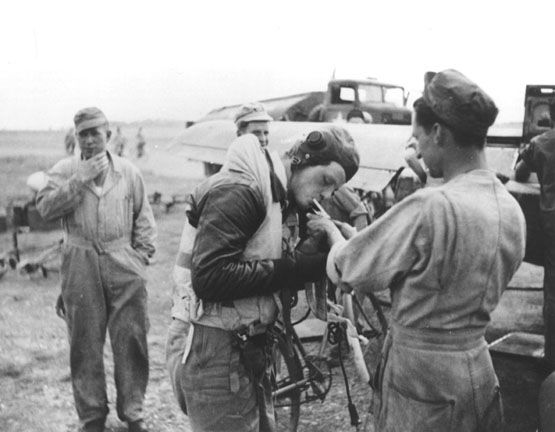
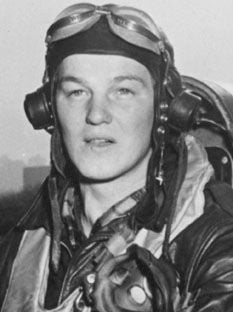
Through four years and hundreds of editions The Salem News updated readers on the latest developments in Europe during World War II. During this era, articles featured the names of local men caught up in many of the largest battles ever fought. Of the era’s headlines, the spotlight shined brightest on Salem’s Ralph K. Hofer. During his brief career as a P-51 Mustang fighter pilot, Hofer destroyed 32 Nazi planes, survived being shot down over Normandy and received the Distinguished Flying Cross.
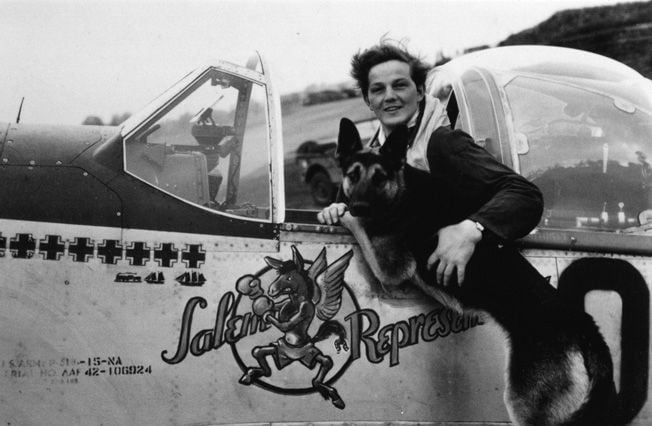
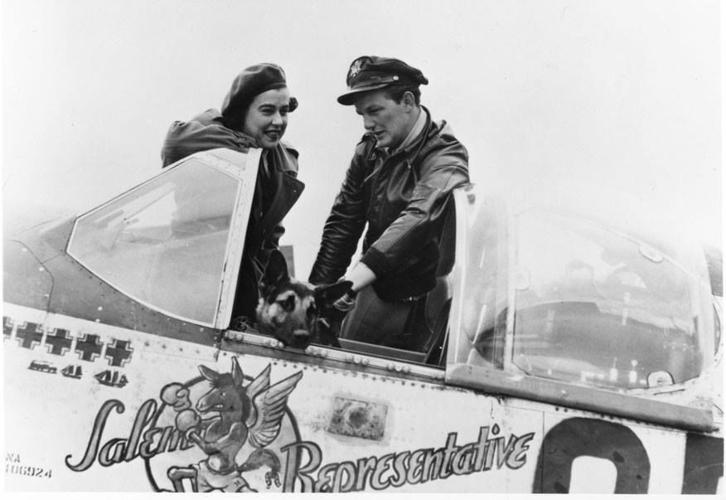
Hofer cited his upbringing for his success, and nicknamed his Mustang fighter “Salem Representative.” In addition to its Rolls-Royce engine, the plane had custom-painted nose art depicting a winged Missouri mule wearing boxing gloves and the trunks of a fighter on its side.
In combat, Hofer used the plane to earn the reputation of being the “last real daredevil of the sky.” His trademark became breaking away from the main group of fighters to take on the enemy one-on-one in lone wolf fashion.
One such example was captured in a report Hofer authored after shooting down a German on April 1, 1944.
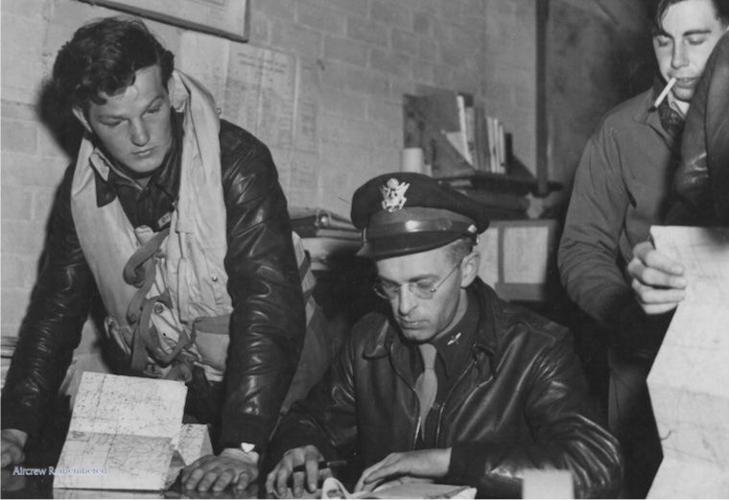
“Four Huns were reported shooting at a [B-24 Liberator]. I saw the Lib going down smoke to my port. Four 109s came in below me after the Lib. I jammed things forward and dived to attack, telling the men with me to get the straggling Hun. I closed in on one of the other three at about 16,000 feet. I fired a 20-degree deflection shot at 250-yard range, hitting the Hun in the engine and cockpit. Pieces flew off and glycol started steaming from its radiators. The aircraft then quit flying forward and began to fill with smoke, flames and glycol streaming back.”
…
Despite these grand trappings, life started humbly for Hofer as a native of Dent County. He was born in 1921, on a farm outside of Salem. At birth he was dubbed Ralph “Junior” Halbrook, but later took the name of his stepfather. Hofer graduated from the old Warfel Grade School and later gained wide renown as a fighter representing Salem’s Lions Club in boxing tournaments.
After leaving the Ozarks as a young man, Hofer lived the life of a rolling stone moving around the country in search of adventure.
It was during a daytrip in Windsor, Ontario, he made a snap decision which forever changed his life.
When Nazi Germany invaded Poland the United Kingdom and its commonwealth of nations entered into the conflict while the United States remained neutral. Many Americans wanting to fight Nazis crossed the border to Canada during this time to join its military in the hopes of going to the European front.
Hofer had no such intention upon first crossing the border as a tourist in the fall of 1941, however, after mistakenly being directed to a recruitment office, he decided to sign up with the Royal Canadian Air Force. He trained in Canada for two years and in 1943 was sent to England. With the United States joining the conflict by that time, Hofer and the other Americans who’d joined the Canadians were transferred into the US Army and made up the storied Fourth Fighter Group of the Eighth Air Force.
It was during his first mission over the Netherlands on Oct. 8, 1943, that Hofer started making a name for himself by singlehandedly shooting down a German ME-109 fighter plane.
“I followed the ME-109 closing fast … to about 100 yards, opened fire and saw strikes and flashes on the Hun,” Hofer wrote in his official report of the incident. “I had to shove the stick forward to keep from ramming him as he turned over and went down into a steep dive. Oil on my wind screen prevented me from seeing any more.”
Throughout the spring of 1944 Hofer emerged as a true standout by shooting down more and more enemy aircraft. The Salem News began to take took notice after international wire reports kept mentioning Hofer and referencing Salem being his hometown.
On March 23, 1944, the newspaper proudly reported Hofer had become an ace and destroyed five Nazi planes. A follow-up on June 1, 1944, reported Hofer’s total had increased to 30.
“Announcement arrived Wednesday, May 31, from a fighter base in England that Lt. Hofer had destroyed three German training planes on the ground that day, tying the record,” The Salem News reported. “His recent successes would indicate that Lt. Hofer is determined to set a record of his own in the European Theater, and his friends in Salem and Dent County are wishing him continued good fortune.”
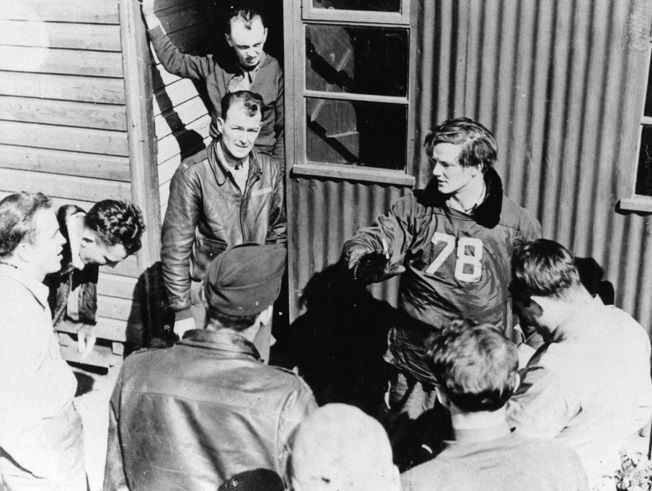
War correspondents abroad soon became enchanted with the Hofer. The young rowdy, long-haired Ozarker cut a mold foreign to the era’s ornate gentlemanly pilots. They reported Hofer wore a silver diamond-encrusted snake ring on his throttle hand and went into battle wearing a blue football jersey. He also became known as "Kid" Hofer, or just simply "Hofe."
On routine flights he was also frequently seen accompanied by his adopted Alsatian dog, Duke, but in order to make room in the cockpit - Hofer left his emergency parachute behind.
Hofer’s greatest fame came compliments of the St. Louis Post-Dispatch’s War Correspondent Virginia Irwin. On June 25, 1944, Irwin penned a widely read profile printed on the front page of the Post-Dispatch’s magazine. She wrote that Hofer, “has a reputation among flyers of being ‘the last of the few,’ the last of the few real daredevils, the last of the few real screwballs who fly for the hell of it, live for the hell of fighting and count that day lost when the Jerries run for home and fail to close in for the fight.”
Irwin went on to report, “On D-Day, Hofer went over and shot up a few targets. On June 11, he went over and bombed a couple of tanks, set four trucks on fire, and ran into a Jerry 25 miles back of the enemy lines, who made a sieve out of his oil system. Hofer crashed on the airstrip, which luckily turned out to be one of ours, got drunk on pure grain alcohol and grapefruit juice, slept through the fire storm of the naval guns over the beach, hopped a ride on a DC3 the next day and landed in England with a headache built for a horse.
“Fighter Command sent an escort after Hofer. He doesn’t know whether it’s because he’s valuable enough to rate a personal escort, or because the powers that be figured he wouldn’t get back for days if left to his own devices.”
The Salem News reported four days later that the Salem Chamber of Commerce sent Hofer a congratulatory letter.
“Your outstanding success and tenacity of purpose as an Ace with the American Air Forces, is reminiscent of the persistent demonstrated during your days of amateur boxing in Salem,” the Chamber wrote. “You are undoubtedly Salem’s No. 1 fighter, and we are quite proud to have Salem mentioned as your home town in all the dispatches now appearing in the metropolitan newspapers containing stories of your destruction of Nazi planes.”
Later on July, 13, 1944, The Salem News reported Hofer received the Chamber’s letter upon returning to base after being shot down over France. He reportedly brought back with him several mementos of the experience.
The Salem News reported, “At one German concrete redoubt Hofer stepped over some late Nazis and helped himself to souvenirs which included a German helmet, canteen and the copy of Mein Kampf drawn from a circulating library by a Jerry named Rudy on Jan. 3.”
Unfortunately, what readers didn’t know was as they read of Hofer’s latest victory, he was already dead.
Historian Paul B. Cora reports Hofer’s last mission was to escort the 15th Air Force’s heavy bombers during a flight over Eastern Europe. During a July 2, 1944, mission to Budapest, Hungary, a large formation of ME-109s was encountered and a savage melee ensued. When the scattered elements of the Fourth returned to Italy later that day six Mustangs were missing, including that of Hofer.
“Being overdue in Hofer’s case was a matter of routine,” Cora writes. “So many times before he had disappeared only to return later with a story to tell and the gun camera film to prove it. Captain Frank C. Jones of the group’s 335th Squadron was among the last to see Hofer’s plane as the group climbed to engage the enemy aircraft at the start of the July 2 encounter. With no further information forthcoming, there was no alternative but to officially list Hofer as missing in action when he failed to turn up by the following day. Several weeks after the conclusion of the Britain-Russia-Italy shuttle mission, word was received that Hofer’s body had been identified within the wreckage of his P-51 several hundred miles south of Budapest in Morstar, Yugoslavia.”
The Salem News lamented the loss in the August 31, 1944, edition by printing, “All of us had hoped that he might someday return to Salem to receive the tribute from his friends as a ‘real hero of the sky.’ His failure to return will only add glory to the fine record of this boy of the Ozarks established in the finest company known.”
…
In her profile, Irwin summed Hofer up by quoting him as saying, “No guy minds being a hero … In fact, I kinda like the idea of being a hero. But if they toss in that old stuff about how I helped to liberate the conquered peoples of Europe I’ll go beet red.”
Irwin continued, “A less straight thinking lad than Hofer might himself in time come to believe in that ‘idealistic hero stuff.’ But Hofer never will. He got into this flying racket on a fluke, not because he nursed beautiful ideas of duty to humanity. That he turned out to be one of the hottest pilots ever to maneuver a Mustang over enemy territory he regards as ‘just one of those things.’”
Seventy-five years after his death, the historian Cora wrote, “Hofer’s short but eventful career with the 4th Fighter Group has earned him a distinguished place within the legend and lore of World War II aviation. Among a breed of individuals for whom flamboyance and daring were hallmarks, Hofer stood out as exceptional to the point of reckless. His very involvement in the air war was the result of an unforeseen opportunity, which he immediately seized. His approach to combat flying was little different, and to close with the enemy he took every opportunity as it came without concern for the risk. Ranked as number 20 among some 260 Eighth Air Force fighter aces of World War II, Hofer demonstrated the old adage that fortune favors the bold, but also proved that fortune can be an all too fleeting commodity.”
Salem Representative may have been branded on Hofer’s Mustang, but it’s a truth which might as well have been tattooed across his chest. In style and attitude, he exemplified what happens when you take an Ozark boy, stick him in a fighter plane and ask him to kill Nazis. True to his hometown roots, Hofer was always quick to play up his dangerous side while refusing to carry the baggage which comes with being put on too much of a mantle.
Irwin labeled him the “Screwball Ace” on a lark, but those familiar with baseball will see the true meaning of the title. Like a well-practiced throw, Hofer was a true gambit wielded by the Allies. During the crucial weeks after D-Day, his cavalier daring was exactly what was needed to reestablish freedom’s foothold in Europe.
Although Hofer may have rejected the title in life, hero status will now and forever be associated with this son of Dent County. He is today buried as one of Missouri’s greatest soldiers in the Jefferson Barracks Cemetery in St. Louis.