The Dent County Health Center (DCHC) has been making serious strides in attempting to expand its facility and service offerings—most recently, administrator Zachary Moser requested at a Health Center Board of Trustees meeting held Aug. 22 to begin recruitment for a family medicine physician, with the board consenting. The DCHC also recently put out a request for qualifications for architectural services, for the purpose of remodeling and expanding the building itself, including its clinical and office spaces. The Salem News sat down with administrator Moser to find out the purpose for the expansion, and what it means to the Salem community.
“As the public health department, it’s kind of our job to look at the community as a whole,” said Moser. “The whole community is our patient, basically.”
This perspective of the whole community being the DCHC’s patient means looking at needs that remain unfulfilled to some of the community. Moser explained that one focus of the facility is the prices of its medical services. The facility is not blind to the fact that most of the community do not have access to insurance, nor access to funds to cover medical expenses, so the lab services the facility offers are the cheapest prices it can offer, through an agreement with the lab corporation.
“One of the best predictors of how long you’re going to live your life is your zip code,” summarized Moser. “That’s really the type of thing we’re looking at. We see access to affordable health care as a public health issue, so that’s where some of the expansions have been coming from.”
On the topic of keeping costs to clients low, Moser shared that DCHC can do so due to its ability to pull from different funding resources, such as grants which can help supplement its staff salaries, services, and programs. The facility is then able to pass on what it saves through those funding resources to its clientele, in the form of low costs to services.
However, Moser warns that billing at the clinic is complicated—if someone is covered under insurance, there are certain things that certain insurances will not pay for at a public health clinic. Staff do their best to point out these billing complications to clients before performing services or programs.
The goal of the facility isn’t to expand too much or become a hospital—it's to expand the “just right” amount, the Goldilocks Principle of not too big, not too little, as there are advantages to being a smaller facility. As an organization grows larger, layers get added to run it. Being small, nimble, and able to adapt is a strength of the facility, says Moser, and allows it to respond to health needs as they arise within the community.
One program that has been added to DCHC’s list of services and seen success is the Title X Program, offered by the facility in partnership with the Missouri Family Health Council to provide free or reduced cost family planning services. The program assists in building toward healthy pregnancies as well as prevention of pregnancy through the offering of contraception or contraceptive devices. Another program the facility offers includes Show-Me Health Women, which provides free breast and cervical cancer screenings.
The facility’s nurse practitioner, April Greener, will be reducing her hours at the facility soon. Due to this, Moser explained the desire to further expand services with an additional faculty member became a necessity, so the facility has begun looking into the addition of a physician. The reason for this addition is also due to the limitations and restrictions Missouri law places on nurse practitioners – such as what they can do without a physician on-site. Alternatively, physicians have different training and expertise that would only add to the current offerings of DCHC.
The addition of an on-site physician would be beneficial for consulting on Covid-19 guidelines, disease investigations, and assisting DCHC in becoming an accredited health department by helping it through a formal community health assessment, said Moser. A physician would be able to see patients, as well.
As the Salem Memorial Hospital struggles to attract employees to Salem, so too, expects Moser, will Dent County Health Center—he shared he expects the process of recruitment for the open roles to take at least a year or more. It’s not an overnight process, unfortunately.
Meanwhile, Moser informed that the facility has considered moving into providing services for Opioid Use Disorder, as some clients that visit the facility need access. Although Four Rivers and Compass Health serve those clients well, said Moser, the organizations tend to serve populations utilizing Medicaid, whereas DCHC tends to serve the uninsured.
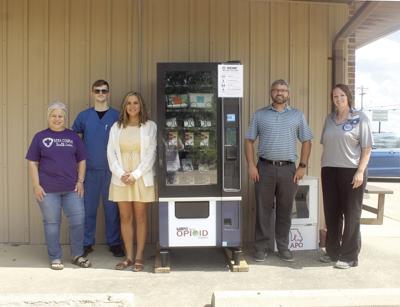
Another recent addition to DCHC was made available to the public Aug. 26—a community resource vending machine. The machine is on the left of the facility and features a multitude of resources—free resources for the entire community. Resources include Narcan, a medicine that can be used to treat opioid overdose, provided by Missouri Institute of Mental Health; emergency contraceptive kits, provided by Missouri Family Health Center, Inc.; drug disposal pouches, provided by Prevention Consultants of Missouri; harm reduction kits, provided by Four Rivers Community Health Center; and a wealth of brochures, including some for Compass Health Network’s Crisis Access Point, Russell House, and more. The vending machine itself was given to DCHC from Meramec Regional Planning Commission, shared Moser, as they were wrapping up a grant for opioids.
The first time Moser saw a resource vending machine like the one beside the facility now was in Richland, as provided by Central Ozark Medical Center. He thought the vending machine was a great idea and was inspired to bring it to Dent County. Moser shared there’s been a newspaper style dispenser beside the facility for a year now, featuring only Narcan, but the recent addition of alternative resources is new.