A new law effective Aug. 28 that modifies the current salvage title requirements received its start in Salem, but will have statewide effects, according to Jamie Schwartz, owner of The Auto Connection.
The legislation, known as House Bill 1150, sponsored by State Representative Jason Smith, was signed by Governor Jay Nixon. Schwartz started a grassroots campaign to get what he said “burdensome” regulations changed on salvage titles.
Schwartz said under the old law when a vehicle was determined to be “totaled” on an insurance claim, the title to any given vehicle is sent to Jefferson City to the Department of Motor Vehicles (DMV) and destroyed. A salvage title is issued.
The salvage title is a negotiable document that a person can buy and sell with, but not buy license for, Schwartz said. To accomplish being able to buy license for a vehicle that has had a salvage title issued, that vehicle by law was to be restored to its original condition.
“The problem with this is that when you are looking at older vehicles it quickly becomes more expensive to repair that vehicle than it is worth,” Schwartz said. “That being said, there are many vehicles sold with salvage title that are perfectly functional and make good inexpensive transportation, but don’t warrant the expense to bring them back to original condition.”
The legislation basically removes the Highway Patrol requirement that has been in place that required vehicles to be restored to their original condition before passing inspection. The bill will apply to salvaged vehicles 10 years of age or older.
Smith said owners of such vehicles are not required to restore such vehicles to their original appearance in order to pass or complete the vehicle examination. It’s basically a cosmetic issue, and owners would still need to pass the safety inspection portion to meet the guidelines of the Highway Patrol.
“This greatly reduces the burden on the owner without compromising the Highway Patrol’s ability to determine if a vehicle contains any stolen parts,” Smith said.
Schwartz said current salvage requirements hurt those looking for inexpensive transportation. New laws will not only help those people, but give business owners more income sources.
“The total amount of time and money I spent on this issue, in certified letters, stamps, gas as well as secretarial expenses, were minimal compared to what we have gained in commerce freedom,” Schwartz said. “I am not by any stretch of the imagination what you would call an activist nor politically motivated, but when it came to an issue like this that affected so many aspects of my business as well as personal life, I felt I had to pursue this with as much energy as possible.”
The salvage issue arose in October 2011 from Schwartz Salvage selling a 1997 Dodge pickup to Mike Fudge. Schwartz said this was a perfectly functional vehicle with very minor cosmetic damage only.
“When the Highway Patrol rejected this vehicle from salvage inspection because the minor damage wasn’t repaired, it forced me to turn to my legislators for relief,” Schwartz said.
Schwartz said he contacted Smith and State Senator Dr. Dan Brown. Then he wrote the” Salvage Title Issue” letter in which he sent copies to Brown and Smith’s offices by way of certified letter.
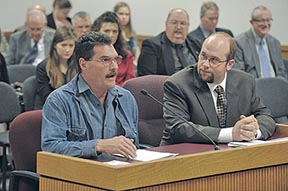
Schwartz and his father, Frankie, made several trips to Jefferson City to speak before the State Transportation Committee, the House Transportation Committee and to the Transportation Chairman, Charlie Dennison.
“Denison had reservations as the bill was written and made the suggestion to make the requirement 11 years and older,” Schwartz said. “I had my thoughts on that but agreed and that let the bill pass through committee.”
Smith then reworded the bill and changed it back to 10 years.
“It was amazing at how much interest all the legislators had in this issue,” Schwartz said. “By any standard the response I received during this whole ordeal was positive. From my understanding, after the fact, this bill being introduced as well as passing and becoming law in only nine months is very unique in that it usually takes years. Both Senator Brown and representative Smith were outstanding in working with me to resolve this issue.”