
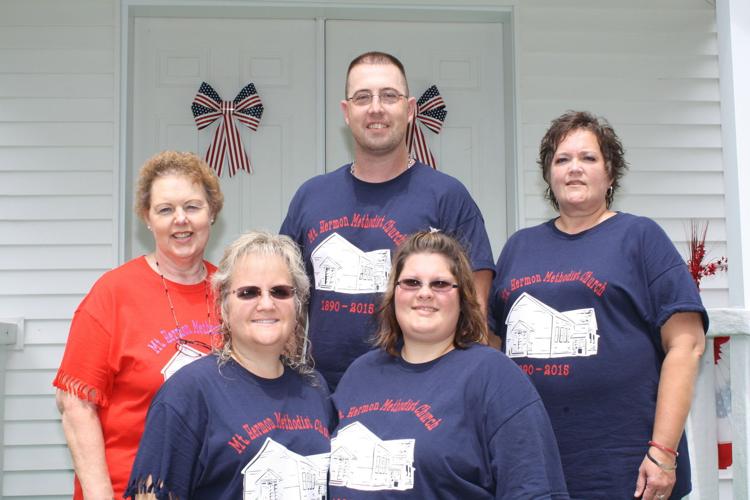
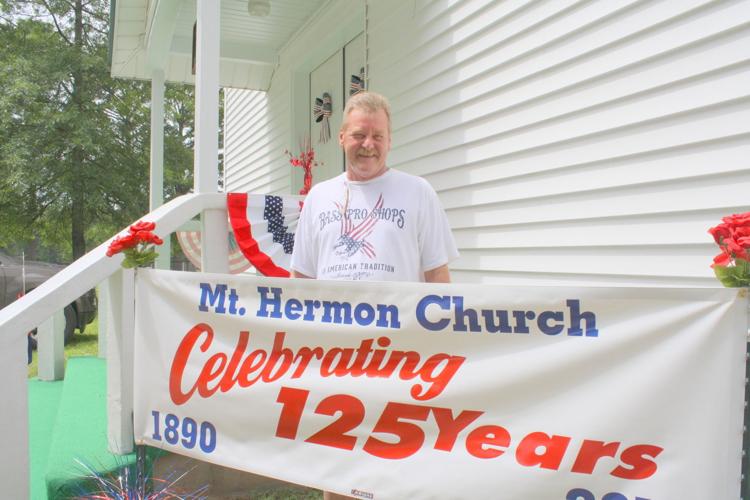
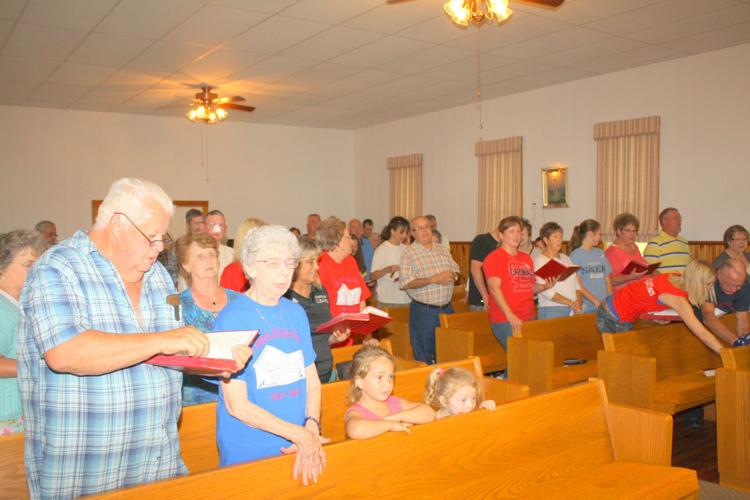

The interaction of the spiritual and practical needs of a rural community is reflected in the history of Mt. Hermon United Methodist Church, located 10 miles west of Salem on Highway CC.
Over the past 125 years, the spiritual discipline practiced by Methodists at Mt. Hermon has raised and refined local values. At the same time, the congregation has made a continuing effort to adapt itself to meet the changing needs of the community.
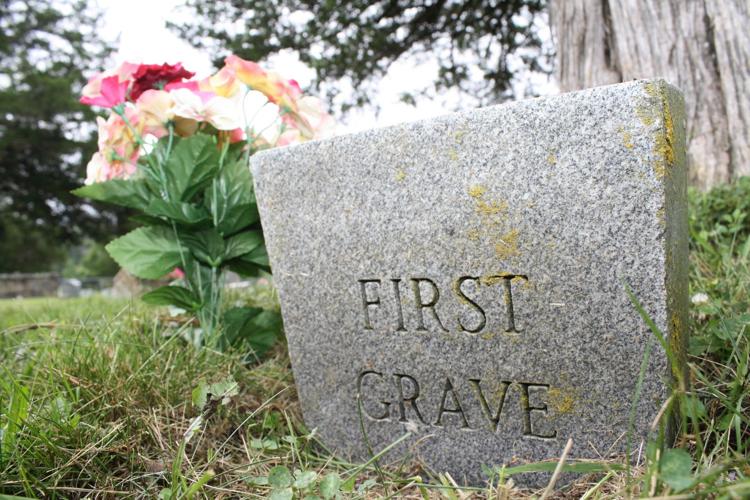
The old White River Trail which pioneers followed west had a favored over night stop at Skiles Spring. When one wagon train stopped in the 1840s, a child became gravely ill. His family remained at the spring when the train moved on. The child worsened and died. The mother thought a nearby hilltop pretty, and wanted her little one buried in the shade of a cedar tree that grew there.
The parents sought out the owner of the land and were granted permission to bury their child there. In the following years local families began to use the site to bury their dead.
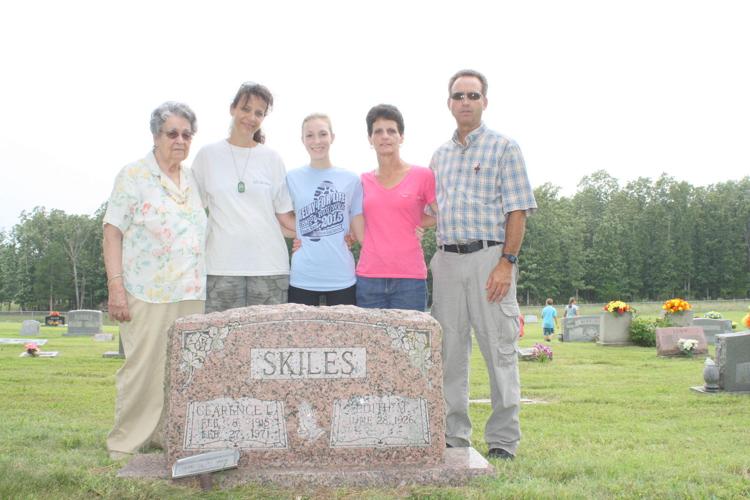
When a congregation that had been meeting in the home of Mary Hunt Boyd and at Boyd School became big enough to need its own sanctuary, the leaders chose to build next to the cemetery. In 1884 Hezekiah Skiles deeded two acres including the early graves to the Methodist Episcopal Church, South, for a community cemetery. At the same time, Mary Hunt Boyd deeded an adjoining two acres to the denomination for use as the site for a church building. In the years since, Mt. Hermon Church assumed responsibility for providing and maintaining burial plots for the surrounding community.
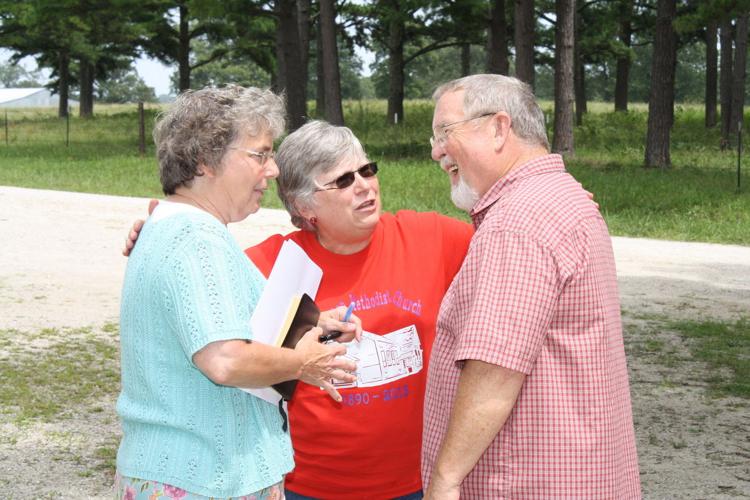
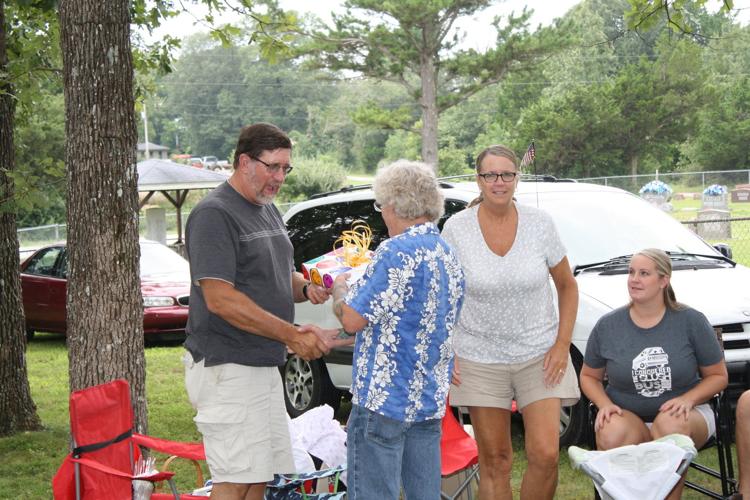
For longer than most anyone can remember, there has been an annual "graveyard working" the second Saturday of August. Residents, members, and nonmembers alike have often gathered to mourn the passing of a friend or relative, or to join in this cleanup effort. For a good many years, though, donations have paid for the cemetery to be mowed, making the cleaning unnecessary. The annual meeting has evolved into a homecoming, with dinner on the grounds.
Although the Methodists began supporting the cemetery in 1884, it wasn't until several years later that their own church building was completed. By most accounts, the first funeral to be held in the church (although still not fully completed) was that of Mary Hunt Boyd in 1887.
Charleen Pewitt Turner recalls her late cousin D.E. "Doc" Boyd said, "that his father, Alfred, laid up stone for the foundation." Ben Day, Martin Cox, John Cox, Marion Cox, Ephraim Skiles, William Boyd, John Boyd, Michael Jones and his sons, Cass, Elijah and Absalom, were among the others who pitched in with labor and materials. "Uncle Mike" Jones is remembered in particular for contributing $75 for materials for the church.
Uncle Mike's wife, Nancy Hunt Jones, was a sister of Mary Hunt Boyd. His father, Joshua T. Jones had came to Dent County from Kentucky in 1840. The family was known for its Northern sympathies and Republican politics. Mike Jones took his politics so seriously that in 1865 (the last year of the Civil War and a time of continuing guerrilla warfare by Southern bushwhackers) he named a son Ulysses Grant Jones.
When the Church building was completed, the community gathered for a dedication service. A plaque was nailed to the building identifying it as the Mt. Hermon Methodist Episcopal Church, South, when Uncle Mike stepped forward to offer another $75 toward expenses if the word "South" were to be removed.
The congregation paid a high price for its affiliation that day. It turned down his offer. Uncle Mike kept his money in his pocket, but he also maintained a friendly relationship with the church. He had been outvoted, but his opinions continued to be respected by church members. Of his sons, Absalom stayed closed to the church over the years, but Joshua, Uncle Mike and many other members of the Jones family are buried here at Mt. Hermon Cemetery.
It wasn't until 1939 that Mike Jones posthumously had his way. In that year, the Methodist Churches, North and South, merged to become the Methodist Church. Another merger in 1968 resulted in the current organization of churches, The United Methodist Church.
In being ordained, a Methodist minister agrees to accept his Bishop's appointments. He becomes an "itinerant minister." For many years, the practice in the Methodist Church was to frequently move ministers from one parish to another. The average stay of a minister at Mt. Hermon during the first 40 years was about four years.
Soon after the congregation first gathered at Mary Hunt Boyd's home in the 1880s, the Bishop arranged for a "circuit rider" to periodically minister to the group. As the church grew and required more pastoral services, a pastor was assigned whose only other charge was the Anutt Methodist Church.
Current church member, Charleen Pewitt Turner recalls her late cousin, Doc Boyd, saying he fondly remembered some of the ministers from that era. He said, "That Anderson Bowles, the minister that preached his mother's funeral, Ionia Carney Boyd in 1912, was an effective organizer. His friendly demeanor brought many new people to the church, and his preaching and Sunday School leadership kept them there.
Rev. J.C. McDaniel followed soon after Bowles. His exceptional preaching brought in still more families. The church was often so full that children had to stand on the benches between their parent's knees. One Sunday the crowd of worshippers even cracked one of the building's sturdy hewn oak floor joists.
Rev. John Dawson is remembered as a "dandy preacher," but members regret the Bishop only let him stay one year. "Sometimes we'd just get used to one when they'd move him on," Charleen Pewitt Turner recalls her dad and mother (Donald and Pauline Pewitt) saying, "Usually when a new preacher came in, the congregation wouldn't know who it would be until the first Sunday he preached."
The system generally worked well, though. "Each preacher has their own contribution to make," Sometimes we'd get perturbed when they moved one on, but generally the Bishop and the District Superintendent made good decisions.
In the late 1930's, Mt. Hermon was first grouped as a pastor's "charge" with the growing Methodist Church in Salem. Rev. George Sparling was the first minister to serve the two churches. Except for a brief period in the 1950s when Mt. Hermon was again grouped with Anutt Methodist Church, Mt. Hermon shared a pastor with Salem until 1981.
Attendance at Mt. Hermon had peaked in the 1940s. Members went to war and took factory jobs in the city. Farms got bigger and families got smaller. By the 1960s, attendance had fallen to 8-10 worshippers for the twice-monthly services. Following church policy, however, the bishop was willing to see that the congregation had adequate pastoral oversight as long as there were any members left.
By 1981, the bishop's patience had been rewarded. When the Salem church began holding two Sunday morning services, it became impossible for the late Rev. Paul Metcalf to also hold services at Mt. Hermon. The denomination supplied the late Rev. Phillip Inman for weekly services at both Mt. Hermon and Anutt United Methodist Churches.
The modest rise in population in the Mt. Hermon area, together with the promise of regular Sunday morning services, had begun to bring more people to the church. For once, more people were coming from town, they liked our little country church where they were able to know everybody. They knew that if anyone had a problem, everyone else would pitch in and help.
A heritage of effective spiritual work by women in the church can be traced back to Mary Hunt Boyd, but a club was not organized until 1916. In that year, Mary's daughter, Dora Boyd Pewitt, brought together churchwomen to form the Mt. Hermon Ladies Aid Society. The first project of the club was raising money to dig a cistern so water wouldn't have to be carried the quarter mile from the Skiles Spring.
It is recalled that the necessary money was raised partially by the women pledging a dime a month. Dimes were hard to come by back then.
After the cistern had been dug, the Ladies Aid went on to provide the church with, among other things, a wood shed, storm windows, a piano, furnace duct work, hardwood flooring and a kitchen.
Among the persons performing the labor on these projects were Edgar and Walter Mauzy, John Cox, and Ephriam Skiles.
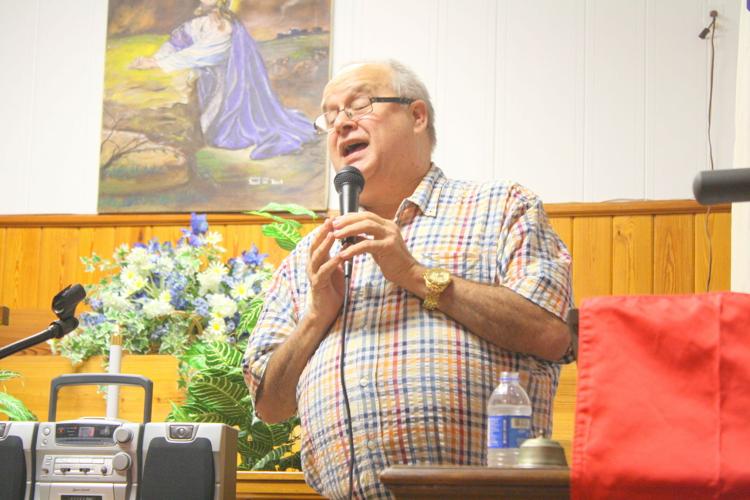
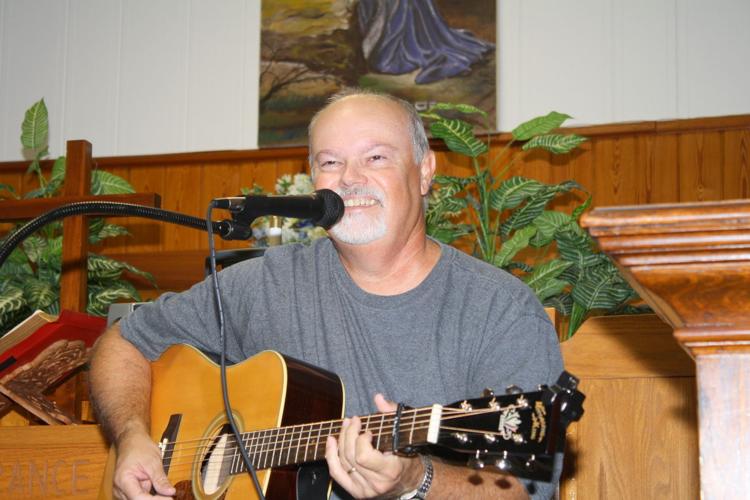
An important link Mt. Hermon Church has had with the community is singing. Quartets and choirs from Mt. Hermon used to sing all over the area. They sang in various other churches, at funerals and weddings, and yearly at the singing convention held at the Salem City Hall.
The late Alfred Boyd and his son, Doc, were renowned for the "shape note" singing schools they would hold wherever there was an interest.
In reminiscing about old times at Mt. Hermon, Charleen Pewitt Turner remembers Doc Boyd saying, “I regret the lack of a choir. … If you haven't got a choir, church can sometimes be dull.” Doc always said, “I look forward to a time when attendance will rise again to the point where the church can have a choir."
It makes the members happy just to be able to make some changes, like adding all new windows, vinyl siding, a new metal roof, new kitchen cabinets and new linoleum, which has all been done in the past 10 years; for so long we had to worry about keeping the church doors open. Mt. Hermon United Methodist Church will continue to take seriously its responsibility to serve the practical and spiritual needs of the community.
Each Sunday at 10 a.m. our church doors are open, and we hope that people living in the community and surrounding area who do not attend a church will come to Mt. Hermon. Once again, we are gaining members, and we want you to know, you are always welcome and will be made to feel right at home. Our pastor, Gaye Lynn Blankenship, and members are always ready and willing to lend a helping hand. Our mission is a life of love through service to Jesus Christ. "The Little Church with the Big Heart."