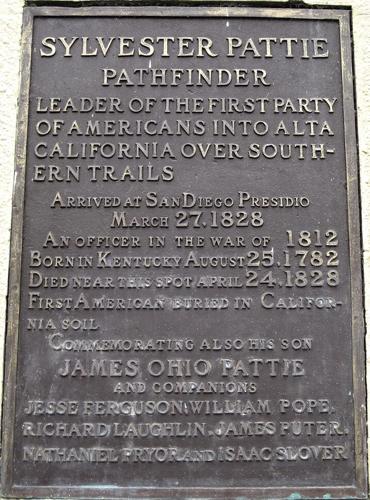
Sylvester Pattie left Slabtown in Texas County in the 1820s and only a few years later was among the first Americans to reach California by taking a route south of the Rocky Mountains. His gravestone in San Diego proclaims him the first American buried in Californian soil.
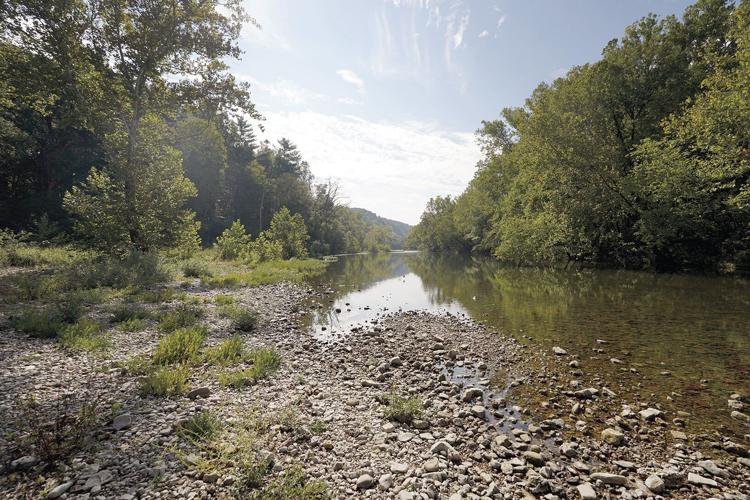
Today’s Patty Creek Wilderness in the Mark Twain National Forest takes its name in part from Slyvester Pattie. Patty Creek was named in his honor, and the wilderness area in turn named for this natural feature. Pattie’s settlement of Slabtown can still be found on the map in Texas County.
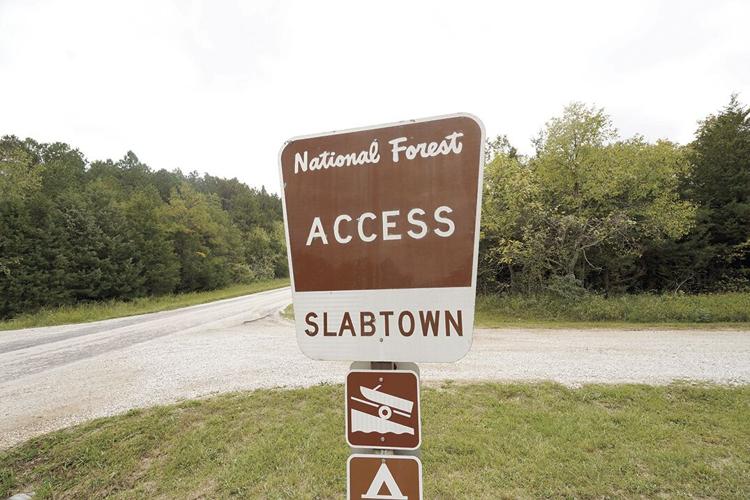
The furthest reach of American settlement into the Ozarks 200 years was a sawmill established by Sylvester Pattie at Slabtown in Texas County. The area today is home to the Slabtown River Access of the Mark Twain National Forest.
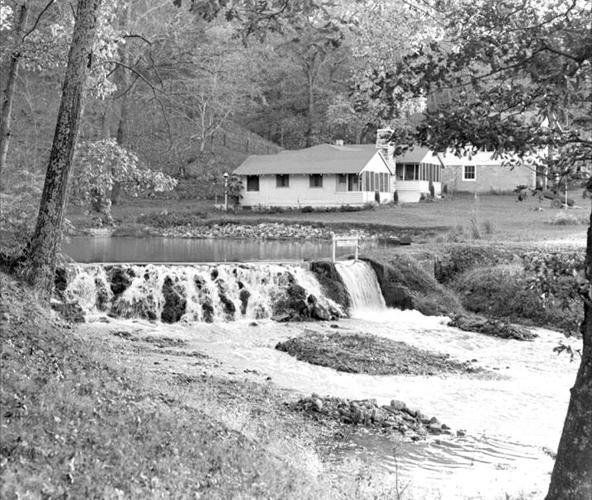
Slabtown Spring in Texas County as it appeared in the 1950s. Frontiersman Sylvester Pattie established a sawmill there 200 years ago as the furthest reach of American settlement into what was then a vast Ozarks wilderness.
Sylvester Pattie left Slabtown in Texas County in the 1820s and only a few years later was among the first Americans to reach California by taking a route south of the Rocky Mountains. His gravestone in San Diego proclaims him the first American buried in Californian soil.
Sylvester Pattie is not a household name in the Ozarks. His legacy today is all but forgotten and most notably lives on as namesake for the Mark Twain National Forest’s Patty Creek Wilderness, although even that title misspells his surname. It’s a dramatic development for a figure who once filled so many molds of the early frontier. Pattie can justifiably be called a pathfinder, founding settler, intrepid western explorer and American martyr.
Two-hundred years ago Pattie presided over the settlement furthest up the Big Piney River when the Ozarks was a vast wilderness prior to Missouri’s statehood. A few years later, Pattie was among the first Americans to reach California by taking a route south of the Rocky Mountains. These achievements being forgotten today is something of a mystery. It’s perhaps the controversies balancing his accomplishments that explain Pattie’s anonymity. Depending on which account you believe, Pattie can be remembered as either a hardy hinterlander, selfish scoundrel or something in between.
What’s known of Pattie comes from four main sources which don’t agree on the facts of his life. Pattie’s son, James, chronicled the adventures he and his father shared to author Timothy Flint in 1831’s “The Personal Narrative of James O. Pattie.” Historian Richard Batman later academically expanded on this account in his book “American Ecclesiastes.” Ozarks historian Lynn Morrow has built upon Batman’s work in several articles on the region’s early lumber industry. Local writer Rick Gunter weaved this information together in a multipart series on Pattie published in the Houston Herald in 2017.
Pattie was born in 1782 when the Revolutionary War was still one year away from ending. The Kentucky frontier was his first home. Still a rough-hewn territory, his father was the day of his son’s birth away burying dead after the Battle of Blue Licks. Once grown, Pattie followed the preceding example of Daniel Boone in relocating in 1812 to St. Charles, Missouri. He arrived just in time for war to break out again with the British.
What’s known for sure is Pattie enlisted in a militia regiment commanded by Daniel Boone’s son, Morgan, to defend the state. However, his war record is a subject of controversy still today. Flint, who authored James Pattie’s 1831 chronicle, claimed the elder Pattie was commanding Fort Cap au Gris at the confluence of the Cuivre River and Missouri River when the enemy attacked. Flint wrote Pattie requested two volunteers from the fort to sneak past British forces and request help from Fort Bellefontaine in St. Louis. When no one stepped forward, Pattie completed the task himself disguised in a redcoat uniform. He then returned with 500 soldiers as reinforcements and broke the siege.
Is this feat truth? Flint claims hearing the account firsthand from veterans under Pattie’s command. However, Batman and Morrow are skeptical. What can be confirmed by documentation is Pattie was promoted to the rank of lieutenant and was put in charge of Fort Cap au Gris for a period. There is no record of Pattie’s heroics though, only correspondence with then general and territorial governor William Clark about deserters and a stolen horse far to the north.
What Pattie’s war service did accomplish was ingratiating him more him with the Boone family. Following the war’s end in 1815, Morgan Boone led an 1816 hunting party into the unsettled land far into the Ozarks’ interior along the Gasconade River. Pattie was invited to join the expedition. Upon seeing the towering pines of the highlands, Pattie envisioned not belts, but industry. Specifically, a “sash” style sawmill which could harness the flow of a spring or river to power a vertical blade and cut pine into board feet on the steady downward stroke.
In American Ecclesiastes, Batman framed this turning point for the Ozarks by writing:
“As the hunter passed through the Ozarks, he saw the country from only one point of view. The large number of caves were good places to seek shelter on a rainy night and possibly a place to flush out a bear or panther. The vast stands of pine forests were made up of individual trees that might contain squirrels, possums, and coons. The springs that abounded in the Ozarks were watering places for deer or elk. The hunter accepted these things as they were and instinctively knew that change would almost instantly destroy the game, and with it the hunters’ livelihood. By 1815, however, there were men entering the Ozarks who saw the country in a different way. The caves were a source of saltpeter, which could be extracted and used to make gunpowder. The pine forests were a source of lumber for which there was a lively market in St. Louis. The springs and streams were a source of power for sawmills that could turn forests into lumber for the expanding towns of Missouri. In the Ozarks the day of the hunter was already passing, the day of the enterprising settler was arriving.”
Slabtown Spring in Texas County as it appeared in the 1950s. Frontiersman Sylvester Pattie established a sawmill there 200 years ago as the furthest reach of American settlement into what was then a vast Ozarks wilderness.
State Historical Society of Missouri
Pattie picked a spot about 40 miles up from the Big Piney River’s confluence with the Gasconade for his sawmill. The spot was where a then unnamed spring and creek connected with the river within a valley framed by steep cliffs of limestone. The creek is now called Patty Creek in Pattie’s honor. The place was dubbed by visitors as Slabtown for the slabs of wood Pattie cut and used for the settlement’s construction. The great spring resultingly is now known as Slabtown Spring.
The furthest reach of American settlement into the Ozarks 200 years was a sawmill established by Sylvester Pattie at Slabtown in Texas County. The area today is home to the Slabtown River Access of the Mark Twain National Forest.
Andrew Sheeley
Historian Lynn Morrow provides insight into Pattie’s road to profit. He and other sawmillers along the Gasconade and Big Piney rivers felled timber, cut it into board feet, formed it into rafts and then floated these wooden fortunes downstream on an epic float trip to St. Charles or St. Louis. Writer Rick Gunter details the task of transporting the lumber required forming the cut boards into a 16-foot by 16-foot square containing around 8,000 board feet. This was called a “crib” and each one was worth a fortune on the frontier. A productive miller could even connect several cribs together for the trip and bring along whatever belts or products acquired from the forest to sell in the city.
Today’s Patty Creek Wilderness in the Mark Twain National Forest takes its name in part from Slyvester Pattie. Patty Creek was named in his honor, and the wilderness area in turn named for this natural feature. Pattie’s settlement of Slabtown can still be found on the map in Texas County.
Andrew Sheeley
Pattie began cutting pine at Slabtown and floating it downriver to St. Louis area markets as early as 1816. However, another fact Morrow highlights about the early Ozarks were its many court disputes. In Pattie’s case, the litigation included who arrived first to Slabtown. A lawsuit filed by William Thompson in St. Charles alleged Pattie and a band under his command ran him off at gunpoint from his homestead by Slabtown. This was one of many lawsuits involving Pattie and his friends. Eventually, Pattie did somewhat prevail in the case over Slabtown when Thompson died in 1819. By that point, Pattie was funding another lawsuit against Thompson filed by Thompson’s own estranged wife.
During his years at Slabtown Pattie’s work was an anchor which brought the Ozarks into the modern world.
“When Slyvester established his mill, he completely changed the area in which he settled. A gristmill was always a sign along the frontier that an area was ready for permanent settlement by farmers,” Batman wrote. He later added, “Owning a mill brought a man like Pattie more than wealth. It also put him at center of community life, for a mill was not just a place to obtain lumber or to grind grain into meal or flour. Most millers added distilleries, breweries, wood-carting mills, cotton gins, or in Pattie’s case, a blacksmith shop. They often served as middlemen, bringing in good from the outside world to be sold or traded.”
Pattie enjoyed great success at Slabtown and became one of this area’s richest men at the time. However, he chose to abandon his sawmill in the 1820s and instead return to the wilderness. Why is also another point of conjecture. Flint wrote that when his wife died, Pattie was too heartbroken to continue living at their family homestead. Morrow and Batman also look toward Pattie’s strained legal debts for his decision to sell out his business. Nonetheless, Pattie sent his children to live with relatives in Kentucky in deciding to leave Missouri to explore west. He took only his son James with him.
Pattie and James left Slabtown in 1824 to travel up the Missouri River as far west as Council Bluffs in what is today Iowa. There, the two were turned around by a federal agent for not possessing a permit to travel furthest upriver. Decisive for the fate of Pattie was fact an expedition led by Sylvester Pratte was just then traveling south heading for Santa Fe in a newly independent Mexico. Pattie not only joined this band, but according to his son, was given its command of the more than 100 adventurers in respect to his war experience.
Once in New Mexico, Pattie and his son began trapping Beaver along the Gila River. James Pattie later told Flint they were given permission to trap after saving the daughter of the Mexican governor from a kidnapping. In reality, Batman writes they were probably hunting illegally.
The next few years are an intriguing and thrilling time for Pattie and his son, but also mysterious. Flint writes James Pattie claimed they hunted as far north as the Yellowstone River, trapped beaver as far west as the Salt River in Arizona, and dug copper at the famous Santa Rita mine in New Mexico. They also battled Native tribes, collected thousands in furs, and they claim had their fortunes stolen by raids and betrayal. Along the way they were at one point forced to eat the horses and the end of one expedition saw half their hunting party abandon Pattie due to exposure. In 1827, Pattie, his son, and his last six followers built canoes and floated down the Colorado River to its mouth at the Gulf of California.
The stories James Pattie recited of his adventures with his father are legendary among frontier historians, if not also mythic in their veracity. Historical records do confirm some of the claims. Contemporary historians also conclude James Pattie’s accounts are accurate in their description of places, peoples and customs of the southwest during that era. However, many of the tales are unbelievable for the embellishments the younger Pattie claimed, or that Flint heaped upon him as author.
What’s confirmed is from the Gulf of California Pattie and his son next made their way to San Diego. The group are the first known Americans to ever arrive to the west coast using this southerly route. In lieu of being welcomed for this feat, Pattie, his son and the rest of the group were arrested on suspicion of forging Mexican documents permitting their activities.
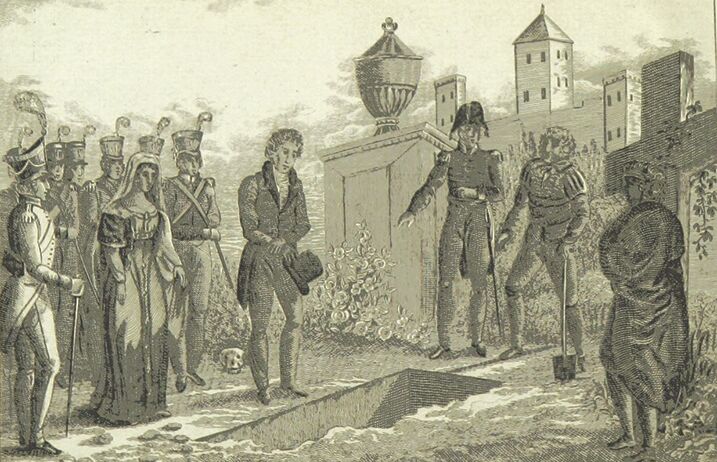
At the time of his arrest the elder Pattie was already ill. His condition worsened in prison and there Slyvester Pattie died on April 24, 1828. His tombstone in San Diego’s Presidio Hill Cemetery declares him to be the first American buried in Californian soil.
An engraving of Sylvester Pattie’s 1828 burial in San Diego included in the 1831 book written by his son, James, and author Timothy Flint.
British Museum
James Pattie related the fate of his father and stories of his adventures to the captain of an American ship in port at San Diego. The younger Pattie was put to work as a translator for the Mexican governor. The account of Pattie’s son was then published in a St. Louis newspaper, providing his family with the first news of their whereabouts for at least four years. The younger Pattie was afterwards released from prison.
Over the next two years James Pattie traveled through California, hitched a ride to Mexico City, and had a personal meeting arranged by an American diplomat with the president of Mexico to protest his treatment. Pattie received no compensation but was given a visa to Vera Cruz. From there, Pattie sailed back to the United States via New Orleans.
Lucky for James Pattie, Louisiana’s US Senator Josiah Johnston was an old friend of his father from Kentucky. Following a chance meeting, Johnston arranged passage up the Mississippi River for James Pattie. It was on that trip Flint heard the younger Pattie tell his tales of the west. Together, the two pinned these stories as a personal narrative. Their book was so popular it was published and republished well after James Pattie’s death in the early 1850s.
Today, Slyvester Pattie’s legacy is an intriguing one for Missouri and its bicentennial passes. As the state first became part of the American sphere, Pattie was among its modernizing forces. However, this founder abandoned this task and what riches he could gain for himself and his family. Instead, he again sought out a wild frontier that he could see was quickly disappearing in the Ozarks.
As a historical figure you can measure Pattie’s significance in many ways. He has a grand plaque and gravestone for himself in San Diego provided by the Daughters of the War of 1812. His son’s book about his life is even still researched today nearly two centuries after his death.
Local writer Rick Gunter put it best in appraising Pattie as an Ozarker. For the Houston Herald, Gunter concluded, “It has been 200 years since Slyvester Pattie built his sawmill on the Big Piney River. A lot has changed through the years, yet the logging of yellow pine still continues. To this day, there are surviving houses and barns in Texas County still showing the weathered pine boards with the distinctive yellow streaks. Some of the old barns look as though they are ready to collapse, yet they are still standing strong against winds. The old boards of yellow pine that came from the first growth forests are extremely resistant to rot and the elements. In St. Louis there are many old structures still standing that were built of Piney River pine planks.”