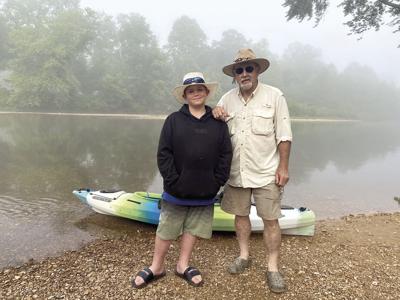
I moved to the Missouri Ozarks in 1973 to get near the many rivers that course their way through the gorgeous Ozark Mountains. I’ve since canoed and kayaked thousands of miles on these sparkling jewels that we enjoy as free flowing rivers. I often travel alone and travel at my own pace utilizing my own personal paddling style. However, I recently kayaked the Meramec River with my 12-year-old grandson. Everything changed.
Twelve-year-old boys are a miracle. They are at that gangly stage of life when they are trying to figure out a myriad of life’s mysteries, while negotiating their way through school, friends, and their parents. They are an open book ready to take on a world of new experiences and hoping to find a place amidst all the confusion in the world.
Paddling a craft downriver on your own is a perfect way to bring clear perspective to the world around you. Pushing off into the current is a mesmerizing experience, which focuses your attention on one objective: keep your kayak tracking in the right direction, and stay upright. It takes some learned skills to do so.
Ronnie had experienced kayaking on small ponds and lakes and short distances on a flowing river. This would be his maiden voyage on a 7-mile journey downriver. Exuberant with youthful energy, he tackled the adventure with the confidence of an experienced paddler.
Before shoving off for the day, I reminded Ronnie of the ABCs of river safety. A. Always wear your personal floatation device, PFD, which is required by law in many areas. B. Bottom down, feet up. If you fall into the water and are floating downstream, the safest method is to keep your bottom low and your feet up. This prevents your feet from becoming wedged under a rock or underwater debris. Should that happen, people often succumb to the powerful flow of the current, are bent over forward and subsequently drown. C. Climb that root wad. Root wads, downed trees, and logjams are most often the greatest hazards floaters encounter on Ozark streams. Those who capsize and wind up in the water often find themselves being washed into one of these obstacles. The natural response is often to attempt to push away from these obstacles. The result is sometimes being swept underneath these obstacles. To prevent being washed under, one should attempt to climb them and get out of the water.
I love to float along and fish for smallmouth bass. Ronnie was far more interested in steering his new kayak and pushing on downriver. I reminded him that it was only a seven-mile float and we would be on the water for over seven hours. Grandma Dian would pick us up at 3 p.m. We needed to pace ourselves.
Ronnie entertained himself by floating slightly ahead and then paddling back to my position. His youthful energy supported his enthusiasm. However, I wondered how long his strength would last.
With temperatures headed towards the low-90s, the morning warmed up quickly. The fish weren’t cooperating, so Ronnie asked if we could stop at a particularly sandy beach to swim.
We had no more landed than Ronnie was in the water, oooohing and aaahing about how cold it was. I grabbed a cool drink and sat down in the warming sand. It felt so very wonderful. I relaxed and enjoyed Ronnie’s antics as he cavorted in the water, both swimming and attempting to catch minnows with his hands.
Ronnie became so enamored with the abundance of minnows in the river that he began to fashion a plan as how he could catch them. He had witnessed me on previous trips as I fashioned a large Coke bottle into a minnow trap. The closest thing we had with us was a very small coke bottle.
We carved the opening out of the bottle, reversed it to make a wide funnel, and inserted it back into the bottle. Super-glu would have been very helpful. Regardless, Ronnie crumbled some left-over donut into the bottle and anchored his make-shift minnow trap in shallow water with rocks.
Minnows quickly picked up the scent of the donut particles from the trap and soon schools were circling it. Ronnie was ecstatic.
Thirty minutes later Ronnie’s minnow trap had not yet caught a single minnow. We surmised that either our design had a flaw, or that minnows simply did not like small Coke bottles.
I caught a short nap on the warm sand, but Ronnie’s raucous laughter shook me from my snooze. We climbed back in our kayaks and headed downstream.
The Meramec River engulfed us in conversation about the beauty of God’s creation. Wildflowers and towering oaks blanketed the hillsides. Turtles basked in the warm sun, bullfrogs bellowed from the stream banks, and hawks soared overhead. It was a perfect day on the river.
As twelve-year-old boys do often, Ronnie grew hungry. We had packed a splendid lunch of peanut butter and jelly sandwiches, fried chicken, donuts and crackers and cold drinks. The sandwiches were for Ronnie and I would eat the chicken. You know what they say about the greatest laid plans. He ate most of the chicken, too!
As the day wore on, Ronnie’s confidence in his padding skills grew. He had followed me through swift spots and handled it perfectly. His new found confidence spawned an adventuresome spirit. He pushed ahead of me a bit. We could hear rushing water downstream.
Ahead lay a turn in the river with water piling up against the right side. The water was swift, but not over three feet deep.
I held back to watch him take on the run. His approach was a little to the right. He understood that if he paddled faster than the current, he could better maneuver his kayak. Regardless, his kayak crashed into the overhanging debris and he flipped. He remembered his ABCs and handled it like a pro. Proud grandpa moment!