
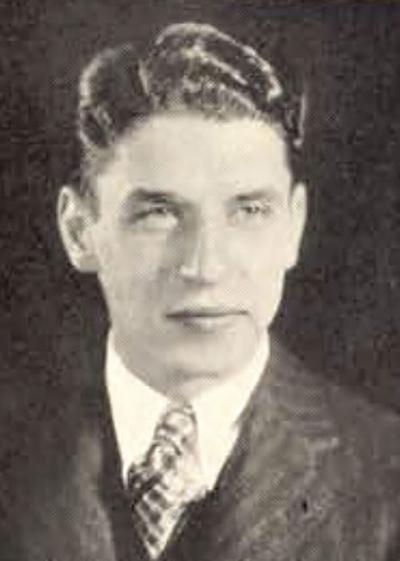
Of all Rolla collegiate graduates, there is perhaps none more notorious as Albert Mueller. Ambitious and brilliant, Mueller found success as a dutiful German immigrant in the early 20th Century. However, traitor can just as aptly be applied to the wayward engineer. For Mueller chose to lead the St. Louis’ German American Bund chapter, and in that role, became Missouri’s most vocal defender of the Nazis.
“I'm still trying to get into his head figuring out why this young gentleman, who in my opinion was living the American Dream, would be enamored by National Socialism,” said Prof. Petra DeWitt. “When he's being interviewed, and being quoted in the newspaper, he appears to like hero worship of Adolf Hitler.”
DeWitt shared what’s known about Mueller during an Oct. 20 public lecture at Missouri S&T’s Curtis Laws Wilson Library titled, “Hitler's American Friends, the German American Bund in Missouri.” It was held as part of the library hosting Americans and the Holocaust, a traveling exhibition of the United States Holocaust Memorial Museum and American Library Association. It will remain on display until the end of the month.
DeWitt said Mueller was born in Frankfurt in 1905 and then immigrated to the United States in 1921.
“He's a very intelligent, bright young man. One newspaper article noted that he received a full scholarship from Washington University in part because he had graduated from high school in two and a half years,” DeWitt said. “He came to the United States only speaking German, and he graduated from an American high school in two and a half years. He was very dedicated to his studies. He learned English very quickly. What he loved to do was read books. A reporter asked him once, ‘Don’t you like girls?’ – ‘No, I want to read books.’”
Mueller declined the invitation to WashU and instead chose Rolla and the Missouri School of Mines for education. DeWitt said his dream in life was to be a mining engineer. Unfortunately, Mueller’s timing couldn’t have been worse. The same year he graduated saw the Wall Street stock market crash and beginning of the Great Depression.
While the turmoil of the 1930s gave rise to Germany’s Nazi Party, the American branch of that fascist movement leafed into the German American Bund. DeWitt said Bund members were as anti-Semitic and hateful as their German counterparts. They were mostly made up of recent German immigrants and older ones who’d faced bad treatment by the United States during World War I.
“To these disillusioned individuals, the Great Depression only confirmed that democracy and capitalism do not work,” DeWitt said.
The German American Bund was in many ways a mirror of Germany’s Nazi Party. It had an “American Fuhrer” in the form of Julius Fritz Kuhn as well as a stormtrooper-like militia known both as either the Oberdienst or “honor guard” depending on who was asking.
There were also Nazi agents who supported the Bund’s cause. One, George Sylvester Viereck, even infiltrated Congress and used its offices to spread propaganda. Strategic support from Germany was also at times present. For example, DeWitt read aloud a 1937 quote from Nazi Herman Goring saying, “Germans in the United States need to be organized, because if Germany should again go to war with France and England, there may come a moment when the United States might consider entering such a war and the groups of organized Germans might throw their influence decisively against a declaration of war and prevent the United States from entering such a conflict.”
Mueller led the St. Louis Bund to its greatest prominence in 1937. The group gained around 100 members and won headlines with the creation of its regional headquarters and camp called “Deutsch Horst” – which roughly translates to “German Eagles Nest.” It was located along the Meramec River near LeMay Ferry in St. Louis.
“During summer camps, youths, both boys and girls, were indoctrinated into National Socialism in similar fashion as the Hitler Youth in Germany,” DeWitt said. She also cited Mueller as claiming the Bund “was formed by people who would not tolerate the attacks on a great man like Adolf Hitler and on the German people in general.”
Mueller and the St. Louis Bund hoped Missouri could be an epicenter of Nazi activity in America. However, they found no favor upon announcing plans for a largescale gathering.
“When it became clear the Bond wanted to hold a national convention in St. Louis, nobody was talking about the economic impact if you bring all the chapters from the Midwest to St. Louis; they were concerned what St. Louis would look like when all of a sudden all these swastika flags will be showing up,” DeWitt said. “The Bund continued to plan out its meeting, then when the actual program was announced in the newspapers, all heck went loose. St. Louisans created the Council for American Democracy for the specific purpose of holding counter demonstrations to this proposed Nazi convention.”
The pushback in St. Louis was fierce. DeWitt said the Bund was banned from the city’s German heritage events and establishments. Protestors also began to thwart Bund speeches and activities. Plans for the national Nazi convention were soon dropped. A Post-Dispatch editorial noted, “German Americans of St. Louis, as shown by their constant rebuffs of Nazis and Nazism, are distinctly not fertile soil for the machinations of Adolf Hitler's American agents.”
DeWitt said beyond not hosting the convention, the St. Louis Bund itself was afterwards in a death spiral.
“By the summer of 1938, the Bund chapter in St. Louis still exists, they still meet on weekends in their camp house along the Meramec River, but they're no longer marching in uniform,” she said. “They don't hold any more rallies because they can't find a building to hold the rally in except the building that they own.”
The Bund’s collapse nationally was caused by multiple blows. DeWitt said a Congressional committee began to report controversial findings about the organization obtained by an infiltrator in Chicago. That development led to Kuhn (the “American Fuhrer”) to later be imprisoned for embezzlement, deported to Germany and eventually incarcerated in the Dachau Concentration Camp once liberated.
The St. Louis Bund was also infiltrated by a patriotic saboteur. Missouri American Legion Commander Fred Bottger was a World Ward I veteran who spoke German. He joined the Bund only to make notes its membership, and later contact employers.
“Many a member of the Bund will be losing their jobs as a result of Bottger’s activities,” DeWitt said.
Those fired included Mueller himself.
“Mueller had lost his job at the engineering firm of Russell & Axon because of his activities,” DeWitt said. “George Russell, president of the firm, told the Post-Dispatch reporter that Mueller was given the choice of quitting the Bund or quitting his job. … Mueller decided to quit his job.”
When the Nazis later invaded Poland in 1939 to start World War II, Mueller and nine other Bund members from St. Louis decided to go back to Germany. His fate is unknown.
“I have no idea what happened to him after he left for Germany,” DeWitt said. “I guess I need to make a trip over there to find out.”
As for the St. Louis Bund chapter, like Nazi Germany; it too faced a destructive downfall.
“Everything comes to an end in St. Louis rather suddenly in September of 1939, right after Hitler invaded Poland,” DeWitt said. “The St. Louis Bund had spent Labor Day weekend at the clubhouse. The following day the house burned to the ground.”
DeWitt said a 50-gallon drum that’d been filled with fuel was found in the ruins after the blaze.
“Window screens were found about 50 feet from the building, indicating there may have been an explosion,” DeWitt said. “No one was ever charged for arson, and I have no idea if this was an inside job, or this was done by somebody on the outside who wanted to get even.”
DeWitt in 2012 published “Degrees of Allegiance: Harassment and Loyalty in Missouri’s German-American Community during World War I.” It won the Missouri History Book Award from the State Historical Society of Missouri. Her second book will be released this year. It’s titled, “The Missouri Home Guard: Protecting the Home Front during the Great War.”


