
The Salem R-80 Schools Construction Trades program launched in 2019 as part of Missouri's Workforce Training Initiative program, according to a July 25, 2019 press release from the Missouri Department of Economic Development.
"The initiative – which is in step with Missouri Governor Mike Parson’s two top priorities of getting more Missourians working through workforce development and building Missouri’s future through enhanced infrastructure – aims to help organizations address gaps in quality job training opportunities throughout the state and increase access to low and moderate income individuals," the release stated.
The R-80 schools proposal was initially spearheaded by Healthy Dent County Executive Director Sherry Lea.
Starting out, the R-80 Construction Trades Program met in the Salem High School library and borrowed the Ag barn for shop time. In January of 2019, Economic Development Director Sally Burbridge attended a training in Jefferson City about Community Development Block Grants. "My obvious initial role was an interest in developing workforce training for the community," Burbridge said in an email. "During this time, I was facilitating community input sessions to develop the Economic Development Strategic Plan for Salem and Dent County."
Now, The R-80 Construction Trades program is in its third year. A.J. Tinker, who is a cross-disciplinary expert on building, teaches the program. SHS principal Marty Anderson said that Tinker’s expertise was exactly what the program needed to succeed.
“We though it would take five years before we would make it this far,” Anderson said. “But A.J. (Tinker) hit the ground running and hasn’t stopped since.”
Anderson said that Tinker has been invaluable to the success of the program. The program’s success is measured by how well it prepares students to enter the workforce and pursue construction-related careers. Anderson said that there are two major goals of the program, to teach students and to help improve the community.
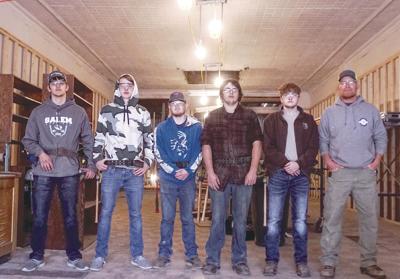
Students of the Construction Trades Program work to improve buildings in the community while learning valuable on the job skills.
The general curriculum for the proposed program is fairly linear as you go through the high school curriculum. A first-year student would have a one-hour block of time where they learn general safety practices and obtain any certifications they need through OSHA. A second-year student would have a two-hour block, which is where they begin to apply those techniques in the field and begin to assimilate to the skills they have learned. In the third year, three hours will be dedicated to completing projects in the area with all the skills they have learned. Anderson explained how it would all come to a head in their final year of high school.
“We want them to do an apprenticeship,” Anderson said, “We want to do something where they are on the job. Post-secondary we want to have opportunities that employers are coming by and talking to the kids. We also want to set things up with the St. Louis Carpenter’s Union and technical schools for their (future education). We would create a pool for local, regional and state-wide employment in the construction area.”
That’s something that Salem seniors Sam Chase and Braiden Carmack are happy about. Chase has learned a lot about framing and has discovered that he wants to pursue that as a career specialization. Chase plans to spend the summer after he graduates in 2021 working on job sites in St. Louis. Carmack hasn’t quite decided what specialization to pursue after graduation, but he is happy that he got the opportunity to learn a little bit of everything, especially his favorite, electrical.
“It kind of gives them an idea about what they might want to do. They may not like framing but they like electrical,” Tinker said. “That’s one of the great things about this program. They actually get to learn all aspects of construction.”
Students like Carmack and Chase have been working on projects like the Fleming building in downtown Salem, where students have done every step of the renovations. Both Chase and Carmack are glad to have been a part of the project.
“Doing this program makes it where we can start out at higher pay,” Carmack said, with Chase nodding by his side.
“And it’s for Salem,” Chase added.
The program will benefit from a new, shared makerspace here in Salem.
The funding for making this project happen is set to come from YOP tax credits. In addition to a $500,000 Community Development Block grant, Salem R-80 schools has $438,396 worth of them to distribute. According to a flyer sent out by Superintendent Lynne Reed, the application process has five steps. Fifty percent of donations will be a redeemable tax credit. For example, if you donate $5,000, you will receive a tax credit of $2,500.
Here’s how the application process works.
• First, you can make your contribution through a check to Salem R-80 School district at 1409 W. Rolla Rd, Salem, MO 65560.
• Second, You must turn in to the superintendant’s office a completed and notarized form with proof of the donation.
• Third, wait four to six weeks to receive a certification from the State of Missouri indicating your approval.
• Fourth, apply your tax credit when you file your tax return.
“Once we have the funding in place, we will work with Sally (Burbridge, Director of Economic Development) to address how the new facility will be used by the school and by the city,” Reed said.
“Nothing has been spent of those funds to date, no funding can be used until the tax credits are sold, Burbridge said. “Tax credit funds must be substantially used before we can tap into the grant funds. The grant funds are secure, but we cannot draw down funds until we have substantially used the tax credit funds as stated.”
Burbridge also stated that she is a big supporter of the makerspace project and that it’s likely that the planning for that space will fall under her department as well, at least initially.
The application deadline is Dec. 31.
To learn more about how to apply for these tax credits through donations contact superintendent Dr. Lynne Reed at lynne.reed@salemr80.org or (573) 729-6642. Other donations to support the project are also being accepted.


