
Charlie Company, 2nd Battalion, 16th Infantry Regiment arrived July 14, 1965 in Vietnam on the USNS Gordon.
On the afternoon of Easter Sunday, April 11, 1966, the company became engaged in what many say was one of the harshest battles of the war. The Battle of Xa Cam My was fought over two days, from April 11–12, 1966, 10 miles south of the village of Cam My. The company suffered heavy casualties, with 80 percent of the 134 soldiers leaving the field badly wounded or killed.
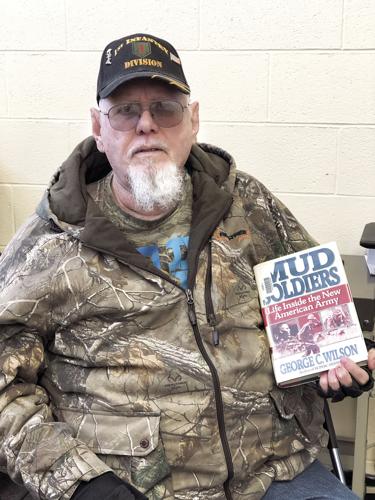
Charles Epperson, a West Virginia native who is now retired in Salem, was on the ground with the U.S. Army that day. Epperson turned 20 July 8 after arriving with advanced troops June 18, 1965. Epperson has lived in Salem for the past two decades. He served in the U.S. Army from 1962-68.
Due to being a veteran of the battle, he has been invited to privately screen a movie March 30 at Wright-Patterson Air Force Base in Ohio, along with several other survivors.
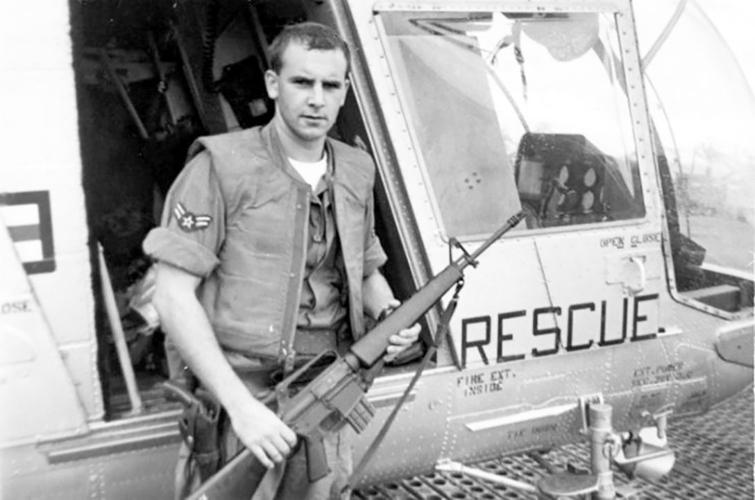
“The Last Full Measure” recounts the story of William “Pits” Pitsenbarger, a Pararescueman, who continually faced danger throughout more than 250 combat missions in Vietnam, the movie outline detailed on Epperson’s invitation. During a rescue mission April 11, 1966, “Pits” was offered the chance to escape on the last helicopter out of a combat zone, heavily under fire. Staying behind to save and defend the lives of his fellow soldiers, he lost his life.
The film stars Sebastian Stan, Samuel L. Jackson, Christopher Plummer, William Hurt, Ed Harris, Alison Sudol, Diane Ladd, Amy Madigan, John Savage and Bradley Whitford and is directed by Todd Robinson. No official release date had been publicized.
Soon after the battle, Pits’ Air Force commanders nominated him for the Medal of Honor, but he did not receive it. An Army general recommended that the award be downgraded to the Air Force Cross, because at the time there was not enough documentation of Pitsenbarger’s heroic actions.
Over three decades later, Pitsenbarger's father sought the help of a Pentagon investigator and other surviving veterans to procure the Congressional Medal of Honor to honor his son.
On December 8, 2000, Pitsenbarger’s father was presented with his son’s Medal of Honor by then Air Force Secretary Whit Peters in a ceremony at Wright-Patterson Air Force Base, the same base where the movie will be screened. Looking on that day were 10 of the Army veterans whose eyewitness testimonials persuaded the Pentagon and Congress to approve the award. Pitsenbarger was the first Air Force enlisted man to earn the Medal of Honor since the U.S. Air Force was established as a separate service in 1947.
In an article posted on Historynet.com in 2006, several of Pits’ comrades were interviewed.
‘He was the bravest man I’ve ever seen, and I saw it all,’ said Martin L. Kroah, Jr., who served two tours in Vietnam, one as a Special Forces officer.
Epperson called Kroah, “a real leader, he lived through seven shots, later dying of prostate cancer (in 2007).”
Pitsenbarger was credited with saving nine lives, after several times refusing to be evacuated himself, during a fight in which 106 of the 134 troopers were killed or badly wounded.
Pitsenbarger, on April 11, 1966, at his own request, descended 100 feet on a winch line from a Kaman HH-43 Huskie helicopter into a dense jungle valley and alighted in the middle of an encircled company of U.S. Army soldiers. The besieged troops were members of Company C, 2nd Battalion, 16th Infantry of the 1st Infantry Division and were under attack by VC about 35 miles east of Saigon.
For the next couple of hours Pitsenbarger crawled through the thick jungle looking for wounded soldiers. He would drag them to the middle of the company’s small perimeter, putting them behind trees and logs for shelter. At one point, Epperson said in a 2006 interview, Pitsenbarger saw two wounded soldiers outside the perimeter. ‘He said, ‘We’ve got to go get those people,’ and I said, ‘No way. I’m staying behind my tree.’ It was just unbelievable fire coming at us from all sides. But he took off to get those guys, and I could see him trying to get both of them and having a hard time, so I ran out there and helped him drag them inside our lines. He was an inspiration to me,’’ said Epperson.
Charlie Company fought so heroically April 11 and 12, 1966, that it won the Valorous Unit Award. The Valorous Unit Award is the second highest United States military unit decoration. The two battalions of the 16th Infantry fought in almost every campaign of the Vietnam War. During the almost five years of combat the regiment lost over 560 men, the regiment's soldiers were awarded two Medals of Honor (both posthumous), 10 Distinguished Service Crosses, and hundreds of Silver and Bronze Star medals. The regiment was awarded 11 campaign streamers, as well as two Republic of Vietnam Cross of Gallantry (with Palm) Streamers for 1965-1968 and 1969 and the Republic of Vietnam Civil Action Honor Medal (First Class) Streamer for 1965–1970, according to Wikipedia.
Another of Epperson’s comrades, Staff Sergeant James W. Robinson, Jr., also received the Medal of Honor for his actions in the April 11 combat. Robinson was born Aug. 30, 1940. In 1963, he enlisted in the U.S. Army after serving three years in the U.S.M.C.
His Medal of Honor citation states, on April 11, 1966, “Sergeant Robinson moved among the men of his fire team, instructing and inspiring them, and placing them in advantageous positions. Enemy snipers located in nearby trees were inflicting heavy casualties on forward elements of Sergeant Robinson’s unit. Upon locating the enemy sniper whose fire was taking the heaviest toll, he took a grenade launcher and eliminated the sniper. Seeing a medic hit while administering aid to a wounded sergeant in front of his position and aware that now the two wounded men were at the mercy of the enemy, he charged through a withering hail of fire and dragged his comrades to safety, where he rendered first aid and saved their lives.
“As the battle continued and casualties mounted, Sergeant Robinson moved about under intense fire to collect from the wounded their weapons and ammunition and redistribute them to able-bodied soldiers. Adding his own fire to that of his men, he assisted in eliminating a major enemy threat. Seeing another wounded comrade in front of his position, Sergeant Robinson again defied the enemy’s fire to affect a rescue. In so doing he was himself wounded in the shoulder and leg. Despite his painful wounds, he dragged the soldier to shelter and saved his life by administering first aid.
“While patching his own wounds, he spotted an enemy machine gun which had inflicted a number of casualties on the American force. His rifle ammunition expended, he seized two grenades and, in an act of unsurpassed heroism, charged toward the entrenched enemy weapon. Hit again in the leg, this time with a tracer round which set fire to his clothing, Sergeant Robinson ripped the burning clothing from his body and staggered indomitably through the enemy fire, now concentrated solely on him, to within grenade range of the enemy machine gun position. Sustaining two additional chest wounds, he marshaled his fleeting physical strength and hurled the two grenades thus destroying the enemy gun position as he fell dead upon the battlefield. His magnificent display of leadership and bravery saved several lives and inspired his soldiers to defeat a numerically superior enemy force.”
For this action, Sergeant Robinson was awarded the Medal of Honor on 16 July 1967. The medal was presented to Sergeant Robinson’s family by Secretary of the Army Stanley R. Resor at the Pentagon on 16 July 1967, the citation states.
Epperson quietly described several of his memories of the tragic day in Vietnam when he stopped by The Salem News with information on the upcoming movie.
“You hear people talking war,” he shook his head, “and you just know what you’ve been through; it’s hard to hear these names and talk about this sometimes.”
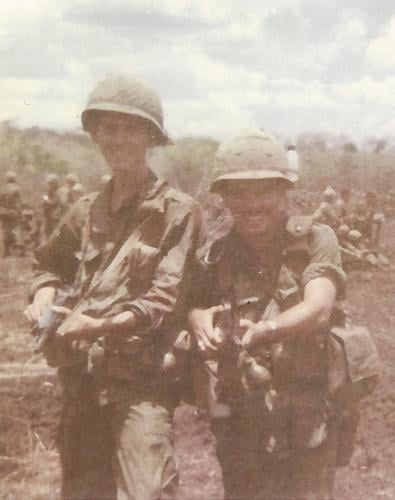
Epperson came by the office again on the day of publication after finding a photo of himself and George Manning a few days before the fateful April 11. With tears in his eyes, he shared more memories and offered insight into a few moments of what it was like covering friends and poker buddies after their death in Vietnam. He gifted me his book, signed on the interior cover, and I will forever be grateful for the time he took to share his story.


